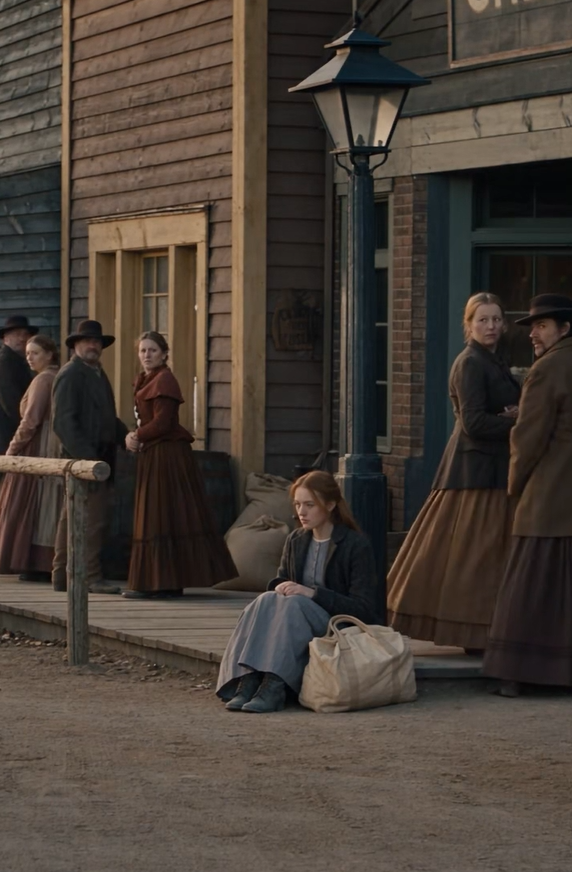
“For the person who one day proved you were free.”
The room became absolutely silent.
Mara could not have known Rowan would pay fifty dollars.
Could not have known the street.
Could not have known Amos would repeat the amount.
Unless—
Lydia’s face changed.
She stood.
“What?”
Rowan followed.
“What is it?”
“My father.”
“Amos?”
“He didn’t choose fifty because of Gideon.”
“That is what he said.”
“He lied.”
“About what?”
Lydia crossed to Mara’s old iron box.
She opened it.
Inside lay the fifty dollars Rowan had paid her as wages.
The original ledger.
The photograph.
And a receipt Rowan had taken from the feed store months after the trial.
He had forgotten it.
Lydia unfolded it.
Amos Voss had signed.
Received from Rowan Creed:
$50.
Beneath the amount was something neither had noticed.
A tiny symbol.
A circle divided by a vertical line.
The same symbol stamped on Mara’s brass bank marker.
Rowan stared.
“Bank mark.”
Lydia whispered, “Those weren’t random bills and coins.”
“What?”
“The money you paid Amos.”
“I took it from my coat.”
“Where did you get it?”
Rowan thought back.
“Feed store.”
“No.”
“I paid for supplies.”
“And?”
The memory returned.
The storekeeper hadn’t had enough change.
He had handed Rowan a packet of money.
A bank envelope.
Fifty dollars exactly.
Rowan went cold.
Lydia stared at him.
“The feed store owner.”
18
His name was Walter Finch.
He had owned the feed store for thirty-three years.
He was seventy-one when Rowan and Lydia confronted him.
He didn’t deny anything.
He simply locked the shop door.
Then sat behind the counter.
“I wondered how long.”
Rowan placed the brass token before him.
Finch closed his eyes.
“You knew Mara.”
“Yes.”
“You arranged the money.”
“Yes.”
Lydia could barely speak.
“Did you arrange the sale?”
“No.”
“Did you tell Amos Rowan would be in town?”
Finch looked at her.
“Yes.”
Rowan’s hand clenched.
“Why?”
“Because Mara asked me to.”
Lydia stared.
“My mother had been dead twenty years.”
“Yes.”
Finch opened an old metal cashbox.
Inside were letters.
Mara’s handwriting.
“She knew Amos better than anyone.”
Finch pushed one letter toward Lydia.
“If Lydia survives and Amos still controls her when she reaches adulthood, he will eventually become desperate enough to trade her safety for access to Black Pine.”
Lydia felt the room spin.
Another line:
He measures all things in money because he understands no other language.
Another:
If Gideon Creed’s son becomes the man Gideon hopes, Amos may mistake kindness for opportunity.
Rowan sat slowly.
Finch explained.
Mara had created contingencies.
Not predictions.
Possibilities.
She entrusted Finch with the bank token and fifty-dollar reserve.
Years later Finch watched Rowan purchase Black Pine.
He remembered the letter.
Then he watched Amos bring Lydia into town.
For weeks Amos had asked questions about Rowan.
When Rowan finally rode in that November morning, Finch sent word—through a boy—that “the Black Pine owner” had arrived.
He never told Amos to sell Lydia.
He never told him a price.
But Amos made the choice Mara feared he would make.
Fifty dollars.
Why?
Because Finch had quietly told Amos that the land office would pay fifty dollars for an old Black Pine document.
A lie.
Bait.
Amos wanted immediate money and a path into Rowan’s cabin.
Rowan reached into his coat that morning to pay.
He had only thirty-seven dollars.
Finch knew because Rowan had just paid for supplies.
So when Rowan asked if Finch could break a larger bank note—
Finch gave him the packet Mara had left.
Exactly fifty dollars.
The money Rowan handed Amos had been Mara’s money.
Lydia stopped breathing.
Finch’s voice shook.
“Your mother couldn’t know who would help you.”
He looked at Rowan.
“She only wanted to make sure that if the day came when a good person stood between you and Amos, that person wouldn’t lack the money.”
Lydia’s eyes filled.
All this time—
The street.
The shame.
The transaction that had felt like proof she was worthless—
Had contained one final act of her mother’s protection.
Amos believed he was selling her.
Rowan believed he was spending his own money to stop him.
But the fifty dollars had crossed twenty-one years to reach that street.
Mara Voss had placed it there.
Not to purchase Lydia.
To give someone the means to interrupt the man who thought he could.
Lydia began to cry.
Finch opened one final letter.
“She wrote this for you.”
Lydia took it.
My darling girl,
If this money ever reaches the purpose for which I saved it, I need you to understand something.
The person who pays it does not own you.
I do not own you.
No father owns you.
No husband owns you.
No law written by frightened men owns the part of you that chooses.
If someone uses these fifty dollars to open a door, walk through it.
But remember:
The person who opens the door is not the reason you stay on the other side.
That must always be your choice.
Lydia couldn’t read farther.
Rowan put his arm around her.
Twenty-one years after Mara Voss had died on a sabotaged mountain road, her daughter finally heard her voice.
Not from a grave.
Not from a ghost.
From a choice planned before anyone knew when it would be needed.
19
That evening Rowan and Lydia walked the old road above town.
The sun sank red behind the mountains.
For a long time neither spoke.
Finally Lydia said, “You realize this makes the story worse.”
Rowan looked at her.
“How?”
“My dead mother gave you the money to rescue me.”
“Technically Finch gave me the money.”
“On instructions from my dead mother.”
“Fair.”
She laughed.
Then became quiet.
“Do you ever think about that day?”
“Every day.”
“Which part?”
“The moment your father said, ‘She’s yours.’”
Lydia looked at him.
“You looked like you wanted to kill him.”
“I did.”
“I thought you were angry because you’d bought something damaged.”
Rowan stopped walking.
“Lydia.”
“I know better now.”
He studied her face.
“Do you?”
“Yes.”
“How?”
She stepped closer.
“Because you spent the rest of that day refusing to act like you’d bought anything.”
The wind moved her hair.
Rowan touched one loose strand.
Lydia continued.
“I used to think freedom was the moment you took me away.”
“It wasn’t?”
“No.”
She smiled.
“That was only the first door.”
“What was freedom?”
“The morning I took a second biscuit without asking.”
Rowan laughed softly.
“The day I told you your shelf was crooked.”
“It was the wall.”
“The shelf.”
“History will disagree.”
“The day I got angry with you.”
“Several options.”
“The day I kissed you.”
Rowan’s expression softened.
“And the day you packed your shirt because you thought you had to leave my land.”
“Not my finest moment.”
“No.”
She slipped her hand into his.
“Freedom wasn’t leaving my father.”
She looked toward the mountains.
“It was realizing I could love someone without becoming their possession.”
Rowan squeezed her hand.
“And you?”
She asked.
“What was freedom for you?”
He thought for a while.