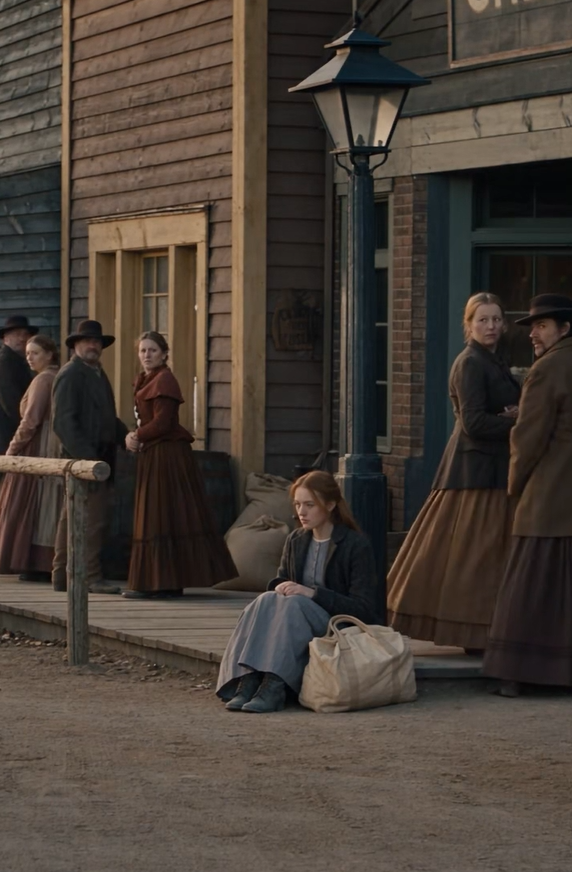
She pressed her face against his chest.
For the first time since arriving, she cried.
Not quietly.
Not politely.
Years came out of her in broken breaths.
Rowan wrapped both arms around her.
He held her while snow struck the windows.
He held her until grief exhausted itself.
Only then did he notice the final name in the ledger.
A name written beside the original Black Pine transfer.
Gideon Creed.
Rowan’s father.
6
Rowan did not sleep.
At dawn Lydia found him outside.
He stood beside the frozen creek holding the ledger.
“You knew.”
He turned.
Her face was swollen from crying.
“Not about your mother.”
“But about him.”
“My father?”
“No.”
Rowan looked at the ledger.
“Mine.”
She came closer.
“Gideon Creed.”
“Yes.”
“Who was he?”
“Land broker. Moneylender. Thief if half the stories were true.”
“You never told me.”
“I haven’t told you much about myself.”
“Why?”
“Because most of it isn’t worth remembering.”
Lydia crossed her arms against the cold.
“Try me.”
Rowan looked toward the ridge.
“My father made money buying land from desperate people. Sometimes they were desperate before he arrived. Sometimes he helped them become desperate.”
Lydia waited.
“When I was twenty-two, I found records showing he had bribed a clerk to seize a widow’s farm.”
“What did you do?”
“Confronted him.”
“And?”
“He laughed.”
Rowan’s jaw tightened at the memory.
“He said land belonged to whoever could keep it.”
Lydia looked toward the cabin.
“So you left.”
“Yes.”
“Where did your money come from?”
“Army wages. Cattle. Trapping. Construction. Anything that didn’t come from him.”
“And the cabin?”
Rowan swallowed.
“That is the part I can’t explain.”
Lydia said nothing.
“I bought this property seven years ago through the territorial office.”
“From Pine Valley?”
“A predecessor company.”
“Did you know your father had owned it?”
“No.”
“Did you know my mother had?”
“No.”
He handed her his deed.
“I swear to you.”
She didn’t take it.
“I believe you.”
Rowan stared.
“You shouldn’t do that so easily.”
“I didn’t.”
She looked directly at him.
“I watched you all winter.”
The words hit harder than accusation.
“I watched what you did when nobody was looking. I watched you turn away when I changed clothes behind a door that didn’t lock. I watched you pretend not to notice when I took a second biscuit because you knew I’d be ashamed. I watched you sleep in a chair for two nights because I was afraid during the storm.”
Rowan looked away.
Lydia continued.
“My father taught me that words cost nothing. You taught me to look at what people do.”
She finally took the deed.
“So I believe you.”
Rowan exhaled.
“But this land is yours.”
Lydia shook her head.
“Legally, perhaps.”
“Not perhaps.”
“You’ve lived here seven years.”
“On stolen land.”
“You didn’t steal it.”
“I benefited from it.”
“That isn’t the same.”
“It matters.”
Lydia looked at the cabin.
For months she had been terrified Rowan might decide she wasn’t worth keeping.
Now Rowan was terrified he had been living inside something stolen from her.
The irony would have been almost funny if it hadn’t hurt so much.
“We need to go to town,” she said.
“Road isn’t open.”
“When it is.”
Rowan looked toward the sky.
Spring was still weeks away.
Too much could happen before then.
He remembered Bell’s warning.
Old land can contain old problems.
Bell knew.
Maybe Amos knew they had found the box.
Maybe he had sent Lydia here deliberately.
The idea made Rowan’s skin go cold.
“Lydia.”
“Yes?”
“Your father recognized me in town.”
She frowned.
“How do you know?”
“He looked at my saddle brand before I paid.”
“And?”
“My brand is registered to Black Pine.”
Her face changed.
Rowan spoke the thought neither wanted to believe.
“I don’t think he sold you to whoever would pay.”
Lydia’s eyes widened.
“I think he sold you to me.”
7
The tracks appeared two days later.
Not animal tracks.
Boots.
One set.
They crossed the creek below the cabin and disappeared toward the ridge.
Rowan followed them until snow began falling.
Whoever had made them knew the mountains.
At the three black pines he found a cigarette stub.
Silas Bell smoked imported cigarettes.
Rowan returned before dark.
Lydia was waiting with his rifle across her lap.
“You found someone?”
“No.”
“Bell?”
“Probably.”
“What does he want?”
“The box.”
“Then why didn’t my father come himself?”
“Because your father is a coward.”
She almost smiled.
Almost.
That night Rowan moved the papers.
Not to another hiding place.
Into Lydia’s canvas bag.
She watched him lift the inner lining with a knife and slide the oilskin bundle beneath it.
“My mother made that bag.”
“Then she’ll forgive the stitches.”
“You sew?”
“Badly.”
“I noticed.”
They worked side by side.
When they finished, no one could see the documents.
“Keep it with you,” Rowan said.
“You keep the ledger.”
“No.”
“Why?”
“Because if someone comes for it, they’ll search me first.”
She understood.
“You think they’ll kill you?”
“I think men who declared a twelve-year-old girl dead for land are unlikely to be troubled by ethics.”
The next morning Rowan taught her to shoot.
Not because she was helpless.
Because he refused to leave her defenseless.
She hated the revolver at first.
The recoil.
The noise.
The smell.
But she learned quickly.
“Again,” she said.
“You’re pulling left.”
“I know.”
“Then don’t.”
She glared.
“Excellent instruction.”
“Free of charge.”
That earned another laugh.
By March, laughter had become something the cabin expected.
Lydia started humming while cooking.
She placed dried mountain flowers in an old blue bottle beside the window.
She repaired the curtains.
Rowan built a shelf because she complained his books were stacked “like firewood written by dead men.”
He told her the shelf leaned because the wall was crooked.
She told him the shelf leaned because he had no idea what he was doing.
The evenings grew lighter.
Snow withdrew from the south-facing slopes.
And with every sign of spring came the promise Rowan had made.
She could leave.
Neither mentioned it.
Until one evening Lydia found him repairing the canvas bag strap.
“You’re making it stronger.”
“Yes.”
“For the road?”
He stopped sewing.
“If you want.”
Her face was unreadable.
“You really mean it.”
“I said it.”
“Months ago.”
“Still true.”
“What if I don’t know where to go?”
“Then don’t decide yet.”
“What if I want to stay?”
Rowan’s hand stilled.
The fire cracked.
Lydia looked at him.
He forced himself to say, “That’s your decision too.”
She turned away.
Something about the answer had hurt her.
Rowan knew it.
He also knew he couldn’t say what he wanted to say.
Not while fifty dollars still existed between them like a ghost.
Not while she had entered his house believing she belonged to him.
He would rather lose her than let gratitude become a chain.
So he said nothing.
Spring came anyway.
8
The road opened in April.
Lydia packed her canvas bag.
Not because she had decided to leave.