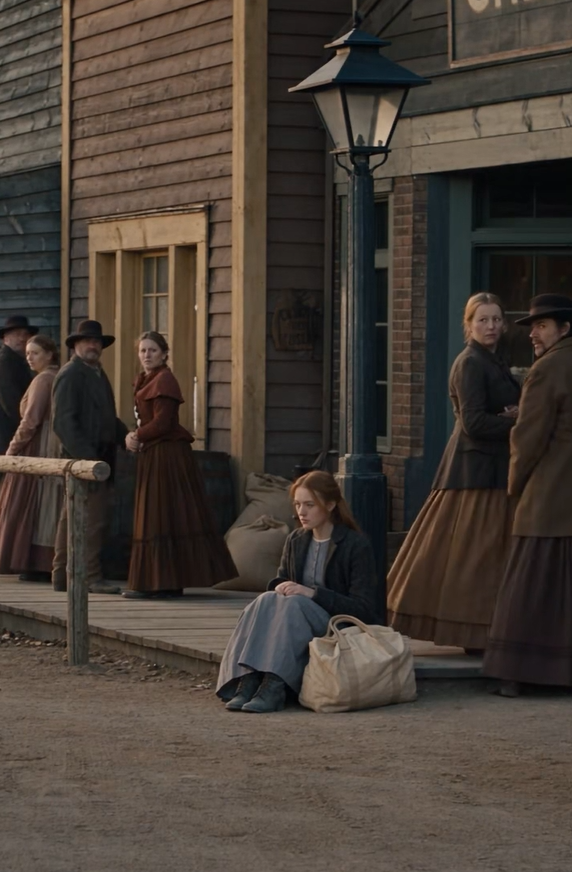
He caught her wrist.
Not hard.
“Look at me.”
She did.
“I trust you.”
Those three words changed her expression.
More than kindness.
More than food.
More than a locked—or unlocked—door.
Trust.
Lydia swallowed.
Then set his shoulder.
Rowan nearly blacked out.
Afterward he woke sometime near midnight.
She sat beside the bed.
“You should sleep.”
“So should you.”
“I wasn’t the one hit by a tree.”
“Branch.”
“Do you always argue technicalities when injured?”
“Only important ones.”
She reached to adjust the blanket.
Her hand stopped near his.
For a second neither moved.
Then Rowan turned his palm upward.
Lydia looked at it.
Slowly, she rested her hand in his.
Nothing more.
No declaration.
No kiss.
No promise.
But her fingers curled around his.
And stayed.
4
In February a stranger came to the cabin.
His name was Silas Bell.
Rowan recognized him before Bell introduced himself.
Bell worked for the Pine Valley Land Company in town.
Thin man.
Expensive gloves.
A smile that never reached his eyes.
Rowan opened the door only halfway.
“Road’s nearly closed.”
“So I discovered.”
Bell brushed snow from his coat.
“May I come in?”
“No.”
Bell’s smile sharpened.
“Still hospitable as ever, Creed.”
“What do you want?”
“I heard you acquired some… domestic assistance.”
Rowan’s face hardened.
“Careful.”
Bell glanced past him.
Lydia stood near the table.
The moment Bell saw her, something flickered in his face.
Recognition.
It disappeared almost instantly.
But Rowan saw it.
Bell removed his hat.
“Miss Voss.”
Lydia went rigid.
“You know me?”
“Small town.”
“You’ve never spoken to me.”
“No. But I knew your father.”
Rowan corrected him.
“Know.”
Bell looked back.
“Of course.”
There was something wrong with the answer.
Lydia stepped closer.
“What do you want with my father?”
“Nothing.”
“Then why come here?”
Bell smiled.
“Business with Mr. Creed.”
He reached into his coat and produced an envelope.
“Pine Valley would like to purchase Black Pine Ridge.”
Rowan didn’t take it.
“No.”
“You haven’t heard the price.”
“No.”
“Ten thousand.”
Lydia’s eyes widened.
Rowan didn’t blink.
“My answer improved?”
Bell chuckled.
“Twenty.”
“No.”
“That’s an extraordinary amount for land worth perhaps three.”
“Then buy someone else’s.”
For one instant Bell’s pleasant expression disappeared.
“Black Pine matters to our investors.”
“Not to me.”
“It should.”
Bell glanced toward Lydia.
Then back at Rowan.
“Old land can contain old problems.”
Rowan stepped onto the porch.
He closed the door behind him.
The two men stood inches apart.
“Say what you came to say.”
Bell’s voice lowered.
“Send the woman back.”
Rowan went very still.
“To whom?”
“Her father.”
“No.”
“You don’t understand the circumstances.”
“Explain them.”
“I don’t need to.”
“Then ride.”
Bell’s jaw tightened.
“Creed, your deed isn’t as clean as you think.”
Rowan stared at him.
“Threat?”
“Advice.”
He mounted.
Before turning away, Bell said, “Ask Lydia what her mother told her about Black Pine.”
Then he rode into the snow.
That evening Rowan found Lydia staring into the fire.
“What did your mother tell you?”
“About what?”
“Black Pine.”
Her face went pale.
Rowan sat opposite her.
“Bell mentioned it.”
Lydia looked toward the window.
“My mother used to say the name.”
“When?”
“When I was little.”
“What did she say?”
“I don’t know.”
“Try.”
Lydia closed her eyes.
For several moments, only the fire spoke.
Then—
“She said if anything ever happened to her, I should remember three black pines.”
Rowan glanced toward the ridge outside.
“There’s a stand of three pines above the creek.”
Lydia opened her eyes.
“She used to sing something.”
“A song?”
“A rhyme.”
“What rhyme?”
Lydia whispered:
“Three black pines above the stone,
keep what blood has made your own.
When the house forgets your name,
lift the hearth and speak the same.”
Rowan stared at her.
Neither spoke.
Slowly, both turned toward the stone fireplace.
5
The hearthstone weighed nearly a hundred pounds.
Rowan moved it with an iron pry bar.
Beneath was dirt.
Nothing else.
Lydia knelt.
Her fingers brushed the soil.
“Wait.”
She dug at one corner.
Metal scraped beneath her nails.
Together they uncovered a small iron box.
Rust had sealed the edges.
Rowan carried it to the table.
“Have you seen this before?”
“No.”
“You’re certain?”
“My mother died when I was twelve.”
“How?”
Lydia’s gaze lowered.
“Wagon accident.”
Rowan studied the lock.
“No key.”
Lydia touched her scarf.
Then stopped.
Rowan noticed.
“What?”
She pulled the scarf loose.
Around her neck hung a narrow leather cord.
On it—
A small brass key.
“My mother gave me this the week before she died.”
Rowan said nothing.
“I thought it belonged to her sewing chest.”
She inserted it.
The lock clicked.
Inside lay papers wrapped in oilskin.
A photograph.
A ledger.
And a letter.
Lydia picked up the photograph first.
A woman stood in front of the very cabin where they now sat.
Younger.
Dark hair.
One hand resting on the porch rail.
Beside her stood a little girl.
Lydia.
She dropped the photograph.
“No.”
Rowan stared.
“That’s this house.”
“No.”
“Lydia—”
“I’ve never been here.”
She backed away from the table.
“I would remember.”
“You were young.”
“I was eight in that picture.”
“You said your mother mentioned Black Pine.”
“She never said we owned anything.”
Rowan unfolded the first document.
His pulse changed.
It was a deed.
Black Pine Homestead.
Six hundred and forty acres.
Registered owner:
Mara Elin Voss.
Lydia’s mother.
Transferable upon death to sole surviving child:
Lydia Mara Voss.
Rowan read it twice.
Then a third time.
“This can’t be right.”
Lydia stared at him.
“Why?”
Rowan stood.
He went to a locked cabinet and removed his own deed.
He placed it beside hers.
The descriptions matched.
Section.
Range.
Parcel boundaries.
Everything.
Rowan’s document said the property had been sold after Mara Voss died without surviving heirs.
Lydia looked between the papers.
“But I’m alive.”
“Yes.”
“I was twelve.”
“Yes.”
“Then how could—”
Rowan’s eyes found a line near the bottom.
A certificate number.
Death of dependent child.
Lydia Voss.
Age twelve.
Declared deceased three days after Mara Voss.
The room became very quiet.
Lydia whispered, “He killed me.”
Rowan looked up.
“What?”
“My father.”
She pointed toward the forged certificate.
“He killed me on paper.”
Her breathing quickened.
“So he could take whatever she left.”
Rowan opened the ledger.
Names.
Dates.
Payments.
Land transfers.
Officials.
Bribes.
Then he found Amos Voss.
Lydia’s father.
Beside his name:
$50 — certification of child deceased.
Rowan felt the blood drain from his face.
Fifty dollars.
He looked at Lydia.
She understood at the same moment.
Her chair scraped backward.
“My father sold me twice.”
“Lydia—”
“Once as a dead child.”
Her voice broke.
“And once in the street.”
Rowan went around the table.
She stepped away.
Not because she feared him.
Because she could barely remain standing.
“He took fifty dollars to erase me.”
Rowan said nothing.
“And you gave him fifty dollars to take me away.”
The cruelty of the symmetry settled over them.
Rowan reached for her.
Stopped.
Waited.
Lydia closed the distance herself.