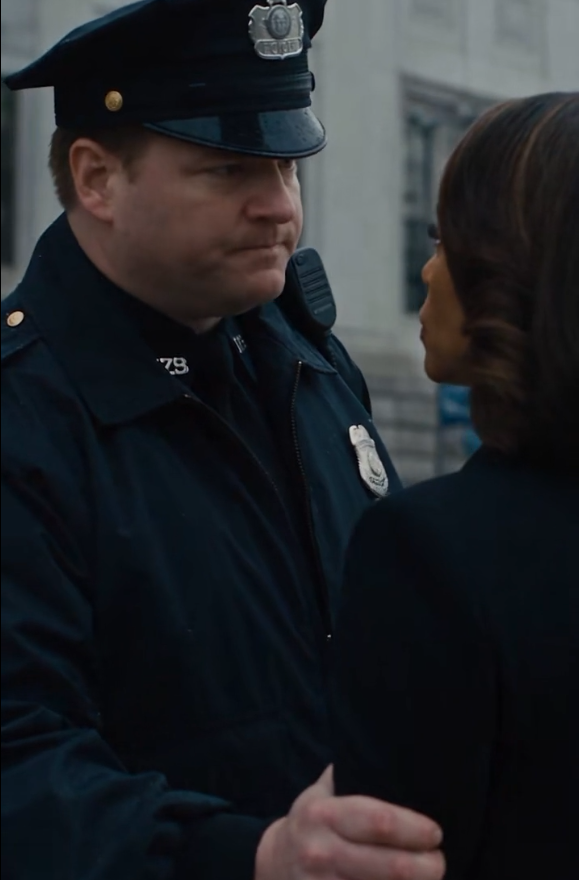
Ava glanced toward Daniels.
“He did not know I was a judge.”
Daniels’s face tightened.
Ava continued.
“That does not reduce what happened. It defines it.”
The words landed harder than accusation.
“He believed I was someone whose complaint would not matter.”
Daniels looked down.
Ava turned back to the panel.
“So do not decide what happens to Officer Daniels because he did this to a judge.”
Her hand moved away from the table.
“Decide what would happen if I had been nobody he considered important.”
No one wrote for several seconds.
Ava sat.
That was all she said.
The panel recessed.
Ava returned to chambers.
The waiting was worse than she expected.
Not because she feared the outcome.
Because the outcome no longer belonged to her.
That was the point.
And points of principle were easier in theory than in practice.
Amanda paced near the window.
“You were good.”
“This isn’t a performance.”
“I know.”
“Then don’t score it.”
Amanda stopped.
“Fine.”
Ava looked at her.
“Sorry.”
“You should be.”
A beat.
Then they both laughed quietly.
The tension loosened.
Amanda sat.
“Do you think he meant it?”
“The corrected statement?”
“The rest.”
Ava considered.
“Yes.”
Amanda seemed surprised.
“That easily?”
“Believing someone is sincere does not mean believing they should avoid consequences.”
Amanda leaned back.
“That sounded very judge-like.”
“I am at work.”
A knock came.
The courthouse administrator entered.
Her expression revealed nothing.
Ava stood.
“Judge Monroe.”
“Administrator.”
“The panel has reached a decision.”
Amanda rose too.
Ava looked at her.
“You don’t have to leave.”
The administrator closed the door.
“The findings are sustained.”
Ava said nothing.
“Improper physical contact. Unjustified seizure and mishandling of personal property. Unprofessional conduct. Failure to follow de-escalation procedures.”
She paused.
“And knowingly filing an inaccurate incident report.”
That last finding carried the most weight.
Ava knew it before the administrator continued.
“Officer Daniels’s employment is terminated effective today.”
Amanda inhaled quietly.
Ava remained still.
The administrator watched her.
“No response?”
“You did not come here for my approval.”
“No.”
“Then I don’t think you need one.”
The administrator gave a faint nod.
“There is something else.”
Ava waited.
“He requested permission to make the corrected statement public.”
That surprised her.
“Why?”
“He said the original report became public, so the correction should be public too.”
Ava looked toward the purse on her desk.
“What did administration tell him?”
“That it would be released as part of the final record anyway.”
“And?”
“He said that wasn’t the same as taking responsibility for it.”
Amanda glanced toward Ava.
The administrator continued.
“He asked whether you would object.”
Ava’s answer came after a moment.
“No.”
“Do you want to read it first?”
“No.”
The administrator looked almost amused.
“You’re trusting him?”
“No.”
Ava’s gaze returned to the window.
“I’m letting him own his words.”
Daniels’s corrected statement was released at 4:30.
The first paragraph was procedural.
The second corrected the physical facts.
The third was only four sentences.
That was the part people remembered.
Ava read it alone in chambers after everyone else had gone.
Judge Monroe told me she was authorized to enter. I decided she was not before I had enough information to make that decision. I treated her refusal to be intimidated as defiance. I became concerned about my conduct only after I learned she was a judge, and that fact has forced me to confront the difference between enforcing rules and using authority to demand submission.
Ava stopped reading.
There was one final sentence.
My first report was written to protect me from what the video showed, and that was another misuse of the trust attached to my position.
She set the paper down.
Outside, rain had begun again.
Softer this time.
Amanda appeared in the doorway wearing her coat.
“You’re still here.”
“So are you.”
“I forgot my umbrella.”
Ava nodded toward the corner.
“You have three.”
“I forgot where I left my umbrella.”
“That is different.”
Amanda noticed the statement.
“You read it?”
“Yes.”
“What do you think?”
Ava folded the pages once.
“I think it is accurate.”
“That’s it?”
“For today.”
Amanda looked at the purse.
“Come on.”
“Where?”
“You need to go home.”
Ava reached for the bag.
Amanda stopped her.
“Actually, give me that.”
“Why?”
“Because I found someone who can repair leather.”
Ava pulled the purse closer.
“No.”
“Judge.”
“No.”
“You said it isn’t ruined.”
“It isn’t.”
“Then let someone fix it.”
Ava looked down at the scratch.
The leather had dried darker along the seam.
“Can they make it look new?”
Amanda hesitated.
“Probably not completely.”
Ava ran one finger across the mark.
“Good.”
Amanda frowned.
“You want the scratch?”
“No.”
Ava picked up the purse.
“But I don’t need it erased.”
Part VI — The Door
The story lasted longer online than it did inside the courthouse.
Outside the building, strangers continued arguing about the video for weeks.
Some people said Ava had shown extraordinary restraint.
Others said she should have identified herself immediately.
Some believed Daniels’s termination was inevitable.
Others believed it was excessive.
Television panels moved on.
The courthouse did not.
Security procedures were reviewed.
The review did not remove officers’ authority to stop people at restricted entrances. Ava would have opposed that.
Instead, supervisors reinforced something more basic.
Ask.
Verify.
Explain.
Escalate only when behavior requires escalation.
Document what happened rather than what would have justified it afterward.
Nothing about the procedures was revolutionary.
That bothered Ava more than if it had been.
Most institutional failures, she had learned, were not caused by the absence of rules.
They were caused by people deciding the rules mattered less than their instincts.
For several days after Daniels’s termination, staff treated Ava too gently.
Officers held doors before she reached them.
Clerks apologized for delays that were not their fault.
One attorney nearly walked into a column while trying to avoid crossing directly in front of her in the hallway.
By the second week, Ava had had enough.
She stopped after court one afternoon and looked at Amanda.
“Why is everyone acting strange?”
Amanda did not look up from her tablet.
“You were on television.”
“I have been on television before.”
“You were on television while someone kicked your wallet.”
Ava winced.
“Must you phrase it that way?”
“It is factually accurate.”
“You’ve been spending too much time around judges.”
Amanda finally looked at her.
“You are a judge.”
“Exactly.”
Amanda smiled.
The building slowly returned to normal.
That mattered.
A courthouse should not orbit one person’s humiliation forever.
Not even a judge’s.
Three weeks after the incident, the repaired purse came back.
The leather worker had cleaned it, reshaped the edge, treated the water damage, and reinforced the seam.
The scratch remained.
Lighter.
Smoother.
Still visible if the light hit it from the side.
Amanda placed it on Ava’s desk.
“Well?”
Ava turned it over in her hands.
The clasp worked again.
She pressed it closed.
The sound was small and precise.
“You hate it,” Amanda said.
“No.”
“You’re doing the face.”
“What face?”
“The face where you decide whether something disappoints you.”