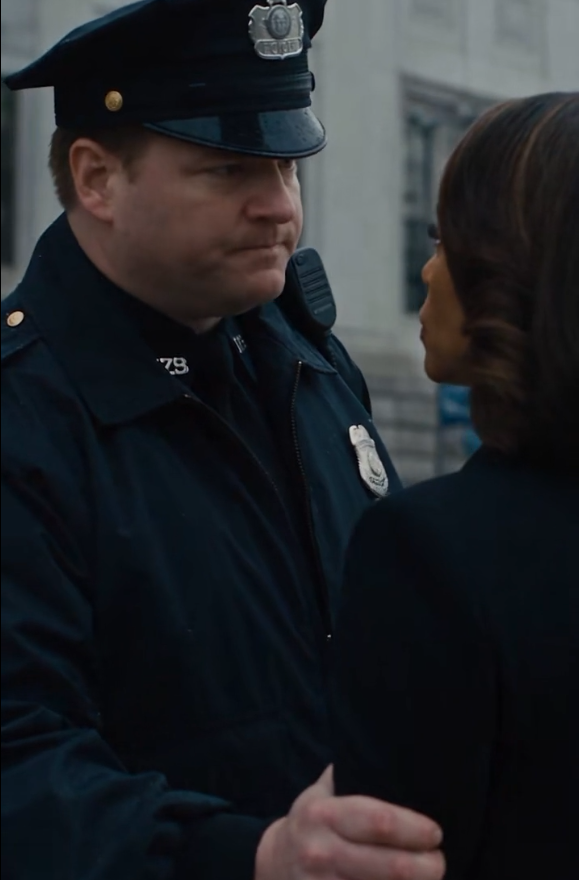
Ava looked at her.
“I do not have that face.”
“You absolutely have that face.”
Ava examined the repaired seam again.
“No. I like it.”
Amanda leaned closer.
“You can still see the mark.”
“I know.”
“That doesn’t bother you?”
Ava remembered rain running down marble.
Daniels’s hand on her arm.
The purse striking stone.
The clerk calling her name.
The sudden disappearance of color from his face.
Then she remembered the review.
His corrected statement.
The sentence he had finally been able to say.
I decided she was not.
“No,” Ava said.
“The mark is accurate.”
Amanda gave her a long look.
“That also sounded extremely judge-like.”
Ava smiled.
“Go home, Amanda.”
Raymond Daniels disappeared from public view.
Ava did not follow what happened to him afterward.
She did not search his name.
She did not ask courthouse staff whether anyone had heard from him.
Consequences were not entertainment.
Months later, an envelope arrived at chambers.
No return address.
Inside was a single sheet of paper.
Amanda brought it in.
“Do you want me to open these first?”
“You already did.”
“Security did.”
“Then why ask?”
“Professional courtesy.”
Ava took the letter.
The handwriting was careful.
She recognized the name at the bottom before reading the page.
Raymond Daniels.
Amanda remained by the door.
“You want me to go?”
“Yes.”
Amanda left.
Ava read.
The letter did not ask for his job back.
It did not criticize the process.
It did not ask Ava to forgive him.
Daniels wrote that losing the position had been harder than he expected and easier than what came after: seeing the same thirty seconds of himself every time he tried to explain why the termination was unfair.
He wrote that for several weeks he had blamed her silence on the steps.
If she had just said she was Judge Monroe.
If she had just shown the card sooner.
If she had just done what he expected.
Then he wrote one line that made Ava stop.
Every version I told myself required you to make a different choice so I would not have to examine mine.
Ava sat back.
The letter continued.
He said he had replayed her words from the review.
Decide what would happen if I had been nobody he considered important.
He had hated the sentence.
Then he had understood it.
Near the bottom, he wrote:
I am not asking you to tell me I am better now. I do not know if I am. I only know I understand why an apology was not enough when what I wanted from the apology was relief.
Ava reached the final lines.
You told me I would remember pushing that wallet.
You were right.
No request.
No dramatic closing.
Only his name.
Ava folded the letter.
For several minutes, she did nothing.
Then she placed it inside the repaired purse.
Not because she forgave him.
Not because she did not.
The distinction suddenly seemed less important than it once had.
People liked forgiveness because it gave stories clean endings.
Real accountability was less tidy.
It required someone to carry an accurate version of what they had done after the audience disappeared.
Daniels, apparently, had begun doing that.
It was enough for Ava to know.
The following morning was clear.
No rain.
No cameras.
No barricades beyond the ordinary ones.
Ava arrived at the courthouse shortly before eight.
She climbed the marble steps alone.
The repaired purse rested at her side.
Near the top, a young woman stood uncertainly beside the restricted entrance, holding a thick folder against her chest.
She looked nervous.
An officer stepped toward her.
Ava slowed without meaning to.
The young woman began explaining something.
The officer listened.
Ava stayed far enough away that she could not hear every word.
She saw the officer point toward another entrance.
The woman asked a question.
The officer answered.
She handed him a paper.
He checked it.
Then he stepped aside and opened the door for her.
No grabbing.
No public correction.
No humiliation.
Just a question asked and answered.
The woman entered.
The officer noticed Ava waiting behind her.
“Good morning, Judge Monroe.”
Ava handed him her identification card.
He checked it.
The same way he had checked the other woman’s paper.
“Thank you.”
He returned the card.
Ava put it away.
For a moment, she looked down the courthouse steps.
The marble had been cleaned.
There was no trace of the rain from that morning.
No sign of where her lipstick had rolled.
No mark where the wallet had stopped near Daniels’s shoe.
Buildings were good at erasing evidence of individual days.
People had to decide what they kept.
Ava touched the repaired seam of the purse.
Then she remembered the voice of the person who had given it to her years before.
Walk into every room as though you were sent there for a reason.
For most of her life, Ava had understood those words as an instruction about confidence.
Standing there now, she understood something else.
Being sent into a room did not mean the room belonged to you.
It meant your choices inside it mattered.
She looked toward the open courthouse door.
Then she walked through it.
This time, no one needed to call her name.