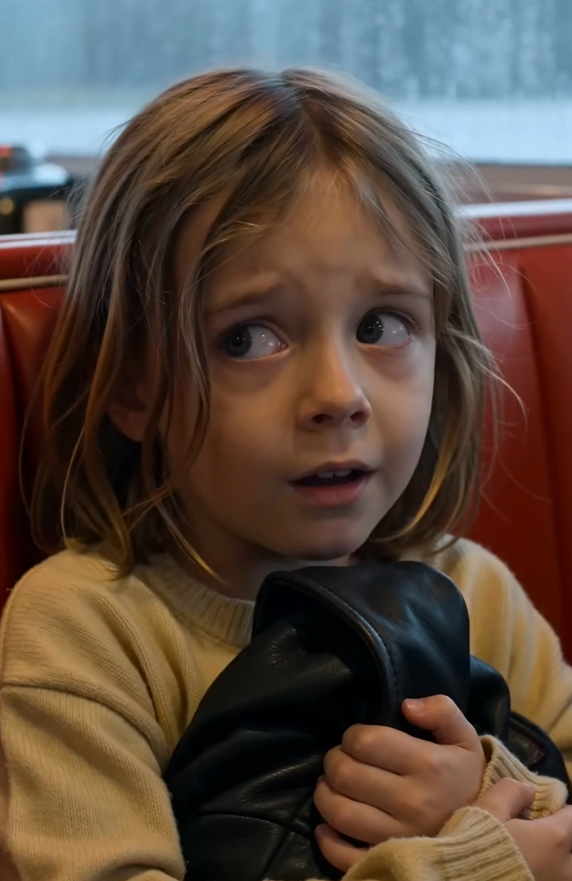
“HE’LL KILL ME IF HE FINDS ME…” – THE LITTLE GIRL IN THE DUMPSTER WHO MADE THREE BIKERS TEAR OPEN A TOWN’S DARKEST SECRET
The first thing Gideon Stray noticed was that the little girl did not scream.
She should have screamed.
Any four-year-old child found curled inside a cold metal trash container behind a nameless diner in the Virginia hills should have screamed when a stranger lifted the lid.
She should have cried, kicked, reached for someone, begged for her mother, or made some sound that belonged to childhood.
Instead, she only looked up at him with huge dark eyes and breathed like something hunted.
Slow.
Shallow.
Controlled.
The kind of breathing that did not come from calm.
The kind that came from practice.
Her bare feet were tucked beneath her.
Her arms were bruised in places no child should ever have to explain.
Her shirt was too thin for the late October cold, and the knees of her pants were torn from a journey that must have hurt every step of the way.
For one suspended moment, Gideon Stray forgot every word he knew.
He forgot the road behind him, the coffee cooling inside the diner, the ache in his knee, the old grief he carried like a folded map in his jacket pocket.
He forgot the life he had spent eight years trying to outride.
All he saw was a child who had hidden in trash because trash had seemed safer than people.
He crouched slowly, keeping one hand open where she could see it.
“Hey,” he said, forcing the gravel out of his voice.
She stared at his hand, then at his face, then past him toward the wooden fence as if someone might appear through the boards.
“I’m not going to hurt you,” he said.
The girl did not move.
He took off his old black leather jacket and held it toward her, not pushing it close, not making her take it, only offering.
For a long moment, she did nothing.
Then her small hands came out from under her arms.
She took the jacket, pulled it against her chest, and pressed her face into the cracked leather like it was the first solid thing the world had handed her all morning.
Gideon stayed crouched.
He had been many things in his life.
Patient was one of the few useful ones left.
After almost a full minute, the child lifted her face.
Her lips barely moved.
“He’ll kill me if he finds me.”
Those seven words moved through Gideon like a blade finding an old scar.
He had heard threats before.
He had heard men beg, lie, bargain, and confess.
He had heard fear in alleys, bars, hospital rooms, parking lots, and places nobody ever wanted named afterward.
But he had never heard fear sound so small.
He had never heard it come from a child who was not asking to be saved because she had already learned that asking did not always work.
“Who?” Gideon asked.
Her eyes flicked to the fence again.
Then back to him.
“My brother,” she whispered.
Her fingers tightened around the leather.
“Kyle.”
Gideon stood slowly.
He held out his hand.
“Come on,” he said.
“Let’s get you inside where it’s warm.”
The girl looked at his hand for a long time before she placed her bruised fingers inside it.
That was how Maisie Rowan entered Clara Boone’s diner.
Not through the front door like a customer.
Not with her mother, not laughing, not asking for pancakes, not leaving muddy footprints from an ordinary childhood morning.
She came through the kitchen wrapped in a stranger’s biker jacket, pressed to the side of a man whose face looked like it had been carved out of weather and regret.
Clara Boone saw the child’s eyes first.
Then the bruises.
Then the way Maisie stayed pressed against Gideon without trust, but with the hard and awful understanding that he was the safest option available.
Clara had owned that diner for eleven years, ever since her husband Ray died and left her with the building, the coffee machine, a mortgage, and the sort of loneliness that learned to move quietly.
She had seen men come in drunk before noon.
She had seen women cry in booths and then fix their lipstick before walking back into the world.
She had seen families pretending not to fall apart over plates of eggs.
She had never seen a child look as if silence was the only thing keeping her alive.
“What happened?” Clara asked.
It came out flat.
Not cold.
Ready.
“Found her in your dumpster,” Gideon said.
“She’s cold.”
A pause.
“She says someone is hunting her.”
Clara moved before the sentence finished settling.
She crouched in front of Maisie, not too close, and softened her face without making it false.
“Hi, sweetheart,” Clara said.
“What is your name?”
The girl looked at her, then at Gideon, then down at the floor.
“Maisie.”
“Are you hungry, Maisie?”
A tiny nod.
“All right,” Clara said.
“Back booth.”
She looked at Gideon.
“I’ll bring something.”
The back booth was the safest seat in the place.
Gideon knew it before Clara pointed to it.
It was far from the windows, close enough to the kitchen hallway, and angled toward both exits.
He sat across from Maisie and let her keep his jacket.
She wrapped herself in it as if leather could become a wall.
Clara brought milk, scrambled eggs, and toast cut into triangles.
Maisie ate carefully.
Not greedily.
Not like a child who expected abundance.
She ate like someone who had learned that even hunger had rules.
She finished the milk first, holding the glass in both hands as if it might be taken away.
When the plate was almost empty, she paused and looked at Gideon.
He nodded once.
Only then did she finish the eggs.
While she ate, Gideon stood near the end of the counter with Clara.
He kept his voice low.
“She said Kyle.”
“Brother?” Clara asked.
“Maybe stepbrother.”
Clara’s jaw tightened.
“You know the family?”
“Rowan,” Gideon said.
“She gave me the last name after you brought the food.”
Clara went still.
“Hannah Rowan’s little girl?”
“You know her.”
“I know enough.”
Gideon looked back at the booth.
Maisie had stopped eating and was watching the front door.
Not glancing.
Watching.
Clara saw it too.
“That child is terrified,” she said.
“That child knew where to hide,” Gideon replied.
Clara looked at him.
“There’s a difference.”
“Yes,” Gideon said.
“That’s what bothers me.”
Outside, Route 211 cut through the hills like a dull gray ribbon.
The diner sat between bare trees, gravel, cold sky, and the kind of silence that made every engine sound important.
Gideon had only stopped for eggs and coffee.
He had not intended to stay.
He had not intended to become part of anyone else’s emergency.
He had spent eight years avoiding exactly that.
Eight years on the road, moving town to town, state to state, never long enough for questions to grow roots.
He rode a scarred Harley Road King, wore a black leather jacket with no patches, and carried no club colors because the last club he had belonged to had burned too much into him.