The Castermen out of North Carolina had given him brothers, enemies, habits, debts, and the kind of history that followed even when no one knew your name.
He had been a road captain.
He had been useful.
He had been feared.
Then Roanoke happened.
Then Cutter died on a Montana highway three years later, and whatever was left of Gideon broke quietly enough that nobody heard it except the road.
Since then, he had spoken less, ridden more, and tried not to stop anywhere that looked like it needed saving.
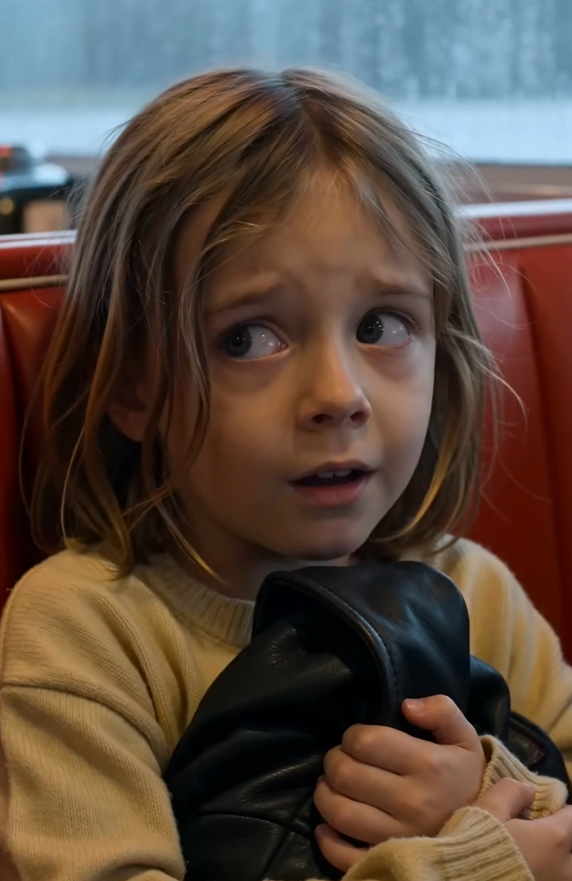
But the child in the booth kept watching the door.
And Gideon did not leave.
At 9:47 that morning, a white panel van pulled into the gravel lot.
It did not park.
It sat for ninety seconds with the engine running, then rolled back onto the road and headed south.
Gideon watched it through the diner window and filed it away.
At 11:12, a black sedan passed the diner twice.
The second pass was slower.
Gideon said nothing.
At noon, the lunch rush came and went.
Local workers, a mother with a toddler, two travelers, a man in a pest control shirt, ordinary faces moving through an ordinary day.
Maisie sat in the back room by then, coloring at a small table Clara had set up for her with old crayons and a stack of children’s books.
Every few minutes, she stopped and looked toward the front.
Gideon noticed every time.
“You were law enforcement?” Clara asked after lunch, refilling his coffee.
“No.”
“Military?”
“No.”
She looked at the way he sat.
Back to the wall.
Eyes on exits.
“You learned that somewhere.”
Gideon did not answer.
Clara accepted the silence.
She had lived long enough to know that some answers were doors, and some doors were locked for a reason.
“She say anything about her mother?” Clara asked.
“She said her mother doesn’t know.”
“Doesn’t know what?”
“What Kyle does.”
Clara’s face tightened again.
“How does a mother not know?”
Gideon looked at Maisie through the cracked-open kitchen doorway.
“Because people like Kyle don’t do what they do where mothers can see.”
Clara’s hand paused on the coffee pot.
“They do it in the spaces between.”
By 2:45, the man walked in.
He was young, clean, and carefully arranged.
Polo shirt under a vest.
Jeans too new to belong to the hills.
Boots without scuffs.
His face wore concern the way some men wore cologne, deliberately and in the right amount.
He scanned the diner too quickly.
Then he slowed his eyes down and put a smile on his mouth.
Gideon sat at the counter and did not turn his head.
Clara stood behind the register.
“Hi there,” the man said.
“I’m looking for my little sister.”
His voice was warm.
Practiced.
“She wandered off this morning.”
He held his hand at about Maisie’s height.
“Brown hair, little girl, about this tall.”
Clara wiped the counter.
“Haven’t seen her.”
The smile held.
“You sure?”
“I’ve been here since six.”
Clara’s voice did not change.
“I’d have noticed a lost little girl.”
The man nodded.
“Right.”
Clara tilted her head.
“You call the police?”
For the first time, something moved behind his eyes.
Just a flicker.
“Yeah,” he said.
“We’ve got that covered.”
He stayed three seconds too long.
Then he left.
The black sedan in the parking lot started after he got inside.
It sat for forty seconds.
Then it pulled north.
Gideon waited until the sound faded.
“That was him,” he said.
Clara stopped wiping.
“Kyle?”
“Or someone Kyle sent.”
Gideon set down his cup.
“Either way, they know to look here.”
Clara looked toward the back room.
“What do we do?”
It was the first time she had said we.
Gideon heard the weight of it.
“We don’t let him take her,” he said.
By late afternoon, the sky had darkened toward blue-gray, and the cold began pressing at the diner windows.
Clara sat across from Gideon at the table closest to the front door.
“You need to know some things,” she said.
“Tell me.”
“The Rowans live about twelve miles north, off Old Mill Road.”
“Hannah Rowan is Maisie’s mother.”
“Kyle Mercer is the stepbrother.”
“Not blood?”
“No.”
Clara folded her hands.
“He was Hannah’s late husband’s son from a first marriage.”
“When Hannah’s husband died three years ago, Kyle stayed around.”
“Helped with the house.”
“Helped with errands.”
“Helped with Maisie.”
The last words tasted bitter.
Gideon looked outside.
“How does nobody see him?”
“Because he knows when to look normal,” Clara said.
“Church events, neighbors, town things.”
“He smiles right.”
“He carries boxes.”
“He fixes things.”
“And Hannah?”
Clara’s expression softened with pain.
“Hannah has been grieving for three years.”
“Sometimes a person trusts the wrong hand because the right hand is gone.”
At 5:15, Clara brought Maisie out from the back.
The child wore an oversized sweatshirt Clara had found in lost and found.
She still had no shoes.
She walked to the chair across from Gideon and climbed into it without asking.
“You’re still here,” Maisie said.
“Yes.”
She looked toward the window.
“He came.”
Gideon held very still.
“How do you know?”
“I heard his voice.”
She looked down at her coloring book.
“He has a special voice for when he’s pretending.”
Gideon felt something deep in his chest go hard and quiet.
A four-year-old should not know that.
A four-year-old should not be able to describe a predator’s performance better than most adults.
“He won’t come through that door again today,” Gideon said.
Maisie studied him.
“How do you know?”
“Because I’m watching it.”
She considered that.
Then she opened her coloring book and began to color.
At 7:22, the diner phone rang.
Clara answered, listened, said, “Wrong number,” and hung up.
She looked at Gideon.
He nodded.
At 8:40, after the diner had officially closed, a dark pickup parked at the far end of the lot.
It sat at a bad angle, engine off, lights off.
Watching.
Gideon put on his jacket.
“I’m going outside,” he said.
Clara looked at him.
“To do what?”
“Stand by my bike.”
“That’s it?”
“That’s it.”
He stepped into the October dark and crossed the gravel lot.
He did not stare at the truck.
He did not make a show.
He simply stood beside the Harley with his hands in his jacket pockets and let whoever sat in that truck see him.
There was an old language to presence.
Some men understood it.
I am here.
I know you are there.
Do not assume this place is empty.
After six minutes, the truck started.
It pulled out without headlights for the first hundred yards, then vanished south.
Gideon stood a minute longer.
He had not solved anything.
He had introduced himself to it.
When he went back inside, Clara had started fresh coffee.
Maisie slept in the break room under an apron and the oversized sweatshirt.
Gideon sat at the counter and stared into the empty lot.
Then he heard motorcycles.
Not one.
Three.
They came from the north, engines slowing with intention.