Dalton Callaway, Silas Brennan, Lawrence Kincaid, Garrett Finch, Raymond Wolfe, Ezra Hayes. Eleanor's hands shook. She pressed the vest to her chest and felt 40 years of grief rise up like a tide. This was the vest Silas had given her the night they buried Dalton. The night she'd stood in a cemetery in Ohio and watched them lower her husband into the ground.
The night Silas had come to her door at midnight with this vest in his hands and tears in his eyes and told her it didn't die with Dalton. That what they'd built didn't die with any of them. She'd kept it. For 40 years she'd kept it wrapped in canvas and stored in a trunk in her bedroom. She'd opened it sometimes late at night when she couldn't sleep.
Run her fingers over the stitching, over the signatures, over the proof that once for a brief moment in time, six men had built something real. And now Silas was gone. The last one. And the vest was hers again. She found the envelope at the bottom of the bag, yellowed with age, Silas's handwriting on the front.
Just one word. Red. She opened it. Inside, a letter, two pages. Written in the shaky hand of a man who was dying but determined to finish.
Red, if you're reading this, I'm gone. Dalton's been waiting long enough. I figure it's time I went and kept him company. Tell him I'm sorry it took so long. I need you to do something for me, for Dalton, for all of us.
There's a Hells Angels chapter in Riverside. My nephew Cole runs it. You never met him. His old man was my younger brother, and he was a piece of work. Did time for armed robbery when Cole was just a kid.
Cole bounced around after that. Marines, Gulf War, came back different, harder. I tried to help him, tried to show him what we had, what we built, but I don't think he ever understood. He's president now, has been for near 10 years, and from what I hear, he's lost his way. Running the club like a business, protection, drugs, all the things we swore we'd never touch.
I tried to talk to him before I got sick. Tried to remind him where he came from, what his uncle stood for. He just looked at me like I was speaking a language he didn't know. Red, I need you to take the vest to Riverside. Show it to him.
Show it to all of them. Let them see what we were, what we built when we had nothing but each other and the road. If they remember, if they understand, then they deserve to carry the name forward. If they don't, then it doesn't matter anyway. Let it die.
Let it rest. But I think maybe, just maybe, if they see it, if they see what loyalty really looks like, it might wake something up in them. Something they forgot they had. I'm not asking you to fix them. I'm just asking you to remind them.
Chapter 3
The boy who never knew his father needs to see what his father's brother stood for. Do this for me, Red. One last ride. Your brother in everything but blood, Silas Brennan. Eleanor read the letter three times, then she folded it carefully and put it back in the envelope.
She looked at the vest, at the signatures, at the proof that once, a long time ago, six men had stood together and meant something. Then she looked at the Polaroid that had been tucked into the bottom of the bag. Six young men, 1959, standing in front of a garage that didn't exist anymore. Cigarettes and leather and motorcycles that gleamed in the sun. They were smiling, all of them, like they just discovered the secret to life and couldn't wait to tell someone.
Dalton was second from the left, 21 years old, skinny, serious, a cigarette tucked behind his ear. Silas was next to him, taller, a hand on Dalton's shoulder. Brothers. Eleanor traced the outline of Dalton's face with her finger. 40 years.
God, it had been 40 years. She put the photo back in the bag, folded the vest, zipped everything up, then she walked out to her truck, started the engine, and drove toward Riverside. The Hells Angels clubhouse in Riverside was called Viper's Den. It sat on the edge of town, a squat brick building with barred windows and a parking lot full of motorcycles. Harleys, mostly.
Dynas and Softails and choppers with custom paint jobs that probably cost more than Eleanor's truck. She pulled into the lot at 9:40. The place was loud, music bleeding through the walls, engines revving, men's voices raised in laughter or argument or both. She sat in the truck for a moment, hands on the wheel, engine idling. She could turn around, drive home, forget Silas's letter, forget the vest, let the past stay in the past where it belonged.
But that wasn't who she was. And it wasn't what Dalton would have wanted. She turned off the engine, grabbed the canvas bag, got out of the truck. The parking lot was a forest of chrome and leather. She walked through it slowly, carefully, like she was navigating a minefield, which in a way she was.
She reached the door, put her hand on the handle, took a breath, then she walked inside. The first thing that hit her was the noise. Music from a jukebox in the corner, voices raised over the music, the crack of pool balls, the scrape of chairs, the kind of noise that comes from 30 men drinking and laughing and forgetting for a few hours that the rest of the world exists. The second thing was the smell. Beer and sweat and motor oil and something darker, something that smelled like violence waiting for an excuse.
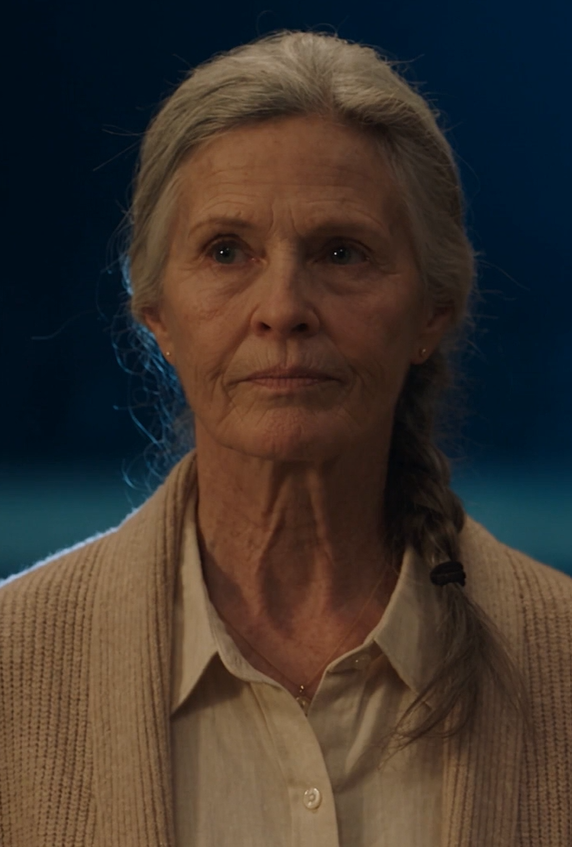
The third thing was the silence, because the moment Eleanor stepped through that door, every conversation stopped, every head turned. The music kept playing, but nobody was listening anymore. 30 men in leather cuts stared at her. Some curious, some amused, some annoyed that their Thursday night had just been interrupted by someone who clearly didn't belong. Eleanor stood in the doorway, gray hair, cardigan, canvas bag held against her chest.
She looked like someone's grandmother, which if she'd had children, she might have been. But she didn't look scared. And that, more than anything else, made the men pause. A man stepped forward from the crowd, big, 6'3" easy, neck tattoos crawling up toward his jaw, knuckles scarred from fights he'd won and probably a few he hadn't. His cut said enforcer across the back.
His face said he'd earned it the hard way. "You lost, Grandma?" His voice was deep, rough, the kind of voice that came from cigarettes and shouting and not giving a damn what anyone thought. Laughter rippled through the room. Someone near the pool table muttered something crude.
Someone else mimicked her in a high-pitched squeak. Eleanor didn't react. She just stood there, calm as Sunday morning, and looked past the enforcer to the rest of the room. "I'm looking for the road captain," she said. Her voice was steady, quiet, but it carried.