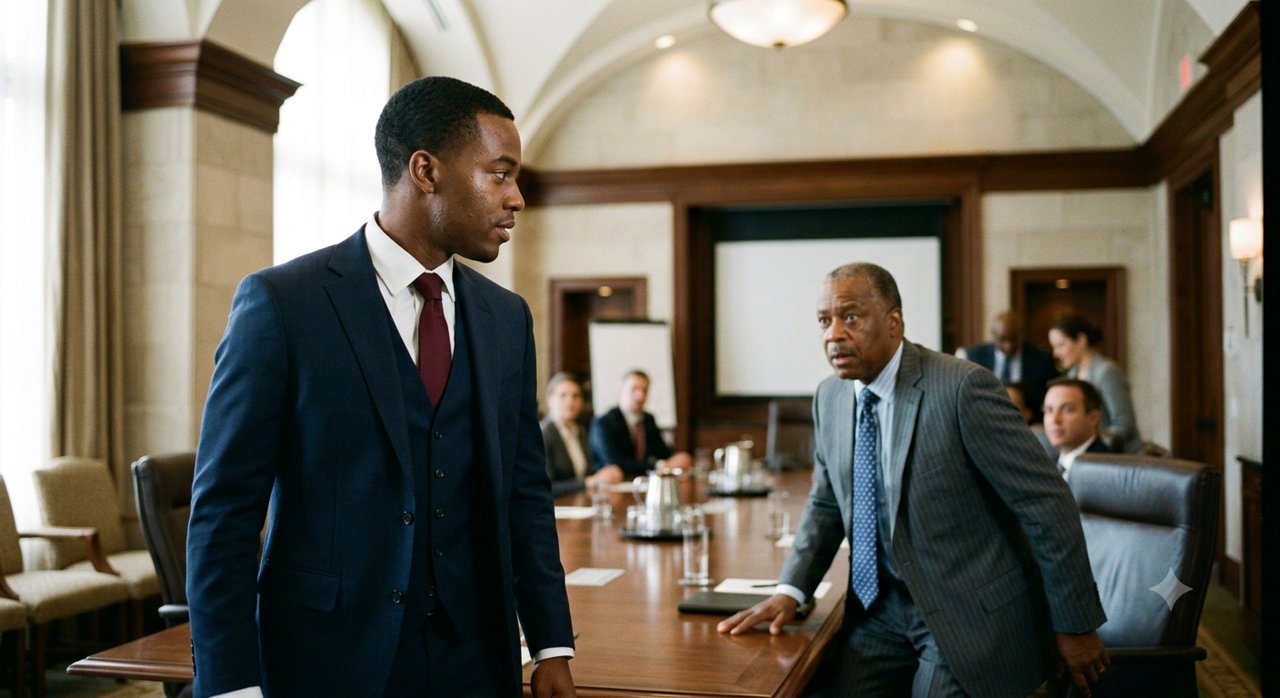
The federal prosecutor's name was Alderman.
He was in his fifties, compact and precise in the way of someone who had spent decades making sure every word he said could not be misread.
He met us in a conference room the morning after Eleanor's house.
The box was open on the table.
Its contents had been photographed, catalogued, and cross-referenced against the digital archive through the night.
Three forensic accountants had worked until four in the morning.
Two assistant prosecutors sat to Alderman's left with yellow legal pads covered in notes.
Alderman looked at Mom across the table.
"Mrs.
Merritt," he said.
"With the original documents and your expanded testimony, we can charge Victor Hale with twelve additional counts — including racketeering, tax fraud across three jurisdictions, and conspiracy in the de@th of Gerald Tate." He set his pen down.
"This will end him."
Mom's hands were folded on the table.
"And the original handler?
The man who gave me the wrong code word?"
"Marcus Elroy.
Former U.S.
Marshal.
He's in custody as of this morning.
His phone records show forty-one contacts with a number connected to Hale's organization over an eighteen-month period.
He also accessed your sister's file twice in the week before she lost contact."
The room was very quiet.
"Donna," Mom said.
"What happened to her?"
Alderman looked at her steadily.
"She's alive."
Mom's breath came out slowly.
"Elroy had her relocated a second time — off the books — to keep her isolated from you and prevent her from surfacing if Hale's case ever reopened.
She's been living under a third alias in a town in Oregon.
She doesn't know any of this has happened." Alderman paused.
"We can have someone with her within two hours."
Mom pressed one hand flat on the table.
I watched her face.
She didn't cry.
She had told me she was done crying about Donna for now.
She had done that part alone at night for years, and now there was nothing left to cry with — only this: the solid fact of her sister being alive, in Oregon, not knowing.
"Tell her I'm coming," Mom said.
"We will."
Alderman opened a folder.
"There's one more thing you should know.
Last night, Victor Hale's attorney contacted our office.
Hale is offering a full plea in exchange for reduction of charges."
Mom looked up.
"Meaning what exactly?"
"Meaning he wants to avoid trial.
He wants to negotiate."
"Don't," Mom said.
Alderman looked at her carefully.
"The plea would still result in significant prison time."
"How significant?"
"Minimum twelve years.
Likely more, given the additional charges."
"And without the plea?"
"With your testimony and the original documents?
We go to trial.
Estimated thirty to forty-five years, depending on the judge."
Mom looked at him without blinking.
"Then we go to trial."
Alderman nodded once.
He hadn't looked surprised.
Webb leaned in from the side of the room.
"Katherine.
Hale knows we declined.
His attorney called back twenty minutes ago." He paused.
"He said Hale has a message for you directly."
Mom went very still.
"What message?"
Webb read from his phone: "'Tell the woman from the waterfront that I remember her face.
I always will.'"
The table was quiet.
Then Mom said, "Tell him I remember Gerald Tate's face.
I always will too.
And unlike Gerald, I'm going to be there when the verdict is read."
Alderman almost smiled.
He picked up his pen.
"Then let's get to work," he said.