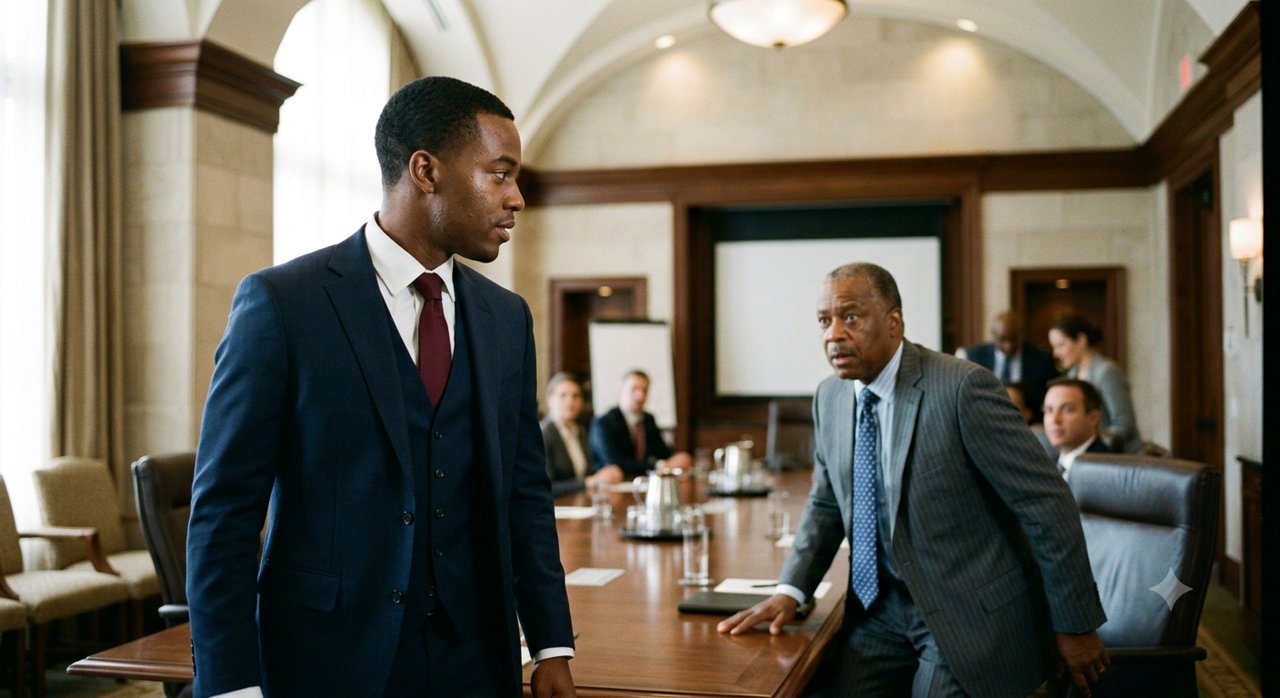
The trial lasted nineteen days.
I was not in the courtroom for most of it.
I stayed in a secure apartment with Reyes, who taught me to play gin rummy badly and let me beat her at it anyway.
Webb checked in every evening.
Foss sent updates through him.
Mom testified for three days.
I watched the first day on a closed-circuit feed in a separate room, with Reyes beside me and a box of tissues neither of us used.
Mom sat straight in that witness chair.
She spoke clearly.
She looked at the jury when she answered questions and at the prosecutor when she listened.
She did not look at Victor Hale.
But once — just once — near the end of the second day, Hale's defense attorney said something sharp and designed to destabilize her.
Something about her credibility.
Something about the years she had lived under a false name.
"You presented yourself as someone you were not," the attorney said.
"To your neighbors.
To your community.
Even to your own child."
Mom was quiet for a moment.
Then she said, "I presented myself as someone who was trying to keep my daughter alive.
I don't apologize for that."
The jury looked at her.
The attorney moved on.
The verdict came on a Tuesday.
Guilty on all counts.
Victor Hale received forty-two years without possibility of parole.
The judge named each count individually.
Hale sat without expression through all of it.
His attorney leaned over and said something to him at the end.
Hale said nothing back.
That was all the exit he got.
Marcus Elroy, the original handler, pled guilty to three counts of obstruction and one count of conspiracy.
He received nine years.
His pension was revoked.
Dad — Ryan Callahan — pled guilty to providing material assistance to a known threat against a protected federal witness.
The judge sentenced him to four years.
He did not look for me in the gallery.
I was not there.
Foss told me the sentencing outcome over the phone.
I was sitting at the window of the apartment, watching pigeons on the ledge across the street.
"Four years," I said.
"Yes."
"Does he know I know?"
"The prosecutor informed his attorney that you were aware of the full circumstances."
I watched the pigeons for a moment.
"Okay," I said.
"Are you all right?"
"I don't know yet," I said.
"I think so."
I meant it.
Three weeks after the verdict, Mom and I were driven to a small airfield outside the city.
New documents.
New names — our real names, reinstated.
Katherine Anne Merritt and Clara Jane Merritt, traveling under their own identities for the first time in eleven years.
Webb walked us to the gate.
He shook Mom's hand.
Then he looked at me.
"You called at the right time," he said.
"From the very beginning.
You did everything right."
I didn't know what to say to that.
So I said, "Is Donna going to be okay?"
"She's already okay.
She's waiting for you."
The plane was small.
Just the two of us and a pilot and the low hum of the engine as we lifted above the city and the city became a shape and the shape became something smaller and finally just the edge of something we were leaving behind.
Mom reached across and took my hand.
She didn't say anything.
Neither did I.
We landed two hours later.
Donna was waiting inside the small terminal — shorter than Mom, with the same line to her jaw and different eyes.
She saw Mom through the glass before we reached the doors.
By the time we got inside, they were already holding onto each other in the middle of the terminal floor, not speaking, not moving, just standing there like two people who had spent years convincing themselves the other one might be gone and were only now, finally, willing to stop.
I stood a little apart and let them have it.
Then Donna looked up and saw me.
"Clara," she said.
Like she already knew my name.
"Hi," I said.
She held out one arm.
I stepped in.
We stood there, the three of us, in the middle of an ordinary terminal with travelers moving around us and an announcement playing overhead, and it was not cinematic or dramatic or particularly beautiful.
It was just real.
It was just us.
And for the first time in as long as I could remember, that was enough.
---
Some people spend years protecting the ones they love in silence — carrying secrets that would break most of us, making choices no one should ever have to make alone.
Katherine and Clara's story is a reminder that it is never too late for the truth to come forward, and never too late to find your way back to each other.
Have you ever had to protect someone you love by keeping a painful truth hidden?
Or has someone you trusted kept a secret from you that changed everything?
Share your thoughts in the comments — we'd love to hear your story.
💬