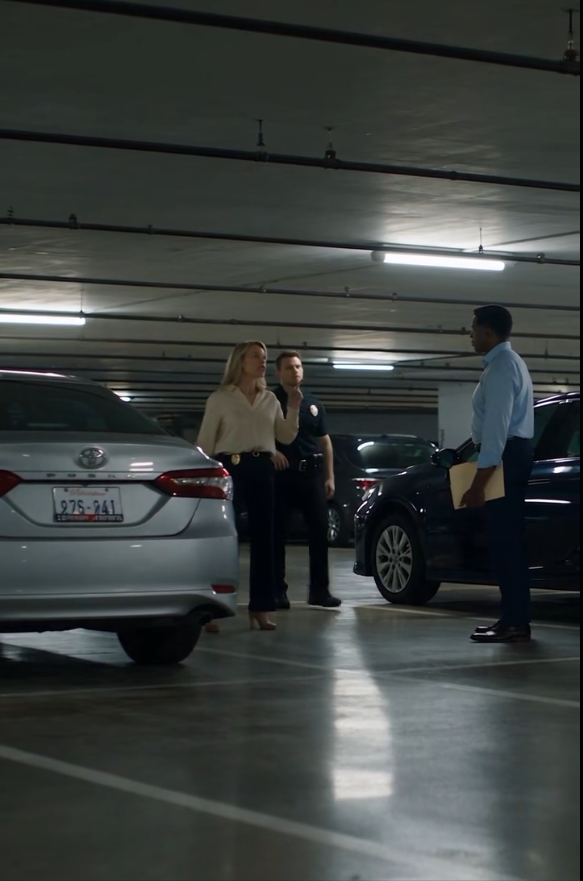
“These aren’t from technical difficulties.”
“No.”
“What happened?”
Marcus looked toward the window.
From seven floors up, the city appeared orderly. Office towers, late-afternoon traffic, a pale strip of river in the distance.
“Someone in the garage thought I shouldn’t be there.”
Evelyn released his wrist.
“And the police?”
“Agreed long enough to put me in cuffs.”
Her face barely moved.
That was how Marcus knew the news landed.
His mother had raised two children while teaching public school for more than three decades. She had built a life out of not giving chaos the satisfaction of seeing her startled.
“Were you arrested?”
“No.”
“Were you charged?”
“No.”
“Did you do anything foolish?”
Marcus almost smiled.
“No.”
“Anything clever?”
He looked at her.
“That depends.”
Evelyn sat across from him.
“What did you do?”
“I asked the officer to keep his camera running.”
She nodded slowly.
“That was clever.”
“I also told him to call the courthouse.”
Her expression changed.
“Why?”
“To verify my identity.”
“No.”
Marcus leaned back.
“No?”
“You told him to call because you knew what would happen when he learned what you do.”
Marcus had no answer ready.
His mother folded her hands.
“Did it?”
“Yes.”
“And then?”
“He took the cuffs off.”
Evelyn looked toward the kitchen counter.
“So the problem wasn’t that he learned he had the wrong man.”
Marcus waited.
“The problem,” she said, “is that he learned he had the wrong kind of wrong man.”
Marcus looked down at his hands.
“Something like that.”
She stood and walked to the cabinet where she kept tea.
“You’re going to file a complaint.”
“I haven’t decided.”
“Yes, you have.”
“No.”
“You’re deciding how much of one.”
Marcus watched her fill the kettle.
That, unfortunately, was true.
He had spent the elevator ride telling himself not to turn a private insult into a public crusade simply because he possessed the tools to do it.
He disliked symbolic cases when ordinary processes would work.
He disliked personal grievances disguised as principles even more.
But the camera changed the calculation.
So did Hayes’s apology.
Not the apology itself—the timing of it.
Marcus had been exactly as innocent thirty seconds before the courthouse clerk identified him as he was afterward.
Only his social weight had changed.
His mother set two cups on the table.
“You know what your father would say.”
“I know what Dad said about everything.”
“He was efficient.”
“He was exhausting.”
“He was usually right.”
Marcus smiled despite himself.
Evelyn sat again.
“You don’t have to destroy anybody.”
“I’m not interested in destroying anyone.”
“But doing nothing is also a decision.”
Marcus looked at her.
She sipped her tea.
“That building manager told me there’s an incident-report process for resident disputes.”
“This became a police matter.”
“I know.”
“You want me to complain.”
“I want you to act like the man you expect people to be when they’re standing in your courtroom.”
That ended the conversation.
Marcus stayed another hour.
They fixed the access problem by calling management from upstairs. The wrong permission category had been assigned to one of the electronic passes. An employee corrected it remotely.
At the door, Evelyn hugged him.
Then she held on half a second longer than usual.
“Don’t let them turn this into a story about a federal judge.”
Marcus understood immediately.
“No.”
“Because that isn’t why it matters.”
“I know.”
She looked at him.
“Make sure you do.”
By the following morning, Officer Daniel Hayes had watched the body-camera footage three times.
The first viewing was procedural.
The second was defensive.
The third was the one he could not stop thinking about.
He sat in a small review room at the precinct with the footage paused on Marcus standing beside the sedan before the detention.
Timestamp: 16:42:11.
Diane Mercer was talking.
The audio was clear.
“He’s been hanging around down here. I don’t know what he’s doing.”
Marcus stood with the folder in one hand.
“I arrived six minutes ago.”
Diane pointed toward the security door.
“He was trying to force his way into the building.”
Marcus responded, calm enough that Hayes now heard the difference.
“I used the access credential issued by management. It didn’t activate.”
Hayes’s recorded voice asked Marcus whether he lived there.
“No.”
Diane: “There. You heard him.”
Marcus: “My mother does.”
Then Diane: “She absolutely does not. I know everyone in this building.”
Hayes paused the video.
That had sounded more persuasive in the garage.
On the screen it looked different.
Not because he now knew Marcus was a judge.
He forced himself to remove that knowledge.
A complainant had made a claim. The subject had offered an immediately verifiable explanation. The property manager was in the building.
Hayes had not called.
He pressed play.
Marcus asked for management verification.
Diane interrupted.
Hayes asked Marcus to turn around.
Marcus repeated the request.
Hayes ordered him again.
Then the cuffs.
The video did not show brutality.
That would have been easier, in a strange way.
There was no strike, no shove, no profanity, no panic.
Nothing obvious enough to let Hayes classify the moment as a singular lapse.
The problem was its ordinariness.
He had made each decision quickly, and each one had felt defensible while he made it.
The recording showed how little information those decisions had required.
A knock sounded behind him.
His supervisor entered.
“You requested review?”
Hayes nodded.
He expected instruction to write the report carefully, preserve the footage, and wait for Professional Standards.
Instead, the supervisor pulled up a chair.
“Walk me through what you thought you had.”
Hayes did.
Trespass complaint.
Nonresident.
Failed access.
Complainant identified herself as resident.
Subject declined to identify himself to complainant.
Supervisor listened.
“And what did you verify before cuffing him?”
Hayes looked at the frozen frame.
“Nothing independent.”
“Did he attempt to leave?”
“No.”
“Threaten anyone?”
“No.”
“Refuse your commands?”
“He questioned the cuffing.”
“That wasn’t my question.”
Hayes breathed through his nose.
“No.”
“Did you ask for identification?”
“No.”
The supervisor looked at him.
“Why not?”
Hayes had asked himself that during the second viewing.
He still disliked the answer.
“Because Mercer was pushing that he didn’t belong there, and he admitted he didn’t live there.”
“And?”
“I moved too fast.”
The supervisor leaned back.
“Judge filed anything?”
“Not yet.”
“The title doesn’t matter.”
“I know.”
“Do you?”
Hayes looked at the screen.
Marcus’s face was turned toward the body camera.
Please make sure that camera keeps recording.
“Yes,” Hayes said.
This time he meant it differently.
Diane Mercer spent the same morning composing an email to building management.
She deleted it twice.
Her first version described Marcus as “hostile.”
She removed the word because, even in memory, he had not been.
Her second version said he had “refused to explain his presence.”
That was not quite true either.
He had explained it.
She settled on “refused to provide identification.”
That was true.
It also omitted that she had been the one demanding it.
Diane did not think of herself as someone who caused scenes.
She considered herself attentive.