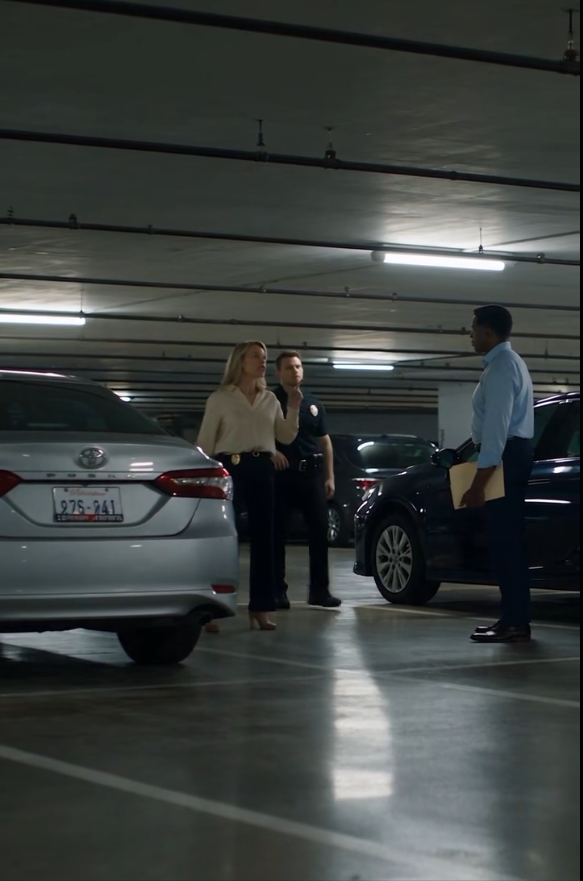
The building was expensive, private, and marketed as secure. Residents paid for controlled access. Two bicycle thefts had occurred the previous year. Packages had vanished. A car window had been broken.
She had spent years telling neighbors that security depended on people speaking up.
What bothered her now was not that she had spoken up.
It was that Marcus’s profession had made everyone behave as though speaking up itself were the problem.
She sent the email.
Three minutes later, management replied with a short acknowledgment and a request that she preserve any messages or photographs related to the incident.
Diane read the line twice.
Preserve.
The same word Marcus had used.
She closed her laptop.
Marcus arrived at the federal courthouse shortly before eight.
Security greeted him as usual.
“Morning, Judge.”
“Morning.”
The words felt louder than they had the day before.
Upstairs, his chambers were quiet. His law clerk had left a stack of motions on the conference table. A jury trial was scheduled to resume at nine-thirty.
Marcus hung his jacket behind his door and stood for a moment looking at his own robe.
Titles were strange things.
A robe could make a room rise when he entered.
A shirt in a parking garage made him someone whose explanation could wait.
His phone rang.
The courthouse clerk.
“I heard about yesterday.”
“I assumed you might.”
“Officer sounded like he swallowed a nail.”
Marcus sat behind his desk.
“Did he ask anything besides identity verification?”
“No. I confirmed your full name, position, and date of birth. Then I asked whether there was a safety issue.”
“There wasn’t.”
“I gathered.”
Marcus opened a case file.
The clerk waited.
“Are you filing something?”
“Yes.”
The answer surprised him only because it came without hesitation.
“With the police department?”
“And building management.”
“Civil case?”
“No.”
“At least not yet?”
Marcus looked toward the windows.
“No.”
He knew how easily the courthouse could distort the matter. Colleagues would hear. Someone would offer to make a call. Someone else would quietly suggest that the police chief personally apologize.
That was exactly what Marcus did not want.
“Please don’t contact the department on my behalf.”
“I wouldn’t.”
“And if anyone asks—”
“I know.”
Marcus smiled faintly.
“Of course you do.”
When he ended the call, he opened a blank document.
He typed:
Complaint Regarding Detention at Private Residential Property.
Then he sat with his hands above the keyboard.
The easiest version would describe humiliation.
The more useful version would describe sequence.
Time.
Statement.
Response.
Verification requested.
Verification not performed.
Cuffs applied.
Identity confirmed.
Cuffs removed.
He began writing.
By nine, he had reduced the incident to three pages of fact.
He attached no argument.
No threat.
No demand for discipline.
Only one request:
Preserve the complete body-camera recording, dispatch audio, incident report, and all related communications. Conduct the same review you would conduct if I held no public office at all.
He read the sentence twice.
Then sent it.
Part III — The Wrong Question
The complaint changed the case because of what it did not ask for.
Hayes expected Marcus to request suspension.
He did not.
The department expected a lawyer’s letter.
None arrived.
City officials expected a call from the courthouse.
Marcus had specifically prevented one.
Instead, Professional Standards opened a routine review.
That word—routine—became important.
Hayes was interviewed on the fourth day.
He sat at a plain table under fluorescent lights with a department investigator across from him. The body-camera footage was available on a monitor, though the investigator did not play it immediately.
“Why did you detain Mr. Reed?”
Hayes corrected automatically.
“Judge Reed.”
The investigator looked at him.
“Why did you correct me?”
Hayes stopped.
Because the title had become lodged in his mind.
Because it still changed the room.
He exhaled.
“I shouldn’t have.”
The investigator made a note.
“Why did you detain Marcus Reed?”
“There was a reported trespass.”
“Was he trespassing?”
“I didn’t know.”
“At the time you cuffed him?”
“No.”
“Did you have probable cause to arrest?”
“No.”
“Was he under arrest?”
“No.”
“Then what was the purpose of the handcuffs?”
“Scene control while I investigated.”
“What scene-control problem existed?”
Hayes shifted in his chair.
“The complainant was agitated.”
“Did you cuff her?”
“No.”
“Was Reed agitated?”
“No.”
“Did he threaten to leave?”
“No.”
“Did he move toward you?”
“No.”
“Did he conceal his hands?”
“No.”
“Did you suspect a weapon?”
“No.”
The investigator folded his hands.
“So what behavior by Reed created the need for restraints?”
Hayes looked at the tabletop.
He could construct an answer.
Officer safety.
Unknown subject.
Conflicting statements.
Restricted-access environment.
All of it would sound legitimate.
None of it would answer the question.
“Nothing specific,” he said.
The investigator watched him.
Hayes continued before he could stop himself.
“I accepted the complainant’s framing too early.”
“What framing?”
“That he was the problem.”
The investigator finally turned the monitor on.
They watched.
This time Hayes noticed something new.
At 16:41:03, before he arrived, Diane could be heard on the emergency call recording played alongside the camera timeline.
“I need an officer down here. There’s a man trying to get into the building.”
Dispatcher: “Is he threatening anyone?”
“No.”
“Has he damaged anything?”
“No, but he won’t tell me who he is.”
“Is he trying to enter now?”
“He’s standing by a car.”
“Do you know whether he’s a guest?”
“No. He doesn’t belong here.”
The investigator paused.
“How could she know that?”
“She couldn’t.”
“And when you arrived, what did you do with that statement?”
Hayes looked at the screen.
“I treated it like something established.”
The investigator nodded once.
The interview continued another forty minutes.
At the end, Hayes asked the question he had been trying not to ask.
“Has Judge Reed requested charges against Mercer?”
“That isn’t how this process works.”
“I know.”
“Then why ask?”
Hayes looked toward the dark monitor.
“Because I think I’ve been waiting for somebody else to tell me how bad the mistake was.”
The investigator closed the file.
“That’s not their job.”
The building’s review was smaller and, in its own way, more uncomfortable.
The property manager met separately with Diane and Marcus.
Marcus’s meeting took fifteen minutes.
He confirmed his mother’s residency, the issuance of the electronic passes, and the access failure.
Then the manager asked, “What would you like us to do regarding Mrs. Mercer?”
“Do you have a policy governing residents confronting other residents’ guests?”
“Yes.”
“Apply it.”
“Would you like a written apology?”
“No.”
“Would your mother like one?”
“You’ll have to ask her.”
The manager hesitated.
“I’m worried this could make Ms. Reed uncomfortable living here.”
Marcus leaned back.
“My mother is capable of telling you whether she’s uncomfortable.”
“I didn’t mean—”
“I know.”
He softened his tone.
“Don’t solve her life around her. She hates that.”
The manager smiled reluctantly.
“I’ve noticed.”
Marcus stood.
At the door, she said, “There is one thing you should know.”
He turned.
“Mrs. Mercer has said she believed she was acting under authority granted by the residents’ safety committee.”