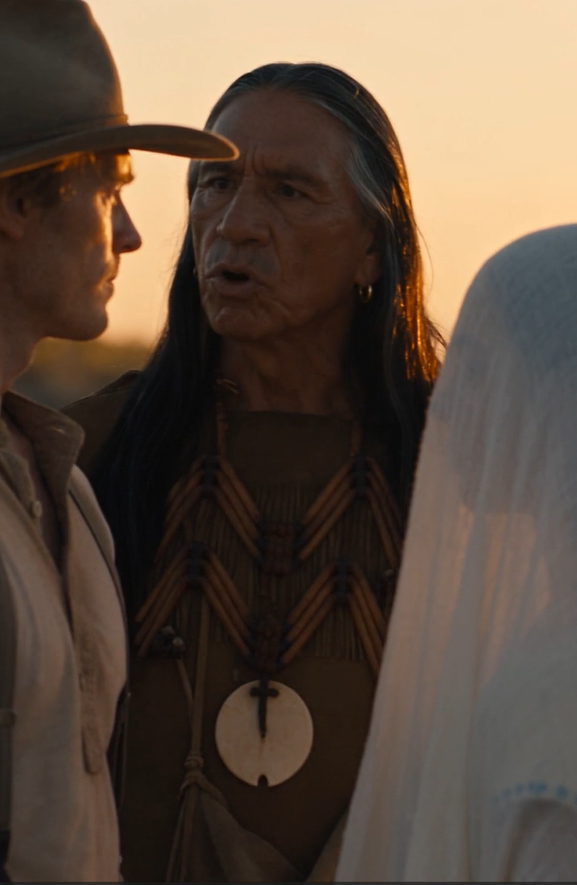
Amaya studied his small camp.
“You really did come here for land.”
“I’ve been saying that since the first day.”
The shadow of a smile appeared on her lips.
“My father thought that was exactly what made you different.”
“I don’t understand.”
Amaya sat on a rock.
“The other men came for me and eventually started asking about the land.”
Thomas leaned against his saddle.
“I came for the land and somehow ended up in a wedding.”
This time, she actually smiled.
Just a little.
“Yes.”
“Your father has dangerous logic.”
“Sometimes.”
Thomas studied her.
“Why did you come?”
Her smile disappeared.
“Because I want to know one thing.”
“Ask.”
“If my father offered you the land without marriage, would you still want it?”
Thomas answered without thinking.
“Yes.”
Amaya nodded.
“Then perhaps there is something we can discuss.”
Hours later, they returned together.
Nahuel received them while sitting in the same place where the first negotiation had taken place.
He did not look pleased.
Amaya spoke before her father could.
“The land and my marriage will be two separate matters.”
Nahuel did not respond.
“If Thomas wants the parcel, he can negotiate for it.”
“You do not have the authority to decide that alone.”
“Neither do you have the authority to decide my husband alone.”
The blow landed cleanly.
Nahuel stared at her for a long time.
Thomas remained silent.
Finally, the chief asked,
“What do you offer for the land?”
Thomas felt Amaya watching him.
This time, there was no trap.
“Labor and cattle.”
“Be specific.”
Thomas was.
He offered six steers over two years and his labor repairing an irrigation channel damaged by flooding north of the river.
He did not ask for full ownership immediately.
He proposed using the parcel for two seasons, proving that he could maintain it, and then renegotiating a more permanent transfer under the available territorial agreements.
Nahuel listened.
Then he looked at Amaya.
“And you?”
“I am not part of the price.”
Nahuel lowered his eyes.
For the first time since Thomas had met him, he looked ashamed.
“No,” he said.
Amaya waited.
The chief raised his eyes.
“You are not part of the price.”
That was the real beginning.
Thomas settled beside the river without a wife.
First he built a small shelter.
Then a corral.
He worked the land.
The irrigation channel needed far more repair than he had expected.
Amaya had known that from the beginning.
“You’re digging too high,” she told him during the second week.
Thomas leaned on his shovel.
“And you waited two hours to tell me?”
“I wanted to see how long it would take you to notice.”
“And?”
“Longer than reasonable.”
Thomas looked at the channel.
“You know how to do it better?”
Amaya took the shovel.
“Yes.”
She did.
She had grown up beside the river.
She knew where the water collected in spring, where the ground gave way after storms, and which parts of the riverbank looked fertile but turned into deep mud.
Thomas had arrived believing he needed land.
He quickly discovered he also needed to learn it.
Amaya did not appear every day.
She wasn’t his helper.
She had responsibilities of her own.
She worked with several women trading leather, dried food, and beadwork.
She knew enough English to argue prices with traders and enough Spanish learned from travelers to surprise Thomas one afternoon.
“Since when do you speak Spanish?”
“Since before you learned where to dig an irrigation channel.”
“That doesn’t answer my question.”
“Then now you understand how I felt when I asked why I was supposed to marry you.”
Thomas accepted defeat.
As the weeks passed, they talked more.
About small things at first.
Horses.
Food.
The places they came from.
Thomas told her about Missouri.
About his father, a tenant farmer who had spent thirty years working a farm he never owned.
That was where Thomas’s obsession with owning land came from.
Amaya understood something then.
“That’s why you almost accepted.”
“Yes.”
“Even when you thought I was horrible.”
Thomas grimaced.
“Your father used a different word.”
“I know.”
“And I didn’t like it.”
“But you were willing.”
Thomas looked at her.
“I was willing to honor an absurd agreement because I was tired of having nothing.”
He did not try to make it sound better.
“That doesn’t make me feel very special,” Amaya said.
“It shouldn’t.”
The answer surprised her.
Thomas continued.
“I didn’t even know you.”
Amaya remained silent.
“If I ever tell you something different,” he added, “it will be after I know you.”
She studied him for a long moment.
“That’s better.”
Meanwhile, the relationship between Amaya and Nahuel remained wounded.
They did not stop speaking.
But they no longer spoke the same way.
One evening, the chief came to Thomas’s parcel.
He came alone.
Thomas was repairing a fence.
“Looking for Amaya?”
“No.”
Nahuel dismounted.
“I came to speak with you.”
Thomas put down the hammer.
“I’m listening.”
Nahuel studied the work along the irrigation channel.
“My daughter believes I tried to sell her.”
Thomas chose his words carefully.
“And what do you believe you did?”
The chief frowned.
“I tried to find her a man who would not choose her for her face.”
“So you made him choose her for land.”
Nahuel fell silent.
Thomas added nothing.
He didn’t need to.
“I thought you were different,” the chief finally said.
“Maybe I am. Maybe I’m not.”
“You rejected the land.”
“Because the price was not yours to offer.”
Nahuel looked toward the river.
“Her mother died when Amaya was fourteen.”
Thomas waited.
“After that, men appeared. Some young. Some not. Each had a different reason for saying he loved her.”
“And you stopped believing them.”
“Yes.”
“So you decided to choose for yourself.”
Nahuel nodded.
Thomas slowly shook his head.
“That was the mistake.”
The chief looked at him.
“Do you think I don’t know that now?”
Thomas did not answer.
Nahuel mounted again.
Before leaving, he said,
“The agreement for the land stands even if you and Amaya never speak again.”
That mattered.
A great deal.
Not because it guaranteed the land.
Because it finally separated the two things.
Spring moved on.
Thomas fulfilled his part.
The steers arrived.
The irrigation channel carried water again.
He planted corn, beans, and a small patch of alfalfa.
His shelter became a modest house.
And the better things went, the more another problem grew.
Rumors.
Traders traveling between settlements began spreading the story.
Some said Thomas had bought land by marrying the chief’s daughter.
Others claimed he had rejected Amaya after seeing her.
One version said she had been too ugly.
Another said she was so beautiful that Nahuel had hidden her.
None of them came very close to the truth.
Amaya discovered how far the rumors had traveled when she accompanied a group to a trading post.
A rancher who knew Thomas asked,
“So you’re the woman he didn’t want?”
Amaya looked at him.
“Who told you that?”
“That’s what people say.”
“Then people are wrong.”
The man smiled awkwardly.