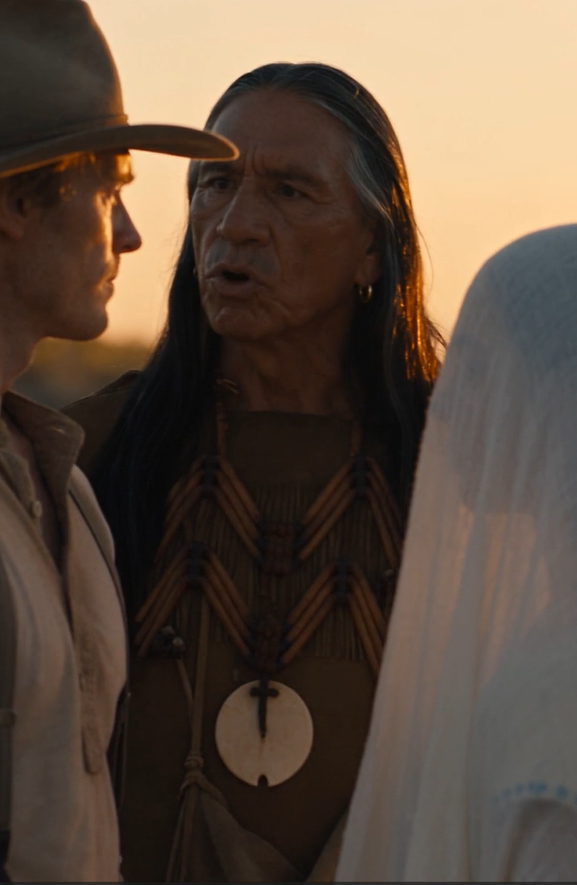
“I didn’t mean to offend you.”
“No. You only wanted to repeat a story you didn’t understand.”
That same afternoon, Amaya went looking for Thomas.
“Have you heard what they’re saying?”
“Some of it.”
“And you don’t intend to correct it?”
Thomas set a rope down on the corral.
“I’ve corrected three versions. Every time, a fourth appears.”
“They say you rejected me after seeing me.”
“They also say we got married.”
“That’s worse.”
Thomas smiled.
Amaya did not.
His smile disappeared.
“You’re right.”
She crossed her arms.
“My whole life, other people have decided what my face means. Now they’re deciding what it means that you didn’t marry me.”
Thomas understood.
“What do you want to do?”
The question calmed her.
Not, “I’ll take care of it.”
Not, “Leave it to me.”
What do you want to do?
“Tell the truth.”
The opportunity came at the beginning of summer.
Several ranchers, traders, and territorial representatives gathered near the river to review water and grazing agreements.
Thomas needed to be there because of the parcel.
Nahuel did too.
Amaya chose to attend.
She wore no veil.
When someone made a joke about the “marriage that bought land,” she spoke.
She didn’t raise her voice.
She didn’t need to.
“Thomas did not buy a wife.”
The conversations stopped.
Thomas stood several paces away.
Nahuel was farther back.
Amaya continued.
“My father offered him land with a condition I did not know about. He told me a different story. When we discovered the lie, we both rejected the marriage.”
One man asked,
“Then what about the land?”
Thomas answered,
“I negotiated for it afterward.”
“Without marriage?”
“Without marriage.”
Nahuel stepped forward.
Everyone waited.
The chief looked at his daughter.
“It is true.”
Amaya was surprised to hear him say it in front of strangers.
Nahuel continued.
“I lied.”
That produced a different kind of silence.
“I believed I was protecting my daughter by choosing the conditions for her.”
He looked at Amaya.
“I was wrong.”
It wasn’t a long speech.
Nor did it erase what had happened.
But Amaya saw something she had not expected.
Her father was willing to publicly accept the shame he had previously tried to control through a lie.
After that gathering, the rumors did not disappear.
But the truth began traveling too.
And it traveled farther.
Thomas completed the two agreed seasons.
When the time came to discuss permanent rights to the parcel, Nahuel imposed no personal conditions.
They talked about cattle.
Water.
Boundaries.
River access.
Nothing more.
Thomas obtained the right to settle there permanently under the terms they had agreed upon.
That same day, he found Amaya beside the irrigation channel.
“It’s yours now,” she said.
Thomas looked across the land.
Five years searching for something like this.
He had expected to feel triumph.
Instead, he felt relief.
“Yes.”
Amaya smiled.
“Then you got what you wanted.”
Thomas looked at her.
“Not exactly.”
She raised an eyebrow.
“Careful.”
“I’m being careful.”
Thomas took a breath.
“When I came here, all I wanted was land.”
“You made that very clear.”
“Then your father tried to give me a wife.”
“Also very clear.”
“Now I have the land.”
Amaya waited.
Thomas continued.
“And I’d still like to get to know the woman better.”
She didn’t smile this time.
But she didn’t leave either.
“That isn’t a marriage proposal, is it?”
“No.”
“Good.”
“It’s an invitation to dinner.”
Amaya pretended to consider it.
“Can you cook?”
“Not very well.”
“Then your proposal is getting worse.”
“I can learn.”
“That’s what you said about the irrigation channel.”
“And I learned.”
Amaya smiled.
“Then perhaps there’s hope.”
They did not marry that week.
Or that month.
Thomas courted her for almost a year.
Sometimes Amaya agreed to dinner.
Sometimes she didn’t.
They argued.
They laughed.
They went days without seeing each other.
Thomas learned that she hated anyone speaking for her.
Amaya learned that Thomas became unbearably stubborn whenever he believed he could fix something without help.
Nahuel learned, with greater difficulty, to ask before interfering.
When Thomas finally proposed, he did not do it beside the river.
There was no audience.
No land on the table.
No document.
No conditions.
They were sitting on the porch of Thomas’s small house while a summer storm approached from the west.
“Amaya.”
“Yes?”
“I want to ask you something.”
She looked at him.
“That is usually better than deciding it yourself.”
Thomas laughed.
“I’ve received a fairly thorough education on that subject.”
Then he became serious.
“Will you marry me?”
Amaya did not answer immediately.
Thomas did not fill the silence either.
He had learned that too.
Finally, she asked,
“And if I say no?”
“Tomorrow, the land is still mine.”
Amaya waited.
“And?”
“And you are still you.”
Amaya’s expression softened.
“That’s all?”
“Yes.”
“Then yes.”
Thomas blinked.
“Yes?”
“Don’t make me say it three times.”
They married at the end of that summer.
Amaya wore no veil.
Nahuel was there.
So were the women who had remained silent on that first day, the men who had avoided Thomas’s gaze, and some of the children who years earlier had learned to repeat stories they did not understand.
This time, no one needed to pretend anything.
Before the ceremony, Nahuel approached Thomas.
“The land was never the real reason I wanted you to stay.”
Thomas looked at him.
“I know.”
“I thought I could control my daughter’s future if I chose the right man.”
“And you almost lost both of us.”
Nahuel nodded.
“Yes.”
Then he looked toward Amaya.
“She reminds me whenever necessary.”
“I imagine that happens often.”
Nahuel almost smiled.
When the time came to give her answer, Amaya spoke before anyone could speak for her.
“Yes. I want this.”
Years later, a version of that story still circulated among the ranches of southern Arizona.
People said Thomas Callahan had entered Apache territory looking for land and ended up paying an unexpected price.
Some spoke of a wedding.
Others of a hidden daughter.
Others still claimed that Nahuel had managed to give away a woman nobody wanted.
Thomas always corrected the same part.
“I paid for the land.”
Then he would look toward the house, where Amaya was usually working, talking, or arguing with someone.
“No one bought her.”
Whenever Amaya heard him, she would add,
“And he didn’t get me with the land either.”
Thomas would smile.
“That took a lot more work.”
That was the only version of the story she liked.
Because the first time, Thomas had agreed to marry her without knowing her face.
The second time, he knew her face perfectly well.
Her character.
Her stubbornness.
Her intelligence.
And every reason sharing a life with her might be difficult.
And he asked anyway.
This time without conditions.
Without land.
Without secrets.
And Amaya was able to give the only answer that truly mattered.
Her own.