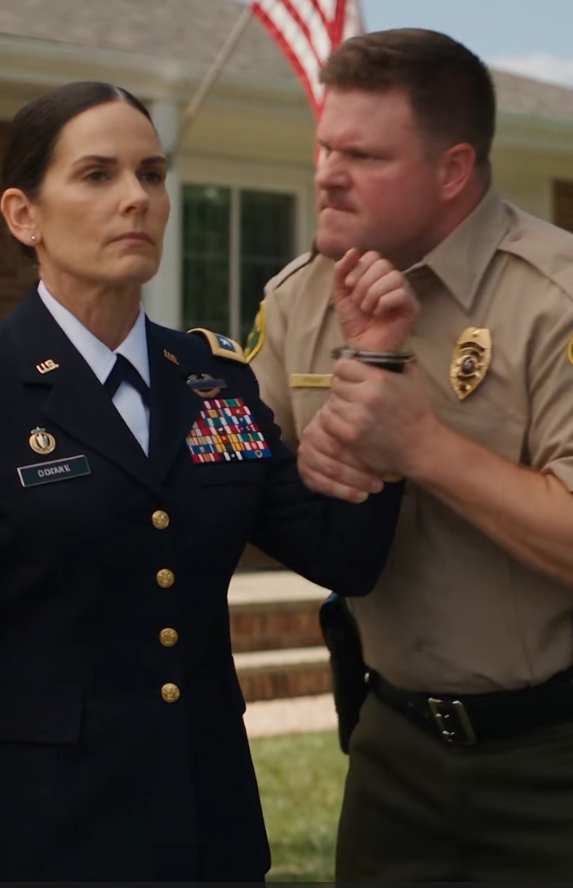
Part I — The Handcuff
At 1:17 p.m. on Memorial Day, my cousin locked a steel handcuff around my wrist in my parents’ backyard and told me I was finally going to learn what real authority looked like.
Twenty seconds later, a black government SUV turned into the driveway.
Derek Nolan did not notice it at first.
He was too busy holding my forearm and performing for the family.
“Maybe this will finally teach you some respect.”
A few people laughed.
Not cruelly, exactly. Not yet. It was the kind of nervous family laughter that rose whenever Derek turned something uncomfortable into a joke and everyone decided it would be easier to go along with him than challenge him.
The cuff pressed cold against the inside of my wrist.
I looked down at it once.
Then back at Derek.
He was forty-three, broad through the shoulders, his face already red from heat, beer, and anger. He wore his tan county deputy uniform despite being off duty, complete with gold badge and duty belt. Derek liked wearing the uniform to family gatherings. It gave him a stage without requiring anyone to admit there was a performance happening.
My father stood at the grill with barbecue tongs in one hand.
My mother was arranging bowls on the picnic table.
Aunt Rebecca hovered near the porch with a paper plate she had stopped filling.
My grandmother Evelyn sat beneath an umbrella, one hand resting on the handle of her cane.
Todd, Derek’s younger brother, had his phone halfway out of his pocket.
Uncle Carl watched with the careful expression of a man deciding whether something was still funny.
I could smell charcoal, cut grass, sweet barbecue Nextce, and the faint perfume my mother wore every Memorial Day because she considered family gatherings an occasion even when everyone else arrived in shorts.
I was still in dress uniform.
Black jacket. Gold buttons. Ribbons. Badges. Shoulder insignia.
I had a remembrance ceremony later that afternoon, and I had not had time to change.
That had been enough to keep Derek entertained for most of lunch.
He had asked whether the ribbons came in the box with the jacket.
Todd had wanted to know whether I was “basically an office manager for the Army.”
Uncle Carl had laughed.
I had smiled because I had learned years earlier that correcting my family usually gave their assumptions more oxygen, not less.
Then Derek had shoved a finger close to my face during an argument about whether police or military authority carried more weight on civilian property.
I had moved his wrist aside.
He called it asNextlting an officer.
Before I realized how seriously he intended to take his own performance, he had pulled a pair of cuffs from his belt.
Now one cuff was closed around my wrist.
The other hung loose.
“Take it off,” I said.
Derek gave me the small smile he used when he thought someone had finally stepped into a situation he controlled.
“You don’t order me around.”
“You restrained me without cause.”
“You put your hands on an officer.”
“I moved your hand away from my face.”
“That’s your version.”
My father set the tongs down.
“Derek. Enough.”
“No, Uncle Walt. Everyone saw it.”
No one answered him.
That irritated him more than disagreement would have.
He looked around the yard.
“Somebody say something.”
That was when the SUV door opened.
Sergeant First Class Marcus Reed stepped onto the driveway carrying a sealed red folder.
I had known Marcus for nearly fifteen years. When I first met him, he had been a young specialist with a talent for learning everybody else’s job before anyone realized he had finished mastering his own. Over the years, he had become the sort of soldier commanders trusted when circumstances were moving too quickly for ordinary channels.
He wore full dress uniform.
The red folder was tucked under his left arm.
Three words were printed diagonally across the corner.
COMMAND EYES ONLY.
Marcus took three steps onto the lawn.
Then he saw the handcuff.
He stopped.
For the next three seconds, no one moved.
That silence became the clearest part of the afternoon in my memory.
Not Derek’s hand around my arm.
Not the metal biting into my wrist.
Not the smell of Nextce beginning to burn on my father’s grill.
The silence.
Marcus’s eyes moved from the cuff to Derek’s uniform, then to my face.
His jaw tightened once.
He stepped forward, heels coming together with instinctive precision.
“General Carter, ma’am.”
The backyard changed.
It did not explode into questions.
It did not erupt.
It simply stopped.
The portable speaker near the porch continued playing a country song, but suddenly it sounded too loud.
Derek’s fingers loosened around my forearm.
Grandma Evelyn leaned forward.
My mother stared at the stars on my shoulders as though she had never seen them before.
She had seen them.
That was what made the moment almost absurd.
My uniform had not been subtle.
But families have a remarkable ability to look at evidence and see only the version of you they decided on years earlier.
A stranger could see stars and understand rank.
My relatives could see the same insignia and remember the girl who spilled lemonade on the living-room carpet at fourteen.
“General?” Grandma whispered.
I turned to her.
“Yes, Grandma.”
Her lips parted.
Nothing came out.
Derek recovered first.
He gave a short laugh.
“No.”
Marcus did not look at him.
Derek glanced from me to the sergeant.
“No. Come on. What is this supposed to be?”
No one answered.
He pointed at Marcus.
“You’re military?”
“Yes.”
“What rank?”
“Sergeant First Class.”
Derek nodded quickly, visibly relieved.
“Right. So you’re a sergeant.”
Marcus remained still.
“And Rachel is supposed to be some kind of general?”
“Yes.”
The relief disappeared.
Derek looked at me.
“You honestly expect me to believe Rachel is a general?”
My mother said his name quietly.
“Derek.”
He ignored her.
“Rachel, enough.”
I almost laughed then.
Not because anything was funny.
Because the alternative was to explain my entire adult life in the middle of my parents’ yard while wearing a handcuff.
There had been reasons I stopped explaining myself to them.
When I graduated from West Point, Derek spent half the celebration talking about how police work was more dangerous than “college soldier stuff.”
When I became a company commander, Aunt Rebecca asked when I planned to get married.
When I deployed, my mother told relatives I was doing paperwork overseas.
When I returned, almost nobody asked what I had seen.
Every promotion became either an administrative detail or an invitation for someone else to compare accomplishments.
Eventually, I let them build whatever version of my life made them comfortable.
Rachel worked for the government.
Rachel moved often.
Rachel was probably somewhere in middle management.
Rachel worked too much.
Rachel thought she was better than everyone.
It was simpler than fighting.
Until that afternoon.
Marcus came to within three feet of me.
His gaze went to the cuff again.
“Ma’am, are you injured?”
“No.”
Derek finally released my arm.
The cuff remained around my wrist.