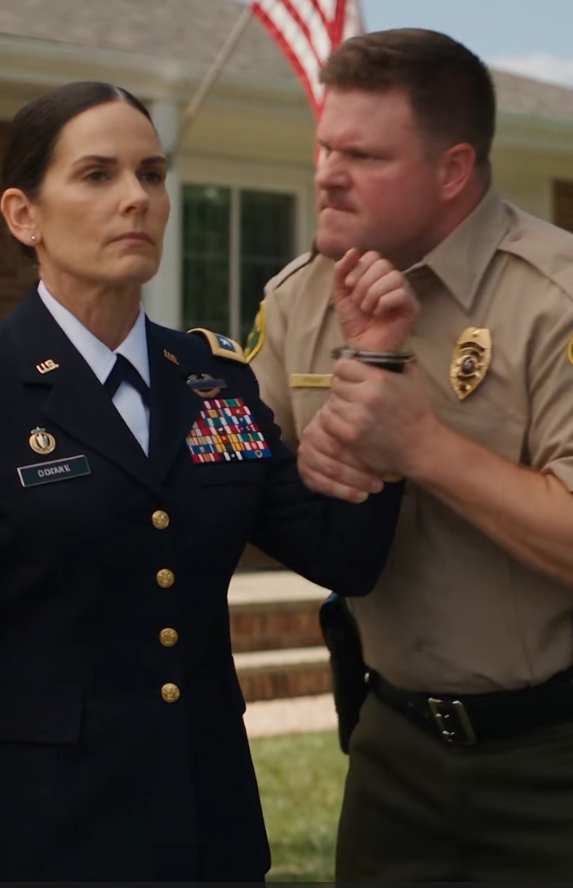
“Show me your identification,” Derek said to Marcus.
One of Marcus’s eyebrows lifted.
I nearly smiled.
Nearly.
“Derek,” I said, “remove the cuff.”
His confidence began rebuilding itself around anger.
“You’re technically being detained.”
“For what?”
“You interfered.”
“With what?”
“You grabbed me first.”
“I touched your wrist after you shoved your finger two inches from my face.”
“You put your hands on an officer.”
My father’s voice hardened.
“Derek. Take it off.”
“No, Uncle Walt.”
Everyone looked at my father then.
He had always been the fixed point of the family. Walter Carter did not need to raise his voice. He had spent his life cultivating the kind of authority Derek tried to manufacture with volume.
But this time Derek did not listen.
Marcus extended the red folder toward me.
“Ma’am.”
My attention changed immediately.
Family disappeared.
The cuff disappeared.
Derek disappeared.
“What happened?”
“The call came in thirty-seven minutes ago.”
“From where?”
“Fort Liberty operations first. Washington after that.”
The tightness in my stomach had nothing to do with Derek now.
“What kind of call?”
Marcus lowered his voice.
“There’s been an incident at the reserve communications site.”
The red folder suddenly felt heavier before I even touched it.
“Casualties?”
“None confirmed.”
“Civilian involvement?”
“Possibly.”
I took the folder with my free hand.
Derek reached toward it.
“What’s that?”
Marcus stepped between us.
Not aggressively.
He did not touch Derek.
He simply occupied the space.
“Do not touch that folder.”
Derek stopped.
It was the first direct command Marcus had given him, and it succeeded where the rest of us had failed.
I broke the seal.
The first page was a preliminary incident report.
At 12:36 p.m., a restricted communications node supporting several military installations had recorded an unauthorized attempt at physical entry.
By itself, that was not exceptional.
Mistakes happened.
Contractors went to the wrong gate.
Credentials malfunctioned.
Civilian personnel occasionally misunderstood access boundaries.
Then I saw the location.
County Route 18.
Nine miles from my parents’ house.
I kept reading.
A county law-enforcement access credential had been used at the outer gate.
I raised my eyes.
Derek was looking directly at me.
Something had changed in his face.
Not much.
Enough.
Marcus saw it too.
“What?” I asked.
Derek shook his head.
“Nothing.”
I looked back at the report.
The final four digits of the credential number were printed in bold.
I knew almost nothing about the sheriff department’s credential system.
Derek did.
His gaze flicked automatically toward the identification card clipped beside his belt.
Too fast.
“Derek.”
“What?”
“What are the last four digits on your department access credential?”
His expression closed.
“What does that have to do with anything?”
“Answer me.”
“No.”
My father stepped away from the grill.
“Derek.”
“I said no.”
Aunt Rebecca moved immediately toward her son.
“Rachel, whatever is in that folder, it has nothing to do with him.”
I looked at her.
That sentence struck harder than anything Derek had said.
Because I had not accused him.
Not yet.
Marcus shifted beside me.
“Ma’am, we should go.”
I nodded.
Then looked at my wrist.
“After this comes off.”
Derek crossed his arms.
“You’re still detained.”
Marcus turned toward him.
“For what charge?”
Derek said nothing.
“Deputy,” Marcus said, “state the charge.”
“You don’t have jurisdiction.”
“No. But she does not need my jurisdiction for you to explain why you restrained her.”
Derek reached for the cuff key.
For a second, I thought embarrassment had finally overcome stubbornness.
Then another vehicle appeared at the end of the driveway.
A dark county sedan.
It came slowly over the gravel and stopped behind Marcus’s SUV.
Derek went still.
Aunt Rebecca whispered something I could not hear.
The driver’s door opened.
Sheriff Daniel Mercer stepped out.
Derek’s boss.
Mercer surveyed the yard, taking in Marcus, my uniform, my family, the barbecue.
Then he saw the handcuff.
“Deputy Nolan.”
Derek swallowed.
Sheriff Mercer crossed the lawn without hurrying.
He stopped beside the picnic table.
Then he raised a clear evidence bag.
Inside it was a county access card.
Derek’s photograph was unmistakable.
But Mercer was not looking at Derek.
He was looking at Rebecca.
“Mrs. Nolan,” he said quietly, “we found this twenty minutes ago inside your vehicle.”
Aunt Rebecca stepped backward.
Derek turned toward her.
“Mom?”
Her mouth trembled.
Mercer reached into his jacket and removed a sealed envelope.
“There’s something else.”
Rebecca looked as though she wanted to leave but had forgotten where the driveway was.
Derek moved toward her.
“Mom, what did you do?”
She looked at him.
Then at me.
“Rachel…”
Mercer opened the envelope.
He unfolded the page inside.
His expression changed.
Then he said the one name nobody in our family had spoken aloud for eighteen years.
“Thomas Carter.”
My father dropped the barbecue tongs.
They struck the patio stones with a sharp metallic clatter.
And before anybody explained another word, I understood that what had begun with a handcuff in my parents’ backyard had not actually begun that afternoon.
It had begun eighteen years earlier.
With my brother.
Part II — What We Buried
I was seventeen the last summer Thomas lived at home.
He was nine years older than me and already seemed to belong to a world far larger than our house.
To me, he had been everything Derek spent his adult life trying to imitate.
Thomas never needed to tell people he was capable.
He simply was.
He had joined the Army young, moved into communications, and developed the irritating habit of understanding machines better than the people who designed them.
When I was a teenager, he would come home in uniform and leave his boots by the back door because our mother hated dirt on the floors.
He taught me how to change a tire.
He taught me how to read a topographic map.
He taught me to drive my father’s old truck even though Dad had specifically said I was not allowed.
Most importantly, Thomas had been the first person in the family who treated my ambition as something other than a phase.
When I told him I was thinking about West Point, he did not laugh.
He brought home a notebook.
“Then stop thinking about it,” he said. “Find out what it takes.”
That was Thomas.
No speeches.
No empty encouragement.
He made things practical.
Then, eighteen years ago, he vanished from our family’s life in stages.
First came an investigation involving the reserve communications facility on County Route 18.
Then came arguments behind closed doors.
Then Thomas moved out.
Then my father told me my brother had made choices we would not discuss.
A few weeks later, Thomas died in a highway accident outside the county.
The funeral was small.
My father did not give a eulogy.
Afterward, Thomas’s photographs began disappearing from the house.
Not all at once.
One from the hallway.
Another from the mantel.
His Army portrait from my father’s office.
By the following Christmas, it was as if the family had collectively decided grief would be easier if memory became impolite.
I left for West Point the next year.
Nobody spoke Thomas’s name at my graduation.