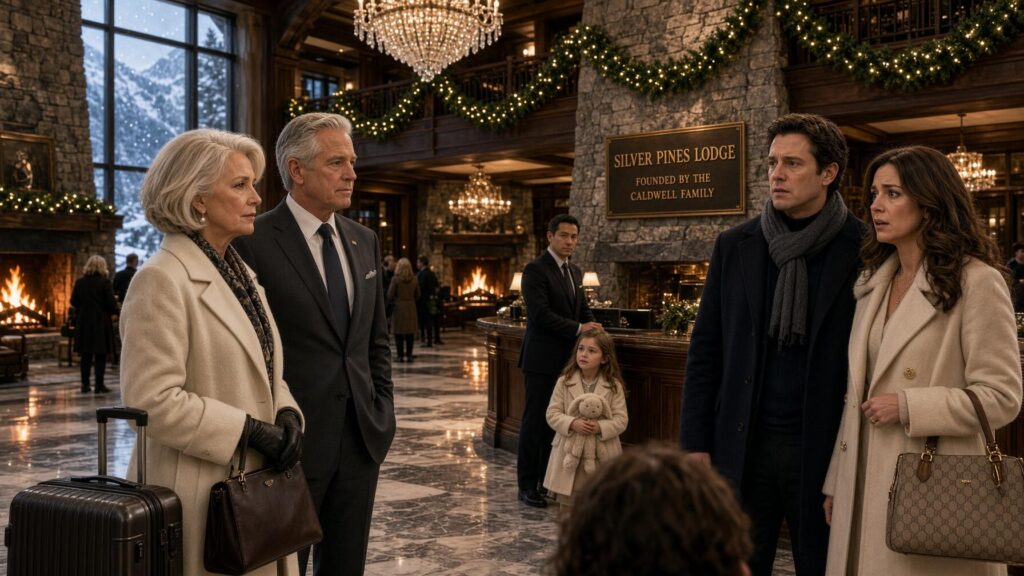
Her expression shifted.
“But?”
“No but.”
She looked suspicious.
“Why?”
“Because Lily is seven.”
Madison blinked.
“She came here expecting Christmas with her family.”
I looked at Daniel.
“I will not punish her because the adults around her behaved badly.”
Daniel’s eyes filled.
Madison said nothing.
I added, “After Christmas, we will decide what relationships look like going forward.”
Madison left.
Daniel stayed.
For a long time neither of us spoke.
Then he said, “I failed you.”
I looked at him.
He was crying.
Not dramatically.
Quietly.
I had seen Daniel cry only a handful of times as an adult.
When his father died.
When Lily was born prematurely.
Now.
“I knew it was wrong,” he said.
“That’s what hurts.”
“I know.”
“No.”
I shook my head.
“You keep saying that.”
He looked at me.
“You knew before we left.
You knew in the car.
You knew when we walked inside.
You knew while I was standing there being told there was no reservation.”
He wiped his face.
“I was scared of the fight.”
“With Madison.”
“Yes.”
“So you let me have it instead.”
He closed his eyes.
That was the truth.
Fear does not eliminate conflict.
It often just decides who is forced to absorb it.
Daniel had decided I would.
Because I was safer.
I would forgive.
I always had.
“Your father used to do that sometimes,” I said.
His eyes opened.
“What?”
“Not like this.
But he hated confrontation.”
I smiled sadly.
“He would postpone hard conversations until I finally had to start them.”
“Did you hate him for it?”
“No.”
“Then—”
“But I made him change.”
Daniel stared.
“Love is not permission to remain weak forever.”
The words sat between us.
He nodded slowly.
Then he said, “What do I do?”
I wanted to answer for him.
Mothers do that.
We spend decades solving.
Guiding.
Softening.
But Daniel was forty-one.
So I said, “I don’t know.”
He looked surprised.
“You have to decide what kind of husband you are.”
I paused.
“And what kind of son.”
That evening, Lily came upstairs wearing a paper chef hat covered in frosting.
She ran into my arms.
“Grandma!”
I hugged her.
Madison stood behind her.
Quiet.
Daniel beside Madison.
Different.
No one mentioned the morning meeting.
We had dinner in the main restaurant.
Not the private family dining room.
I wanted Lily to have normal.
She told me about gingerbread houses.
Snowmen.
A little boy who put candy canes on the roof and then ate all of them.
Daniel listened.
Madison barely spoke.
At dessert, Lily looked at me.
“Grandma, were you really a kid here?”
“Yes.”
“Did Grandpa Daniel’s dad come here too?”
She meant Thomas.
“Yes.”
“Did Daddy?”
I looked at Daniel.
“Once.”
Daniel frowned.
“I don’t remember.”
“You were four.”
Lily smiled.
“So this is our family place.”
My throat tightened.
I looked at her.
“Yes.”
Then I added carefully:
“But family places only stay family places when people take care of them.”
She nodded as though I had explained something about watering plants.
Maybe that was enough.
Christmas Eve arrived the next day.
Snow covered the pines.
Guests gathered near the fireplaces for carols.
Lily wore a red dress.
Madison wore green velvet.
Daniel stood beside her.
I came downstairs wearing one of my mother’s old silver brooches.
As I reached the bottom step, Marcus approached.
He held an envelope.
I frowned.
“Not more trust papers.”
He smiled.
“No.”
“What?”
“A maintenance record.”
I raised an eyebrow.
“Marcus.”
“You may want to see it.”
I opened the envelope.
Inside was a copy of an old renovation request.
Eleven years earlier.
Thomas Caldwell.
My husband.
One handwritten note sat at the bottom.
Keep Elaine’s room exactly as it is.
She’ll come back when she’s ready.
My vision blurred.
I looked at Marcus.
“He wrote this?”
“Two months before he died.”
I pressed my fingers against the page.
For eleven years, I thought I had stayed away because returning would hurt too much.
Thomas had known that.
And somehow, he had also known I would come back.
Behind me, Lily called:
“Grandma!
Come see the tree!”
I folded the paper carefully.
Then I walked toward my family.
Not because everything was repaired.
It wasn’t.
But for the first time, I understood that coming back did not mean returning to the past.
Sometimes it meant deciding what was still worth carrying forward.
Christmas morning began before sunrise.
Lily knocked on my bedroom door at six twelve.
I know because I looked at the clock and briefly considered pretending to be asleep.
Then she whispered through the door:
“Grandma, Santa came.”
No adult with a functioning heart can ignore that sentence.
I opened the door.
She stood in snowflake pajamas holding the same stuffed rabbit.
“Come on.”
I followed her downstairs.
Daniel and Madison were already in the sitting room.
Coffee on the table.
Fire burning.
Presents beneath the tree.
For a few hours, we did something difficult.
We acted like a family without pretending nothing had happened.
There is a difference.
Lily opened a beginner’s ski set.
A telescope.
Books.
A bracelet from me.
When she hugged me, I felt Madison watching.
Not angrily.
Something else.
Maybe guilt.
Maybe fear.
Maybe simply uncertainty now that the world had stopped arranging itself the way she expected.
Daniel gave me a small box.
Inside was an ornament.
Silver.
A miniature version of the Silver Pines plaque.
FOUNDED BY THE CALDWELL FAMILY.
I looked at him.
“I ordered it before the trip,” he said.
That surprised me.
“Why?”
He swallowed.
“I knew the lodge mattered somehow.
I just didn’t know how much.”
I ran my finger over the tiny letters.
“Thank you.”
He nodded.
After breakfast, Madison asked if we could speak privately.
We went into my mother’s old sitting room.
She stood near the windows.
For once, she did not seem interested in looking composed.
“I was cruel to you.”
I waited.
“I thought you were judging me.”
“I often disagreed with you.”
“That felt like judgment.”
“Those are not the same.”
“I know that now.”
I said nothing.
She continued.
“When Daniel told me there was some family trust, I started thinking about it.”
“I know.”
“I didn’t know what it was.”
“But you hoped.”
Her face tightened.
“Yes.”
At least she was honest.
“I grew up without money,” she said.
I knew that.
Madison’s father had left when she was young.
Her mother worked two jobs.
She had spent adulthood building an image of stability so perfect that any reminder of where she came from seemed to threaten her.
I had understood that for years.
Understanding did not excuse cruelty.
“I hated feeling poor,” she continued.
“I hated being the girl who couldn’t go on school trips.
The girl who wore the wrong shoes.
The girl whose mother counted grocery money.”
She looked away.
“When I married Daniel, I thought I was finally past all of that.”
“And my existence threatened that how?”
She laughed bitterly.
“Because you never seemed impressed.”
I blinked.
“By what?”
“Anything.”
The house.
Cars.
Vacations.
Clothes.
Restaurants.