I realized she was right.
Not because I disliked them.
Because I had grown up around real wealth.
Madison’s performance of wealth had never affected me.
She mistook that indifference for disdain.
“You made me feel like none of it mattered.”
“It didn’t matter to me.”
“Exactly.”
I considered that.
Then I said, “Madison, the problem was never that you liked expensive things.”
She looked at me.
“The problem is that you started using money to decide who deserves dignity.”
Her eyes filled.
I continued.
“You thought I had less than you, so humiliating me became easy.”
She did not deny it.
“And the second you discovered I had more, your entire tone changed.”
Her face crumpled slightly.
That was harder for her to hear than anything else.
Because it was undeniable.
“I’m ashamed of that.”
“You should be.”
She nodded.
No protest.
No accusation.
That mattered.
Then she said, “I’m sorry.”
I waited.
“For deliberately not booking your room.”
I felt the words land.
“For hoping you would feel embarrassed enough not to come on future trips.”
Another truth.
“For what I said in the lobby.”
Her voice shook.
“And for using Daniel’s fear of conflict because I knew he usually gave in to me.”
That one surprised me.
She looked toward the door.
“I knew he wouldn’t confront me.”
“Until now?”
“I don’t know.”
Neither did I.
That was between them.
I did not forgive Madison in one cinematic moment.
Real forgiveness does not work like that.
I simply said, “Thank you for telling the truth.”
She nodded.
“Are we okay?”
“No.”
Her face fell.
I added:
“But we might be someday.”
That was the most honest thing I could offer.
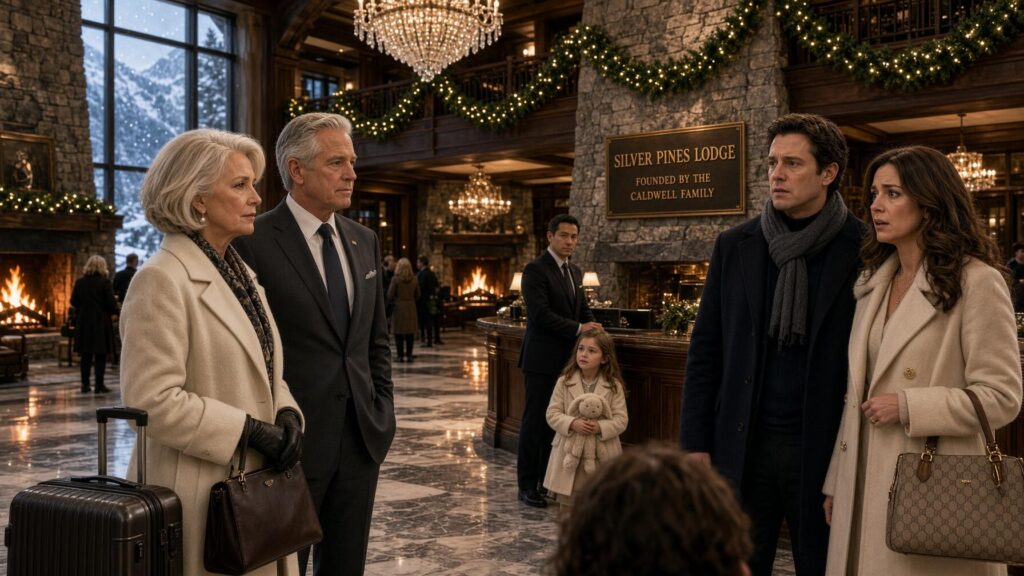
Later that afternoon, Daniel found me near the bronze plaque in the lobby.
Guests moved around us.
Christmas music played.
No one knew that three days earlier this exact spot had nearly split our family open.
Daniel stood beside me.
“I spoke to Madison.”
“I assumed.”
“We’re going to counseling.”
I looked at him.
“She agreed?”
“Yes.”
“Good.”
He swallowed.
“And I called my financial adviser.”
I waited.
“I told him to stop making inquiries about your trust.”
Something in me softened.
“Thank you.”
He looked at the plaque.
“I really didn’t know.”
“I believe you.”
“I should have asked.”
“Yes.”
“I thought asking would make me look greedy.”
I smiled sadly.
“So instead you asked everyone except me.”
He almost laughed.
“When you say it like that…”
“There’s no good way to say it.”
He nodded.
Then he looked at me.
“What do you want to happen to this place?”
There it was.
The question he should have asked months earlier.
Not What do I get?
What do you want?
I turned toward the lobby.
Silver Pines had changed enormously since my father opened it.
But pieces of him remained everywhere.
The stone around the fireplace.
The old oak beams.
The plaque.
My mother’s desk upstairs.
Thomas’s note.
I thought about Lily running through the halls as if she had always belonged here.
“I want it protected.”
Daniel listened.
“I want it profitable enough to support the people who work here.”
He nodded.
“I want family members to remember that owning something is not the same as deserving it.”
He looked embarrassed.
“Fair.”
“And I want Lily to grow up knowing where she comes from without believing where she comes from makes her better than anyone.”
That one mattered most.
Daniel stared at the plaque.
Then he said, “Can I learn?”
I looked at him.
“About the lodge.”
“For inheritance?”
His face tightened.
“No.”
I waited.
He met my eyes.
“Because it matters to you.”
I believed him.
Not completely.
Trust does not regrow in a sentence.
But enough.
“Yes.”
I nodded toward Marcus.
“Start by asking him how many people work here.”
Daniel frowned.
“I don’t know.”
“I know.”
“That’s the point, isn’t it?”
“Yes.”
He smiled.
Over the next year, Daniel visited Silver Pines four times.
Not as an owner.
Not as an heir.
As a student.
He spent time with housekeeping.
Maintenance.
Food service.
Accounting.
Guest relations.
Marcus made sure of that.
The first week, Daniel complained that Marcus had him touring laundry operations at six in the morning.
I told him my father would have started at five.
He stopped complaining.
Madison came twice.
The first time, she mostly stayed with Lily.
The second time, she asked if she could join one of the employee meetings.
Small things.
No miracle.
No transformation montage.
Just different choices repeated often enough to become new habits.
I did not change the trust to reward them.
I did not threaten to disinherit anyone.
That was never the point.
Money had already caused enough damage.
I changed one thing instead.
I added a family education requirement.
Any beneficiary who wanted involvement in Silver Pines would need to understand the business from the ground up.
Not just profits.
People.
History.
Responsibility.
When Marcus read the amendment, he smiled.
“Your father would approve.”
“I know.”
Two Christmases later, we returned.
All of us.
This time, Madison booked every room herself.
Mine included.
When I arrived at the front desk, the concierge smiled.
“Welcome back, Mrs.
Caldwell.”
I gave him my name anyway.
He checked the computer.
“Of course.
We have your reservation.”
Madison stood nearby.
Our eyes met.
For one second, we both remembered.
Then she said:
“I checked it three times.”
I laughed.
Actually laughed.
“So did I.”
Daniel groaned.
“You two are never letting that go.”
“No,” Madison said.
“Probably not.”
That surprised me.
Not the words.
The humility.
Lily, now nine, pulled me toward the bronze plaque.
“Grandma, look.”
“I’ve seen it.”
“I know.”
She pointed to the five words.
“Dad told me Grandpa Samuel built this.”
“Yes.”
“And someday I might help take care of it.”
Might.
Help.
Take care of it.
Not mine.
Not inherit.
Not sell.
I looked at Daniel.
He heard it too.
He smiled.
“Your granddaughter listens better than I did.”
“That is a low bar.”
Madison laughed.
Daniel shook his head.
We walked toward the elevators.
Before stepping inside, I looked once more at the lobby.
The place where Madison had expected to humiliate me.
For a long time, I thought that moment was about hidden wealth.
It wasn’t.
The lodge mattered.
The trust mattered.
The plaque mattered.
But none of them were the real reversal.
The real reversal happened when I understood that knowing my value and proving my value were not the same thing.
Madison thought a woman without a reservation had no power.
Daniel thought silence would protect him from choosing sides.
I thought hiding the family legacy would protect my son from entitlement.
We were all wrong in different ways.
That Christmas forced the truth into the open.
Money did not make me worthy of a room.
My name on a trust did not make me deserving of respect.
Silver Pines did not transform me from the woman Madison could humiliate into the woman she needed to impress.
I was the same person before Marcus stepped out of that elevator.
The same mother.
The same grandmother.
The same widow.
The same Elaine Caldwell.
That was the part I eventually made sure Lily understood.
One evening during that second Christmas, she and I stood beside the bronze plaque while snow fell beyond the windows.
She traced the letters with one finger.
“Does this mean our family owns the hotel?”
I looked at her.
“It means our family is responsible for it.”
She thought about that.
“What’s the difference?”
I smiled.
“Ownership tells you what you can take from something.”
“And responsible?”
“Responsibility tells you what you owe it.”
She nodded slowly.
Then she took my hand.
“Can we get hot chocolate?”
“Yes.”
“With extra marshmallows?”
“Absolutely.”
We walked toward the fireplace.
Behind us, the plaque remained on the wall.
FOUNDED BY THE CALDWELL FAMILY.
Five words Madison had walked past without reading.
Five words Daniel had never understood.
Five words that once represented inheritance to me.
Now they meant something else.
A family name does not guarantee character.
Money does not create dignity.
Property does not create belonging.
Those things have to be earned in smaller moments.
A son speaking when silence would be easier.
A wife admitting cruelty instead of disguising it as misunderstanding.
A grandmother refusing to punish a child for her parents’ mistakes.
A family learning that love and boundaries can exist in the same room.
Three days before that Christmas, Madison had brought me to Aspen expecting me to discover I had nowhere to stay.
She was right about one thing.
I did discover something.
I discovered exactly where I stood.
And after eleven years away, I finally came home.
THE END