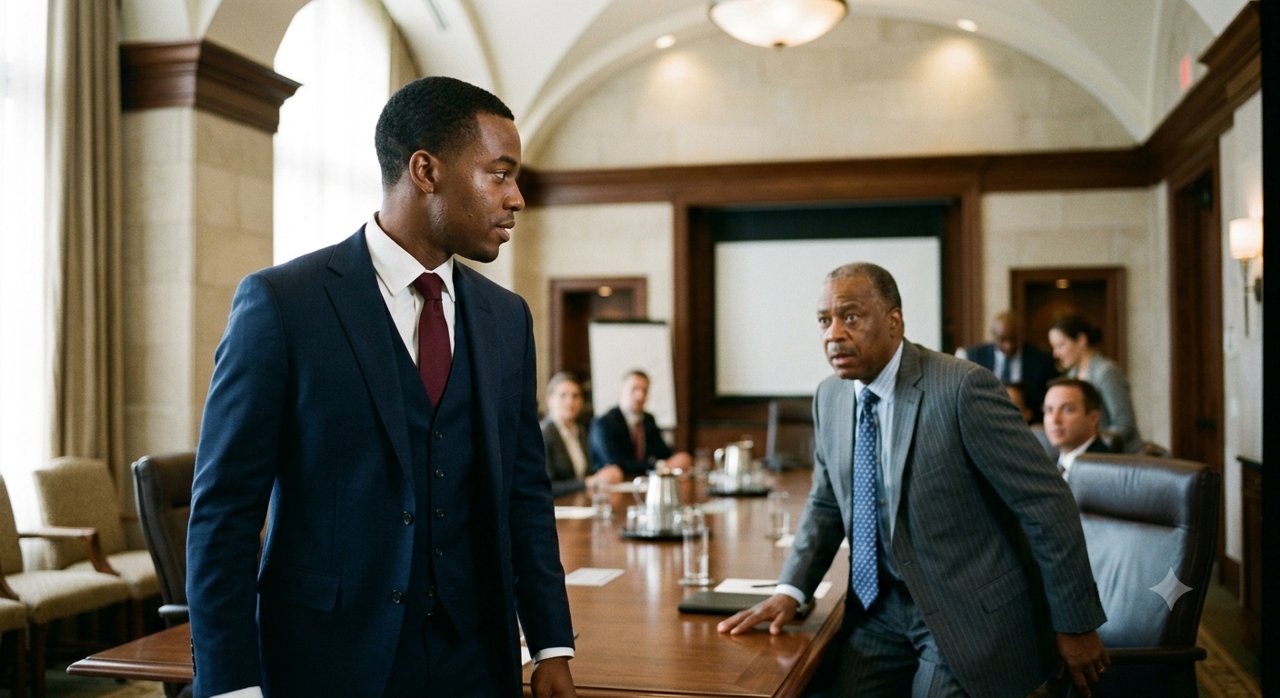
The lobby outside the auditorium was all hard floors and fluorescent light.
Diane was standing near the far window with a paper cup of coffee she hadn't touched.
When she saw me come through the door, she set the cup on the windowsill and straightened up.
"Carol," she said.
"Diane."
We hadn't spoken in four years.
She looked older.
So did I, probably.
"You should sit down," she said.
"I'd rather stand."
She nodded.
"Fair enough." She folded her hands in front of her.
"I need to tell you something I should have told you a long time ago.
What happened at Kellerton — the restructuring, the elimination of your position — it wasn't real."
I kept my face still.
"What do you mean it wasn't real."
"I mean your role was not on the restructuring list.
Not originally." She looked at the window, then back at me.
"I received a call three days before I brought you in.
From an outside number.
A woman who said she was calling on behalf of one of our major account contacts.
She told me that if your employment continued, the account would pull their contract."
The lobby felt very quiet.
"She gave her name as a personal assistant," Diane continued.
"But I traced the number afterward.
It came back to a private cell registered to a Chloe Hargrove."
"That's her maiden name," I said.
"I know that now."
I looked at her.
"You knew at the time that something was wrong."
Diane didn't look away.
"I suspected.
I told myself it was a legitimate business concern.
I told myself I was protecting the company." She paused.
"I was protecting my own position.
And I have carried that ever since."
A door opened at the far end of the lobby.
Two other graduates spilled through with their families, laughing, taking photographs.
The noise washed over us and receded.
"Why are you here today?" I asked.
"Michael called me," Diane said.
"Two weeks ago.
He found my name in some of your old employment paperwork you had kept in a file box.
He asked me directly what had happened.
I told him everything." She reached into her bag and pulled out a folded document.
"I also put it in writing.
Notarized.
Dated.
Everything I just told you, and more."
I looked at the document but didn't take it yet.
"Chloe cost me four years," I said.
"I lost my apartment.
Michael and I moved into a two-bedroom with my sister.
I took night shifts at a pharmacy while I rebuilt.
Four years."
"I know."
"You could have told me."
"Yes," Diane said.
"I could have." She held the document out.
"I can't give you those years back.
But I can make sure she doesn't walk away from this without a record of what she did."
I took the document.
The paper was heavier than I expected.
Or maybe my hands were just tired.
Behind me, the auditorium doors opened again.
I heard David's voice first, sharp and low, the way he used to get when he was trying to control something that was already out of his hands.
"You need to explain this to me right now," he said.
Chloe's heels clicked fast on the hard floor.
"Not here, David—"
"Then where?
Because our son just stood up in front of four hundred people and—"
"He is not our son," Chloe snapped.
"He is your son.
And he has clearly been poisoned against me by—"
She stopped.
She had seen me.
She had seen the document in my hand.
Her eyes went to Diane.
Then back to me.
Something moved across her face that wasn't quite fear and wasn't quite anger.
It was the look of someone calculating how much damage had already been done.
"Carol," she said.
Her voice had changed.
Softer now.
Careful.
"Whatever she told you, you need to understand there are two sides to—"
"Chloe." I kept my voice level.
"I have a notarized statement.
I have Michael's screenshots.
And I have four years of employment records showing exactly what I lost." I folded the document and held it at my side.
"I think we're past two sides."
David looked at the document.
Then at his wife.
"What is that?" he said quietly.
Chloe said nothing.
"What is that, Chloe?"
The lobby had gone still around us.
Even the families with their cameras had slowed.
Chloe turned toward the exit.
"I need some air," she said.
She pushed through the glass door and walked out into the afternoon without looking back.
David stood in the middle of the lobby holding his graduation program.
He looked at me.
He looked at Diane.
He looked at the door Chloe had just walked through.
"How long?" he said.
His voice was very quiet now.
"How long has she been doing things like this?"
I didn't answer.
That wasn't my question to carry anymore.
But Diane looked at him steadily and said, "That's something you're going to need to ask her yourself.
And I'd suggest you ask it soon, before she has time to prepare an answer."
David's program bent in his grip.
He walked toward the exit.
And somewhere behind us, the auditorium doors opened one more time, and Michael stepped into the lobby still wearing his graduation gown, the empty envelope in his hand, looking for me.