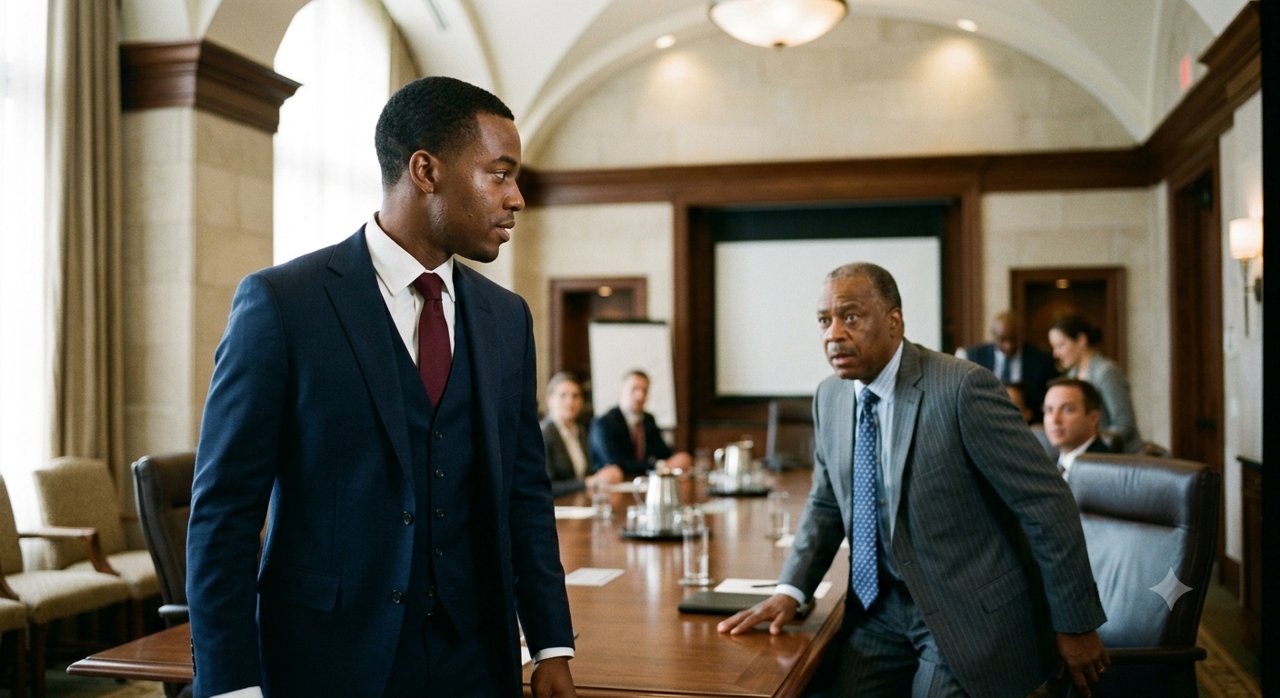
Michael spotted me across the lobby and crossed it in about ten strides.
He was still holding the envelope.
Up close, I could see that his hands weren't entirely steady either.
"Mom." He put both arms around me and held on.
I let him.
I pressed my face against his shoulder and let myself breathe for the first time since I had walked into that auditorium.
"I'm sorry I didn't warn you," he said into my hair.
"I was afraid if I told you beforehand, you'd ask me not to do it."
"You were right," I said.
"I would have."
He pulled back and looked at me.
"Are you angry?"
"No." I meant it completely.
He noticed Diane then, standing a few feet away.
He nodded at her once.
"Thank you for coming."
"Thank you for calling me," she said.
"I should have been called four years ago.
I'm sorry it took your phone call to make me do the right thing."
Michael looked at the document in my hand.
"Is that the statement?"
"Yes."
"Good." He reached into the envelope and pulled out a second folded set of papers.
"Then you should have these too."
I opened them.
They were printed screenshots.
Twelve pages.
Chloe's email address in the header of every one.
The earliest was dated six weeks before I lost my job.
The most recent was dated eight months ago.
I read the first one.
Then the second.
"Michael," I said slowly.
"This one is recent."
"I know."
"She contacted Kellerton again eight months ago.
She was trying to make sure you didn't get the Harmon scholarship."
"She didn't succeed," he said.
"I got it anyway.
But yes.
She tried."
I looked up at him.
"You've known about all of this for three weeks and you carried it alone?"
"I needed time to think about what to do with it." He took the pages back gently and slid them into the envelope.
"I didn't want to just show up at the house and throw it at Dad.
I didn't want to send you a text.
I wanted to do it somewhere she couldn't control the room." He looked around the lobby.
"She controlled every room.
Every holiday dinner, every phone call, every time you and Dad tried to talk about anything involving me.
She always found a way to be in the middle of it."
"I know," I said.
"You never said anything."
"You were a child.
And then you were a teenager.
And then you were someone I was trying not to burden." I folded the envelope carefully and held it.
"I made a choice every single day not to put that weight on you."
Michael was quiet for a moment.
"She told Dad you were unstable," he said.
"After the divorce.
She told him you had problems.
That your memory wasn't reliable.
That anything you said about the marriage couldn't be trusted." He said it plainly, without drama, the way you say something you have rehearsed enough times that the pain has been worn smooth.
"He believed her.
For a long time, he believed her."
I didn't say anything.
There was nothing useful to say.
"He's outside with her right now," Michael said.
"I know."
"I don't know what he's going to do."
"That's not something either of us can decide for him," I said.
Michael looked at the exit door.
Through the glass, we could see David and Chloe standing on the steps.
David had his back to us.
Chloe was talking.
Her hands were moving.
She was explaining something, building something, and even from this distance I could see the shape of it — the careful reconstruction she was already attempting.
"She's going to talk her way out of it," Michael said.
"Maybe," I said.
"But she can't talk her way out of a notarized statement and twelve pages of printed emails."
Diane, who had been quiet, spoke up.
"There's something else you should both know." She reached into her bag again and produced a business card.
"I spoke with an employment attorney last week.
Before today.
I wanted to understand what exposure existed." She held the card out to me.
"What Chloe did — the deliberate interference with your employment through false representation to a business contact — has a name.
It's tortious interference.
And given that she attempted it a second time with the scholarship, there may be a pattern that a court would find very interesting."
I looked at the card.
"You're telling me I could sue her," I said.
"I'm telling you that you have grounds worth discussing with someone qualified," Diane said.
"What you do with that is entirely your decision."
Michael looked at the card in my hand.
He didn't say anything.
But something in his face settled — a tension releasing, a held breath finally let go.
Outside, Chloe had stopped talking.
David had turned around.
He was looking through the glass at us.
At me.
At Michael.
At the envelope.
He pushed the door open and came back inside alone.