Part I — The House That Never Changed
The first thing I noticed was that Frank’s service pistol was warm.
Not hot. Not enough to burn.
Just warm from being carried against his body all evening before he pressed the muzzle against the back of my head and forced my cheek into my mother’s marble dining-room floor.
That detail stayed with me because everything else happened quickly.
His knee drove between my shoulder blades. One handcuff was already locked around my right wrist. The second hung open from his hand, clicking softly whenever he moved.
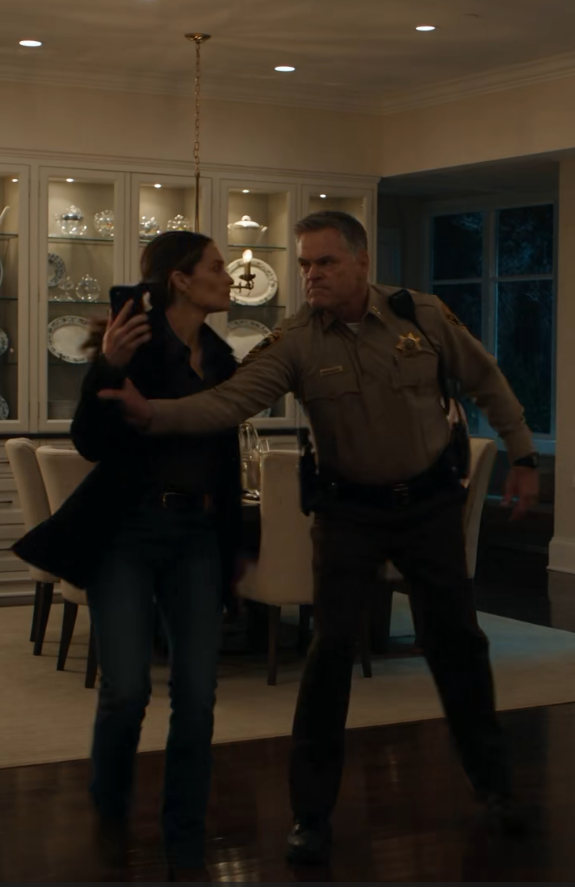
“Drop the phone,” Sergeant Frank Danner said.
I kept my left hand open against the floor where he could see it.
“Frank, you are interfering with a classified federal communication. Take your hand off me.”
He laughed.
The pistol pressed harder against my skull.
“Classified.”
He repeated the word as if I had announced that I was queen of England.
“You seriously expect me to believe the Pentagon calls you?”
My mother stood beside the dining table in a pale silk robe, one hand resting on the back of a chair.
She was watching me.
Not Frank.
Me.
Her expression was almost peaceful.
That disturbed me more than the gun.
“Stop pretending, Maya,” she said. “You’ve humiliated this family enough.”
For a moment, I stopped hearing Frank breathe behind me.
I heard only her voice.
I was fifty-one years old. I had spent most of my adult life in rooms where decisions could move aircraft, ships, intelligence assets, medical teams, and thousands of soldiers before dawn.
I had learned how to brief secretaries, senators, combatant commanders, and exhausted young officers whose hands still trembled after their first bad night overseas.
I had learned how to tell a president that the available options were all terrible.
I had learned how to stand beside flag-draped coffins without letting the families carry my grief along with their own.
None of that prepared me for my mother sounding exactly as she had when I was sixteen.
You’ve humiliated this family enough.
Some sentences grow old with you.
Frank tightened his grip.
“Other wrist.”
I did not move.
“Maya.”
His voice sharpened.
“You’re under arrest.”
“For what?”
“Impersonating a military officer. Threatening law enforcement. Obstruction. Interfering with police authority. I can keep going.”
“You should stop while the list is still recoverable.”
He dug his knee deeper into my back.
My mother inhaled.
Frank said, “You think that rank garbage works on me?”
The encrypted black phone lay six inches from my face.
A small green indicator remained illuminated.
The line was still open.
I could hear faint room noise from the National Military Command Center.
Someone there had heard everything.
That changed the situation.
Not emotionally.
Operationally.
I lowered my voice.
“Frank, listen carefully. Put the weapon down. Release me. Step away from the phone.”
He bent closer.
“I’m the police here.”
And there it was.
Not a police officer.
The police.
Inside this house, those had always been the same thing.
My mother had called me at 5:12 that morning.
I had been halfway through coffee in government quarters outside Washington, reviewing a briefing packet my aide had delivered the previous night.
My phone had displayed her name.
We did not speak often.
Not because of one dramatic falling-out.
Those are easier.
You know where the wound is.
Ours had been years of small cuts.
Birthdays reduced to obligatory messages. Christmas calls that lasted eight minutes. Questions about my work followed by immediate disinterest. Invitations issued late enough that I could rarely attend.
Frank had been in my life since I was fourteen.
He had joined the Brookfield Police Department young, spent his career there, and eventually built his identity around the idea that the badge made him the final authority in every room.
When I received an ROTC scholarship, he called it charity.
When I earned an appointment and graduated from West Point, he said the standards must have dropped.
When I made captain, he asked whether they still let “desk people” wear uniforms.
Major became “office manager.”
Colonel became “paper pusher.”
Brigadier general became a joke he told his friends.
Major general became a subject we were apparently no longer allowed to discuss.
By the time I pinned on my third star, Frank had settled on a story he preferred.
I handled administrative planning for the Army.
That was what he told the neighbors.
That was what my mother allowed him to tell them.
The lie gave Frank somewhere to stand.
So I let him stand there.
Distance was cheaper than endless correction.
Then my mother called at 5:12 and said, “Maya, I need you.”
Her voice was shaking.
I put the briefing packet down.
“What happened?”
“I don’t want to make this bigger than it is.”
That phrase always means the opposite.
“Mom.”
Silence.
Then: “Frank’s been drinking.”
I stood.
“How much?”
“I don’t know.”
“Is he there now?”
“He went out.”
“Did he hurt you?”
Another silence.
That one changed everything.
“Mom. Did he hurt you?”
“No.”
Too fast.
“Did he threaten you?”
“I shouldn’t have called.”
“Did he threaten you?”
“I’m just scared.”
I was already moving.
“Lock the doors. Do not tell him you called me. If he returns before I get there, call 911 and leave if you can do it safely.”
“Maya, don’t send anyone.”
“I’m coming.”
“No soldiers.”
That should have registered more strongly.
At the time, I heard embarrassment.
Later, I would hear planning.
I canceled two morning briefings, redirected my aide to Washington, and arranged transportation home with as little attention as possible.
No uniform.
No stars.
No visible protective detail.
My security team objected.
I overruled them.
That decision would bother me later.
Not because it was reckless in the dramatic sense.
Because it was personal.
Senior officers spend years teaching younger leaders that emotion does not excuse abandoning procedure.
Then one phone call from your mother turns you back into a daughter.
I arrived shortly after noon.
Frank’s truck was in the driveway.
My mother opened the door smiling.
That was the first real warning.
“You look tired,” she said.
I stepped inside.
“Where is he?”
“In the den.”
“Are you hurt?”
“No.”
“Did he threaten you?”
She glanced toward the hallway.
“Can we not start like this?”
I stared at her.
“You called me crying.”
“I was upset.”
“You said you were afraid.”
“I was.”
“Of Frank?”
She looked away.
Frank appeared at the far end of the hall wearing jeans and a department T-shirt.
He did not look drunk.
His posture was steady. Eyes clear.
“General MacArthur finally made it,” he said.
My mother smiled nervously.
I understood then that the call had not been what she claimed.
But I did not yet understand why.
Frank walked past us.
“Since you flew all this way, might as well have dinner.”
“I’m leaving.”
My mother caught my sleeve.
“Maya, please.”
Her fingers were cold.
That stopped me.
Not because I trusted her explanation.
Because somewhere beneath everything that had happened between us, she was still my mother, and I was still capable of hoping.