So I stayed.
That was how, seven hours later, I ended up face-down on her dining-room floor with Frank’s gun against my head.
Dinner had begun almost normally.
Frank talked about crime statistics, city politics, and a younger patrol officer he considered soft.
My mother asked whether I was seeing anyone.
I told her no.
Frank cut into his steak.
“Hard to keep a relationship when you’re always off pretending to run the world.”
I drank water.
My mother said, “Frank.”
“What?”
He looked at me.
“Just conversation.”
I had survived rooms with men actively trying to provoke strategic mistakes.
Frank was easier.
Or I thought he was.
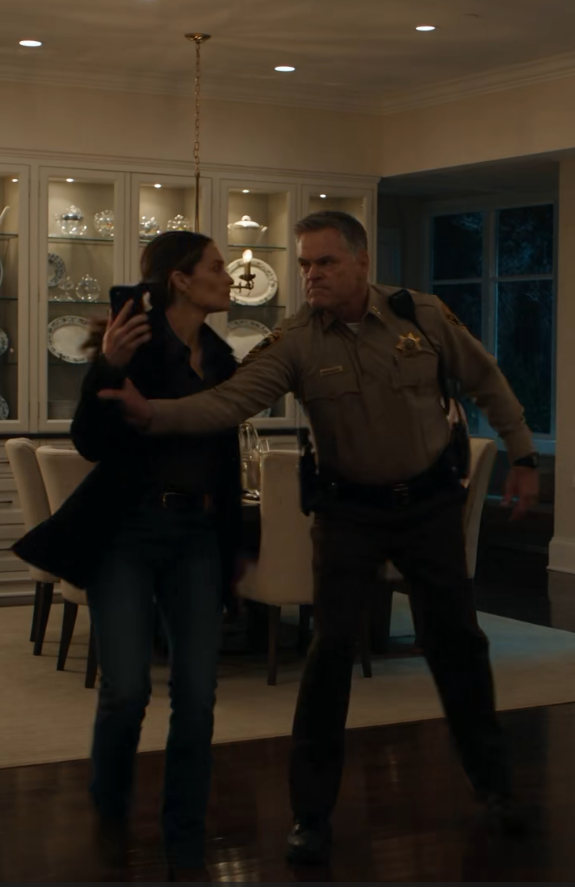
At 8:41, the black phone vibrated inside my coat.
I immediately knew it mattered.
Very few people could reach that device directly, and nobody used it casually.
I took it out.
Frank looked at the phone.
“What’s that?”
“Excuse me.”
I stepped away from the table and moved toward the window.
I authenticated quietly.
“Pierce.”
The voice from the National Military Command Center came without introduction.
“General Pierce, we need your authorization on the revised deployment order.”
I turned slightly from the table.
“Read the amendment.”
The officer began.
The change itself was narrow but time-sensitive, connected to force movements already underway. I listened, asked two questions, and requested confirmation that the legal review had been completed.
Then Frank’s chair scraped behind me.
“Who’re you talking to?”
I raised one finger without turning.
The universal sign for wait.
Frank had never responded well to being asked to wait.
He came closer.
I continued the call.
“Confirm the second phase remains conditional.”
“Confirmed, General.”
Frank stopped beside me.
I could feel him looking at the phone.
Then the voice said, “We need your authorization, ma’am.”
That was the moment Frank’s face changed.
Not confusion.
Recognition.
Immediate, furious recognition.
He had heard enough words over the years to know what military communications sounded like.
Maybe he had always known more than he admitted.
That possibility landed heavily.
I said, “Authorization granted under the revised conditions. Record my authentication—”
Frank seized my wrist.
I looked at his hand.
Then at him.
“Let go.”
“Who is that?”
“Do not touch me during an active secure call.”
His grip tightened.
“Still giving orders inside my house?”
The phone almost slipped.
I shifted my footing and kept hold of it.
My mother rose from the table.
“Frank.”
For half a second, I thought she was going to stop him.
Instead, she picked up my black coat from the chair.
She moved it across the room.
Away from me.
That was when the last charitable explanation died.
They had not simply argued before I arrived.
My mother had not panicked and called me impulsively.
She had brought me there.
For something.
Frank twisted my wrist.
“Put the phone down.”
“Release me.”
“Or what?”
I looked him directly in the eye.
“You do not want to find out.”
He pulled his handcuffs.
After that, events moved fast.
He tried to wrench my arm behind me.
I turned enough to protect the shoulder without striking him.
He interpreted restraint as weakness.
People often do.
He locked the first cuff.
My mother said, “Maya, just cooperate.”
I stared at her.
“With what?”
Frank shoved me forward.
I went down deliberately rather than let him throw me badly enough to fracture something.
He planted his knee against me and drew his pistol.
Then he built his case aloud as though rehearsing for a report.
Impersonating an officer.
Threatening law enforcement.
Interfering with police authority.
My mother supplied the witness statement before he asked.
“Maya attacked him first.”
Her voice barely shook.
That hurt.
Not because I needed her protection.
Because lies become easier after repetition.
And my mother sounded practiced.
I stopped arguing.
I watched Frank’s reflection in the glass-front cabinet.
His breathing was too quick.
His pupils were large.
He was afraid.
That mattered.
Angry men are dangerous.
Frightened men with guns are worse.
The black phone remained connected beside me.
A quiet voice came through the speaker.
“General Pierce, are you compromised?”
Frank froze.
I turned my face enough to speak clearly.
“Affirmative. Armed local officer. Private residence. One civilian assisting.”
Frank snatched up the phone.
“Who is this?”
The response was immediate.
“Identify yourself.”
Frank straightened, pistol still in his right hand.
“Sergeant Frank Danner, Brookfield Police Department. This woman is under lawful arrest.”
“Sergeant Danner, place your weapon on the floor and step away from Lieutenant General Maya Pierce.”
My mother’s fingers tightened around the chair.
Frank looked down at me.
The first crack appeared.
Then he kicked the phone under the table and grabbed his radio.
“Dispatch, officer needs assistance. Armed suspect impersonating military command. Send everyone.”
I closed my eyes for one second.
Not fear.
Calculation.
If local units arrived first, they would receive Frank’s version before seeing anything else.
Uniform bias was real. Not corruption. Not stupidity.
Training.
Officers arrive, identify the known officer, secure the unknown person, then sort the situation.
Frank was counting on that.
Sirens sounded in the distance.
He smiled.
“Let’s see who they decide to believe.”
My watch was pinned beneath my left forearm.
I curled two fingers inward and pressed the emergency transmitter hidden along the underside.
One vibration.
Signal transmitted.
Two.
Protective detail acknowledged.
Frank never noticed.
Thirty seconds later, tires tore across the edge of my mother’s lawn.
Headlights flooded the dining room.
Not patrol-car headlights.
High beams.
Large vehicles.
Multiple.
Frank turned toward the windows.
Five black armored SUVs stopped across the front of the property.
Doors opened almost simultaneously.
Men and women in dark protective gear moved toward the house.
A voice thundered from the porch.
“Sergeant Danner, remove your hands from the general before we remove them for you.”
Frank went white.
Then the front door began to open.
And I understood that the most dangerous part had just begun.
Because Frank still had the gun.
Part II — Pressure
The door opened three inches before Frank swung the pistol toward the hallway.
I spoke before anyone outside could see the movement.
“Frank.”
He looked down.
“Don’t.”
My voice was quiet.
That got his attention better than shouting would have.
“You point that weapon at the door and this changes permanently.”
His mouth opened.
I continued.
“The people outside do not know you. They know I activated a distress signal during a classified call. They know an armed man is restraining me. That is all they need to know.”
The pistol trembled.
Barely.
But I saw it.
My mother saw it too.
“Frank,” she whispered.
“Shut up.”
She flinched.
There.
Not large.
Not theatrical.
A small tightening through the shoulders.
Recognition.
I filed it away.
Outside, the voice came again.
“Sergeant Danner. Weapon on the floor. Hands visible.”
Frank backed away from the doorway.
“This is my residence.”
“No, it isn’t,” my mother said.
We both looked at her.
She swallowed.
“The house is mine.”
It was an absurdly small correction.
It mattered anyway.
Frank stared at her.
She lowered her eyes.
He turned back toward me.
“You did this.”
“I pressed a button.”