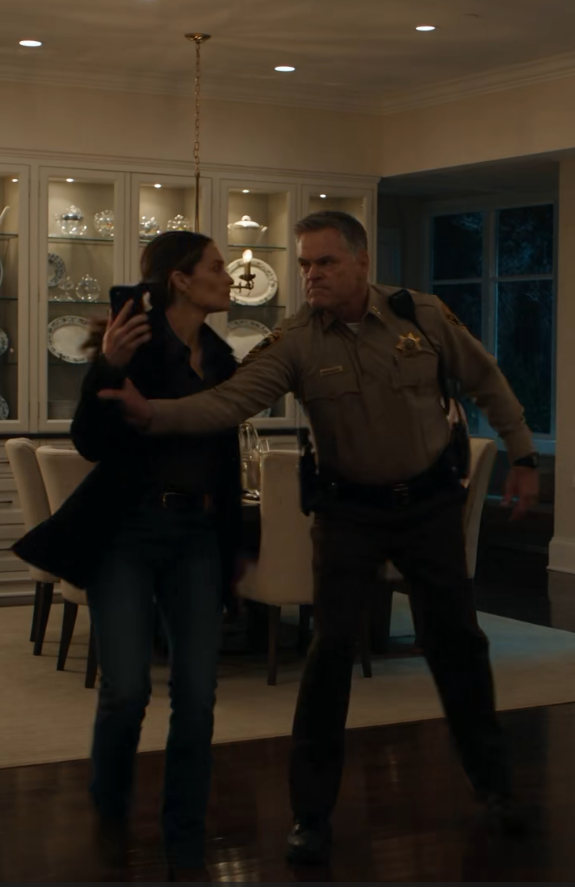
Her eyes lifted.
“I was scared.”
“Of what?”
She looked toward the hall where Frank had been taken.
“Everything.”
“That isn’t an answer.”
“I didn’t know he would do that.”
“You moved my coat.”
Her face tightened.
“I wanted you to stay.”
“You lied about being sick.”
“I said I was scared.”
“You implied he was drunk and threatening you.”
“He had been drinking.”
“He was sober when I arrived.”
“He can drink and still look sober.”
That sounded practiced too.
I leaned back.
“Why did you need me here?”
She glanced at the federal personnel across the room.
“I can’t talk with all these people.”
“They’re here because your husband put a loaded pistol against my head.”
“He would never have fired.”
The sentence hit harder than I expected.
Not because she defended him.
Because it revealed the accommodation required to live with him.
He would never have fired.
As if that was the standard.
I stood.
Her hand shot out.
“Maya.”
I looked at it until she withdrew it.
She said, “Please don’t destroy him.”
“I’m not in charge of what happens to Frank.”
“You know people.”
“So does he. That’s part of the problem.”
Her mouth tightened.
“You could make one call.”
“Yes.”
Hope appeared in her face.
I finished.
“And I won’t.”
The hope disappeared.
“He’ll lose everything.”
“That may happen.”
“Thirty years.”
“That doesn’t make tonight disappear.”
“He’s your family.”
“No.”
It came out more sharply than I intended.
I lowered my voice.
“He’s your husband. He has been my stepfather for thirty-seven years. Those facts do not make me responsible for protecting him from consequences.”
She looked at the floor.
“You always do this.”
“Do what?”
“Talk like everybody is one of your soldiers.”
“No. If you were one of my soldiers, we would have had this conversation twenty years ago.”
She looked up.
That landed.
I regretted the cruelty immediately.
Not the truth.
The delivery.
I sat again.
“Mom.”
Her eyes filled but no tears fell.
I had inherited that from her.
“What did he want?”
She shook her head.
“You’re still protecting him.”
“I’m protecting our life.”
“From what?”
Her laugh was small and bitter.
“You have no idea what it’s like to build everything around somebody and then realize you may have been wrong.”
I thought of commanders I had relieved.
Units I had reorganized.
Friends I had lost because I would not endorse decisions I believed were unsafe.
“I know more about that than you think.”
“No. You leave.”
The words came quietly.
“You’ve always been good at leaving.”
There are accusations that are unfair and still contain truth.
I had left.
For school.
For the Army.
For assignments.
For war.
For command.
For work that always supplied a reason not to return.
Some of that had been ambition.
Some duty.
Some survival.
I said, “That still doesn’t explain tonight.”
She looked past me.
“Frank got a letter.”
“What letter?”
She said nothing.
I waited.
Finally: “From your office.”
“My office doesn’t communicate with Frank.”
“He said it was connected to a background investigation.”
Now I understood less, not more.
“What investigation?”
“He wouldn’t show me.”
“Did it have my name on it?”
She nodded.
“When?”
“Two weeks ago.”
“And after that?”
“He started asking questions.”
“What kind?”
“About your position. Your clearances. Your travel. Whether you had protection when you came home.”
The cold feeling arrived slowly.
This was no longer merely about Frank’s resentment.
“Did you answer?”
Her silence answered for her.
I stood.
Across the room, my security lead saw my expression and approached immediately.
“What is it?”
I looked at my mother.
“When Frank received that letter, did he contact anyone?”
“I don’t know.”
“Did anyone visit?”
She hesitated.
“One man.”
“When?”
“Last week.”
“Who?”
“I never met him.”
“Did Frank?”
“Yes.”
“Where?”
“In the garage.”
“For how long?”
“Maybe an hour.”
I turned to my security lead.
“Secure every device in this house under appropriate authority. Notify counterintelligence.”
My mother stared at me.
“What are you doing?”
“Finding out what tonight actually was.”
From the hallway came Frank’s voice.
Loud.
Angry.
“You have no right to take that!”
I walked toward the sound.
An investigator stood near the dining room holding Frank’s phone in an evidence bag.
Frank saw me.
“You.”
The hatred in his face had changed texture.
Less personal.
More frightened.
I stopped.
“What was in the letter, Frank?”
He said nothing.
“What did someone ask you to do?”
His expression closed.
Behind him, the local lieutenant looked at me.
“What are we talking about?”
I kept my eyes on Frank.
“He didn’t bring me here tonight because he suddenly got tired of hearing about my career.”
Frank said, “Don’t flatter yourself.”
“No?”
I stepped closer.
“Then why was my mother instructed to get me here without security?”
She gasped behind me.
Frank looked past my shoulder toward her.
That was enough.
I had not known she had been instructed.
I had guessed.
He confirmed it with his eyes.
My mother whispered, “Frank?”
I turned.
Her face had emptied.
“You told me it was because you needed to talk to her.”
He looked at her.
“Keep your mouth shut.”
The local lieutenant took one step forward.
Frank ignored him.
My mother stood.
“What did you do?”
Nothing about her tone was theatrical now.
For the first time that day, she sounded afraid.
Frank said, “I was trying to fix this family.”
I looked at the evidence bag.
Then the black phone still sitting beneath the dining table.
The night had just acquired a second problem.
Someone had wanted access to me.
And Frank had delivered it.
Part III — The Reversal
By midnight, my mother’s house had become a controlled scene.
Not a war zone.
Not the spectacle neighbors would later describe.
A crime scene.
The distinction mattered.
Federal counterintelligence personnel arrived quietly. Local officers remained in charge of the potential asNextlt and weapons offenses committed within their jurisdiction. Federal agents dealt with the secure communication, possible targeting of a senior military official, and whatever sat inside Frank’s phone.
Everyone was careful about authority.
Everyone except Frank.
He demanded his attorney.
That was the smartest thing he did all night.
After that, he mostly stopped talking.
I gave a preliminary statement in the den.
I did not embellish.
I did not interpret.
At 8:41 p.m., secure device activated.
At approximately 8:44, physical contact initiated by Sergeant Danner.
Warning issued.
Restraint applied.
Weapon drawn.
Threat communicated through positioning of firearm.
Distress signal transmitted.
Protective detail entered.
Weapon discharged during redirection as Sergeant Danner oriented toward entry team.
Facts.
The investigator across from me finally said, “General, I need to ask this plainly. Did you believe Sergeant Danner would shoot you?”
I looked through the doorway at the indentation one of the chair legs had made in the rug.
“No.”
He waited.
I added, “I believed he could.”
“That distinction matters to you?”
“It matters to anybody around a loaded weapon.”
He wrote that down.
When the formal questions paused, my aide called from Washington.