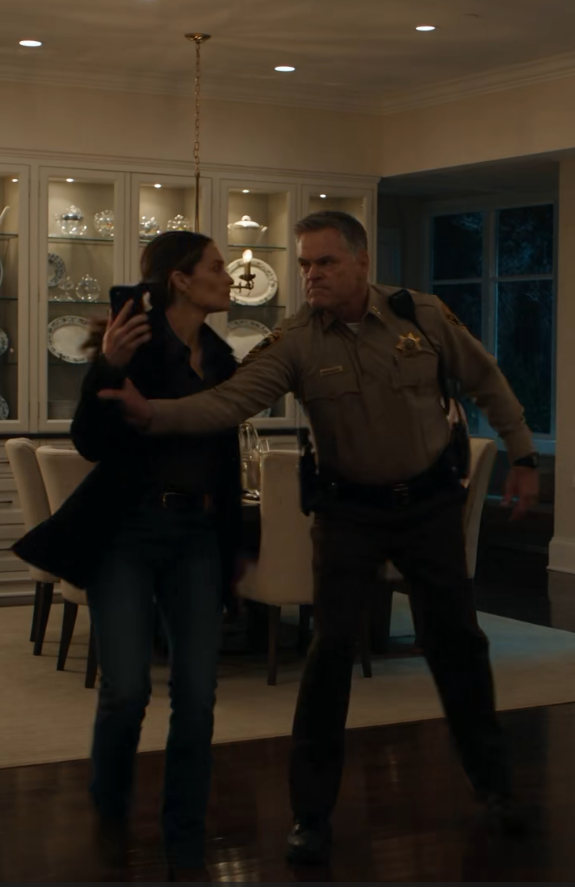
“You brought federal agents to my home.”
“You put a gun against my head.”
“I was making an arrest.”
“No.”
I shifted carefully, testing the pressure of the cuff.
“You were trying to create one.”
His eyes narrowed.
There it was.
I had guessed correctly.
Not the full motive.
But enough.
Frank had wanted an incident.
A record.
Something he could write down.
Something he could use.
“You think you can walk in here and look down on everybody,” he said.
“I came because she told me she was afraid of you.”
His expression flickered.
He looked at my mother.
She said nothing.
I watched them look at each other.
Pieces moved.
The fake illness.
The insistence that I come alone.
The coat moved out of reach.
The accusation prepared instantly.
Frank’s radio crackled.
“Unit twelve, approaching residence.”
Local police.
Frank grabbed it.
“This is Danner. Suspect is detained. Federal individuals forcing entry. Unknown authority.”
The person outside must have heard.
A sharper command followed.
“Do not transmit. Put the weapon down.”
Frank shouted toward the hall.
“Get out of my house!”
One of the protective agents appeared at the edge of the doorway.
Weapon lowered but ready.
“General?”
“I’m intact.”
“Is the officer still armed?”
“Yes.”
Frank snapped, “I have jurisdiction here.”
The agent did not even glance at him.
“General, can you move?”
“Not safely.”
The answer was for everyone.
Frank heard it.
The agent heard it.
More importantly, the local officers arriving outside would hear it on body microphones soon enough.
Frank’s pistol moved toward the agent.
I twisted.
Not violently.
Precisely.
My left shoulder rolled. My hips shifted. Frank’s knee lost its angle for half a second.
I drove backward into his balance and caught his gun wrist with my free hand.
The pistol discharged.
The explosion inside the dining room was enormous.
Glass broke somewhere behind us.
My mother screamed and dropped beside the table.
The protective agent crossed the space immediately.
Frank’s wrist hit the floor.
Two more agents entered.
The gun disappeared under controlled hands.
Frank shouted as they pulled him away from me.
“Get off me! I’m police!”
No one struck him.
No one needed to.
They secured both arms, removed his department radio, and moved him facedown onto the floor three feet from where he had held me.
For the first time all night, Frank and I were at the same level.
His face turned toward mine.
“You attacked an officer.”
I sat up slowly as an agent unlocked the handcuff from my wrist.
A red groove circled the skin.
I rotated my hand once.
“Your body camera on?”
Frank stopped breathing for a beat.
I had noticed the camera clipped to his shirt when he emerged from the hall after my arrival.
Standard department equipment.
A tiny green light had been visible during dinner.
At some point before the confrontation, it had gone dark.
That was not proof of everything.
It was a clue.
One of the local patrol officers entered.
Young.
Maybe late twenties.
His eyes moved across the room.
Frank restrained.
Federal protective personnel.
Me on the floor.
Pistol secured.
My mother crouched by the table.
The shattered glass cabinet behind us.
He did what a good officer should do.
He did not assume.
“Who fired?”
“I did not,” I said.
Frank shouted, “She grabbed my weapon!”
The officer looked at the protective agent.
The agent said, “Sergeant Danner retained the weapon while restraining the protected principal. The general redirected his firing hand when he raised it toward federal personnel.”
Frank tried to sit up.
“Protected principal? She’s my stepdaughter.”
Both could be true.
The local officer’s expression changed slightly.
He looked at me.
“Ma’am, identification?”
“My credentials are in the coat on the sideboard.”
My mother looked at the coat she had moved.
The officer retrieved it.
He found the credential case inside.
Opened it.
Read.
Looked at me.
Then read it again.
He handed it to the federal agent.
“Lieutenant General Maya Pierce,” the agent said. “United States Army.”
No one saluted.
I appreciated that.
The room did not need ceremony.
Frank stared at the credential case.
For years he had survived by pretending my life was exaggerated.
Now reality sat six feet away in another officer’s hand.
He chose anger.
“Anybody can print a card.”
The local officer slowly turned toward him.
“Sergeant.”
Something in the single word told Frank to stop.
He didn’t.
“She came in here making threats. She’s been unstable for years. Ask her mother.”
The local officer looked toward my mother.
She was still beside the table.
For the first time, uncertainty had replaced the calm mask.
He asked, “Ma’am, did you witness the beginning of the altercation?”
My mother looked at Frank.
Then at me.
“Yes.”
“Did General Pierce attack Sergeant Danner?”
A long pause.
Frank said, “Tell him.”
The officer’s head snapped toward him.
“Sergeant, do not answer for the witness.”
My mother rubbed one hand along her opposite arm.
Her eyes stayed on the floor.
“I…”
She stopped.
Frank’s jaw tightened.
“Tell him what happened.”
The officer stepped between them.
“That’s enough.”
Then, very gently to my mother, “Ma’am, you don’t have to decide how to explain everything this second. I need you to tell me whether anyone here is hurt.”
She looked at me.
Something in her face moved.
“No.”
Then she saw the red mark around my wrist.
Her answer changed.
“Maya.”
“I’m fine.”
The words came automatically.
They were not entirely true.
A medical specialist from my detail examined my head and wrist while the house filled with controlled activity.
Local supervisors arrived.
Federal security personnel coordinated with them.
The National Military Command Center documented the interrupted call.
Frank was separated from my mother and advised not to speak.
He continued speaking.
That helped nobody except the investigators.
“This whole thing is political.”
No one responded.
“She set me up.”
A local lieutenant told him, “Frank, stop talking.”
“You know me.”
“I do. Stop talking.”
“She walked into my house with some secret phone, making threats.”
The lieutenant looked exhausted already.
“Stop.”
“I was doing my job.”
“No, you were off duty.”
That was the first statement that silenced him.
Frank blinked.
The lieutenant continued.
“You’re in jeans. You were not dispatched. You initiated enforcement activity inside a private residence involving a family member. Stop talking until representation gets here.”
Frank’s face changed.
Not because he finally understood what had happened.
Because somebody whose authority he respected had refused to validate him.
My mother sat at the far end of the living room with a blanket around her shoulders.
I stood near the window while my wrist was wrapped.
One of my agents approached.
“General, we need to relocate you.”
I looked toward my mother.
“Give me a minute.”
“Ma’am—”
“One minute.”
The agent stepped away.
I crossed the living room.
My mother did not look up.
I sat in the chair opposite her.
For several seconds neither of us spoke.
Finally I said, “Why?”
She pressed her lips together.
“Maya—”
“Why did you call me?”