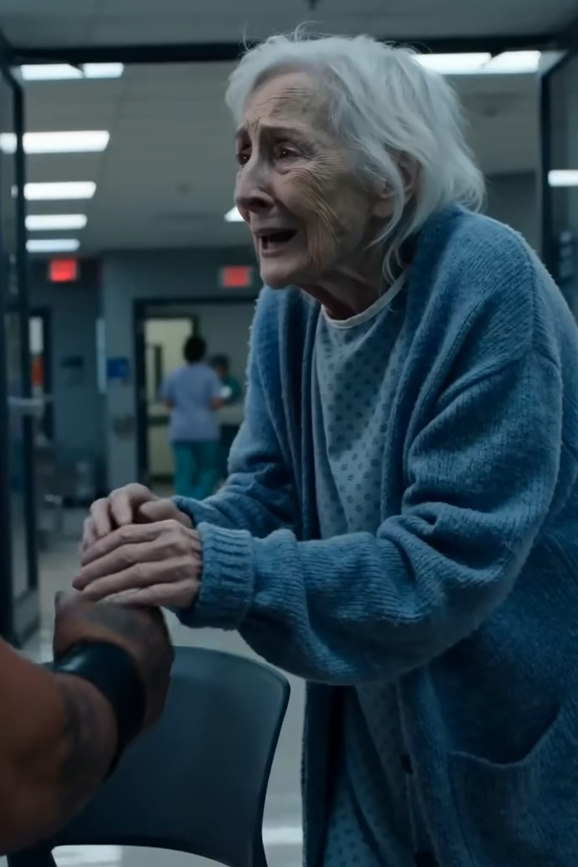
“PLEASE PRETEND YOU’RE MY GRANDSON,” THE OLD LADY WHISPERED – WHAT THE HELL’S ANGEL DID NEXT LEFT EVERYONE SPEECHLESS
A man like Tyler Ramos was not the kind of man strangers touched.
Not at 2:00 in the morning.
Not in a hospital corridor.
Not with blood drying stiff across his denim shirt and a Hell’s Angel patch hanging heavy over his chest.
People saw him and moved away before he ever said a word.
Nurses lowered their eyes.
Security guards pretended not to stare.
Parents pulled children closer.
Men who thought they were brave suddenly remembered somewhere else they needed to be.
Tyler Ramos was six feet four inches of road grime, prison muscle, old scars, steel-toed boots, and silence.
Everyone in three states called him Brick.
It was not a nickname given with affection.
It was a warning.
He looked like something built to break other things.
That night, he sat alone in a plastic chair at St. Jude’s Medical Center, hunched forward with his massive forearms resting on his knees.
The chair groaned under him every time he shifted.
The corridor smelled of rubbing alcohol, floor wax, old coffee, and the kind of fear people tried to swallow quietly because there were no other choices left.
Above him, a fluorescent bulb buzzed like an insect trapped in glass.
It flickered every few seconds, throwing hard white light over his boots, his hands, his beard, and the blood on his shirt.
None of that blood belonged to him.
That was the worst part.
It belonged to Jackson Miller, his road captain, his brother in every way that mattered except blood.
A teenage kid in a rented sedan had drifted across a lane without checking his blind spot.
The Harley had gone down hard.
Jackson had gone harder.
Brick still remembered the sound.
Metal folding.
Bone meeting asphalt.
Rubber screaming.
Jackson trying not to scream.
By the time the ambulance arrived, Brick had been kneeling in the ditch with both hands pressed against his brother’s chest, feeling broken ribs shift under his palms while blood soaked through his fingers.
Now Jackson was somewhere on the fourth floor, under bright surgical lights, his chest opened by strangers wearing masks.
Brick could do nothing.
That was why he hated hospitals.
He hated the helpless waiting.
He hated being ordered to sit.
He hated the clean floors that pretended death was tidy.
He hated the way people in scrubs used calm voices while everything inside a person was falling apart.
Most of all, he hated the way normal people looked at him inside places like this.
On the road, men knew what to do with him.
They either respected the cut or tested it.
In a hospital, people only judged.
They looked at the patches, the tattoos, the knife clipped at his belt, the busted knuckles, the dried blood.
They decided he was trouble before he breathed.
They did not see that he had ridden forty miles behind an ambulance with his heart hammering.
They did not see him holding Jackson’s hand in the trauma bay until a nurse forced him back.
They did not see family.
They saw a monster.
Brick stared at the floor and ground his jaw until his teeth ached.
He reached into his pocket and pulled out a crushed pack of cigarettes.
Then he remembered where he was, cursed under his breath, and shoved them back.
He needed nicotine.
He needed sleep.
He needed a fight.
He was going to get none of them.
Then came the sound.
Soft slippers against linoleum.
Slow.
Uneven.
Almost careful enough to be a ghost.
Brick did not look up.
He assumed it was a security guard sent to move him along.
Or a nurse about to ask if he needed anything in that false midnight voice people used around grief.
He prepared the low snarl that usually ended conversations before they began.
Then a hand touched his forearm.
It was small.
Cold.
Knobby.
So light it felt like a dry leaf landing on leather.
Brick froze.
No one touched him like that.
Not without asking.
Not without consequences.
He raised his head slowly.
The woman standing in front of him barely cleared five feet.
She wore a faded blue wool cardigan over a hospital gown that hung on her like a sheet left over a chair.
Her hair was wispy and white, pinned back with mismatched bobby pins that looked as though they had been found in a drawer from another lifetime.
Her face was carved with wrinkles so fine and deep they seemed to hold shadows.
Purple bruises dotted her forearms where IV tape had been ripped away and placed again.
Her skin looked as thin as old paper.
Her eyes were milky blue, clouded by cataracts, but they were fixed directly on his.
Not on the patch.
Not on the blood.
Not on the rings across his fingers.
Not on the knife.
His eyes.
Brick stared back, confused by her nerve.
She should have been afraid.
Everyone else was.
But this old woman stood in the dead of night under buzzing hospital lights, one hand trembling against the arm of a man who could have frightened half the ward just by standing up.
Her lips moved.
At first, he thought she had lost her way.
Then she whispered five words that did not belong in the same world as him.
“Please pretend you’re my grandson.”
Brick blinked.
The words hung there between them, absurd and fragile.
He looked left down the corridor.
A janitor pushed a mop near the far end, not paying attention.
He looked right toward the nurses station.
Two nurses stood behind the counter, their faces lit blue by a phone screen.
No family.
No doctor.
No one rushing after her.
Just the old woman and her impossible request.
“Lady,” Brick grunted, pulling his arm back, not hard but enough to break her touch, “you got the wrong guy.”
She did not move.
“I ain’t nobody’s grandson,” he said.
His voice came out rough, scraped raw by smoke and exhaustion.
“Not anymore.”
The old woman’s chin lifted a fraction.
“Go back to your room before you fall over,” Brick added.
She swayed slightly.
For one second, he thought she would drop right there.
But she steadied herself with a stubbornness that made his eyes narrow.
“I know exactly who you are,” she said.
Her voice sounded like dry leaves scratching across concrete.
“You’re one of those motorcycle boys.”
Brick let out a bitter breath.
“Yeah,” he said.
“I am.”
“You scare people,” she said.
“I do.”
“So take the hint.”
“I need someone who scares people.”
That stopped him.
Brick leaned forward.
The plastic chair complained beneath him.
“What the hell are you talking about?”
“My name is Margaret,” she said.
Then she pointed a trembling finger toward the heavy double doors that led deeper into the ward.
“They won’t let me leave.”
Brick’s face hardened, though he did not yet understand.
“Who won’t?”
“The doctors.”
Her hand lowered.
“They say I’m not of sound mind.”
She swallowed, and he heard the wet rattle under her breath.