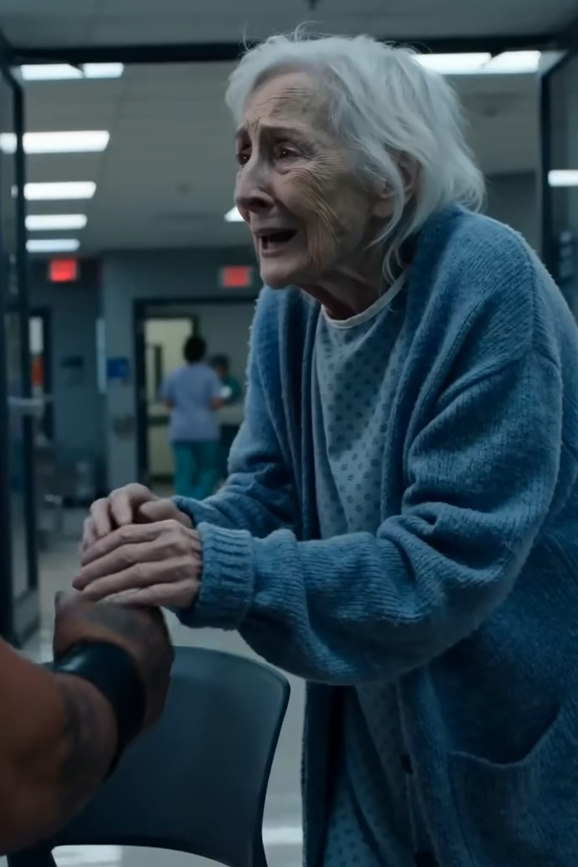
“They say I need an immediate family member to sign the discharge papers if I want to leave against medical advice.”
Brick stared at her.
Then he barked a short, humorless laugh.
“So call your family.”
The old woman looked down for the first time.
Just for a second.
“I have a grandson in Seattle.”
“Good.”
“He changed his phone number two years ago.”
Brick’s expression did not move.
“I have a daughter,” Margaret continued.
“She doesn’t answer her phone.”
There it was.
The invisible wound.
Brick saw it even before her mouth tightened.
Not fear.
Not confusion.
Humiliation.
She was ashamed to admit that the people who should have come had not come.
She was ashamed to ask a stranger for something family should have given for free.
Her chin trembled once.
Then she clenched her jaw shut so hard the tremble disappeared.
Brick knew that look.
Jackson had made the same face in the ditch when his ribs were shattered.
A man trying to keep the world from seeing what pain had done to him.
“I am dying,” Margaret said.
No drama.
No pleading.
No theatre.
Just the plain truth, placed between them like a folded document.
“Congestive heart failure.”
Brick said nothing.
“My lungs are filling with fluid.”
She lifted one bruised hand to her chest, as though something inside it had become too heavy.
“The doctor says maybe two days.”
Her mouth twisted.
“Three, if they force machines down my throat and breathe for me.”
The fluorescent light buzzed.
Somewhere far away, a call monitor beeped.
Brick’s fingers curled slowly around his knees.
“I don’t want the machines,” Margaret said.
“I want to go home.”
Her voice thinned, but it did not break.
“I want to die in my own bed.”
“I want to look at my own ceiling.”
“I want to smell my own dust.”
She turned her clouded eyes back to him.
“But they won’t let me walk out alone.”
Brick looked past her toward the nurses station.
The two nurses were still laughing quietly over the phone.
Maybe they had families waiting at home.
Maybe they had already learned to laugh because the alternative was falling apart every night.
But to Brick, in that moment, they looked like part of the machine.
A bright, clean, paperwork-fed machine that had taken one old woman and turned her into a liability.
A chart.
A bed number.
A bill.
A body to keep breathing until the right box was checked.
He hated that more than he wanted to.
“I’m a felon, Margaret,” he said.
His voice dropped lower.
“I got warrants in two states.”
It was not a confession offered for sympathy.
It was a warning.
“I got a rap sheet longer than your arm, and I look like I eat people for breakfast.”
Margaret did not blink.
“I walk up to that desk,” Brick said, “they’re going to call the cops.”
“You don’t have to show them an ID,” she said.
Brick almost laughed again.
“You just have to stand there.”
Her breath rasped.
“Look angry.”
That time, Brick did laugh.
It was quiet and dark.
“Tell them your name is David,” she said.
“Tell them you’re taking your grandmother home.”
The name landed strangely.
David.
A borrowed name.
A missing name.
A name that belonged to someone who should have been there.
Brick rubbed both hands over his face.
His palms smelled like motor oil, copper, hospital soap, and tobacco.
He looked toward the surgical wing doors.
Jackson would be under for hours.
Brick could sit here and rot in rage, or he could do one useful thing for one dying woman who had looked straight at him when everyone else looked away.
Maybe he agreed because he hated the hospital.
Maybe he agreed because exhaustion had cracked open some locked room inside him.
Maybe he agreed because this frail old lady in a drafty hallway had more courage than the doctors, the nurses, and the missing family combined.
Or maybe it was because, for one second, she had not seen a monster.
She had seen a chance.
Brick stood up.
The chair squealed beneath the sudden absence of his weight.
Margaret took one small step back as his full height rose over her, but she did not retreat.
Brick zipped his leather vest halfway up, hiding the worst of Jackson’s blood.
Then he looked down at her.
“All right,” he said.
“Let’s go find your doctor.”
Margaret’s shoulders sank as if those words had taken ten pounds of fear off her bones.
But she did not thank him.
Not yet.
Maybe she was afraid gratitude would make the whole thing vanish.
The nurse’s station sat at the center of the ward like a fortified island.
Behind the laminate counter were blinking monitors, stacked clipboards, abandoned cups of coffee, rolls of medical tape, and the tired glow of computer screens.
A young resident in green scrubs was hunched over a chart, scribbling fast with the tense aggression of a man who had been awake too long and respected by too few.
He did not look up when Brick approached.
Margaret followed one step behind, her hand gripping the bottom of his leather vest like a child holding a parent’s coat in a crowd.
Brick felt her fingers there.
He did not tell her to let go.
He stopped at the counter.
He did not clear his throat.
He did not say excuse me.
He raised one massive hand and slapped his palm flat against the laminate.
The sound cracked through the ward like a gunshot.
The resident jumped so hard his pen flew from his hand.
One nurse gasped.
The other nurse backed into a rolling chair.
The resident looked up.
His eyes widened.
Brick watched the man’s face process the information in pieces.
The size.
The beard.
The tattoos.
The blood.
The Hell’s Angel patch.
The quiet old woman standing in his shadow.
“Can I help you?” the resident asked.
His voice tried to be professional.
It failed.
“Yeah,” Brick said.
“I’m David.”
He stepped aside just enough for Margaret to be seen.
“I’m here for my grandmother.”
The resident blinked several times.
“Mrs Higgins?”
“That’s what I said.”
“Sir, you’re her grandson?”
Brick leaned forward until the resident could see every scar across his knuckles.
“You got a hearing problem, Doc?”
“No, I just -”
“I said I’m David.”
Brick did not raise his voice.
He did not need to.
“I am taking my grandmother home.”
Margaret stood with both hands clasped in front of her, small and silent in the enormous shadow of him.
The resident glanced at her.
“Mrs Higgins is in active heart failure.”
He looked back at Brick, trying to find the safest path through the conversation.
“If she leaves this facility without medical support, she may not survive the weekend.”
“She knows.”
“We have strict protocols.”
“Your protocols ain’t my problem.”
The resident’s face flushed.
“Sir, this is not about inconvenience.”
“No,” Brick said.
“It’s about her dying where she wants to die.”