“An elderly woman passed away peacefully in her sleep.”
“Sir, can I have your name?”
Brick looked toward the bedroom hallway.
“No.”
“Sir, are you with the deceased now?”
“Yes.”
“What is your relationship to her?”
Brick paused.
The question sat in the kitchen among the magnets, the old calendar, and the faded child’s drawing.
Relationship.
Friend.
Stranger.
Liar.
Grandson.
“She was not alone,” he said.
Then he ended the call.
He went outside and sat on the porch steps.
The rain had slowed to a steady drizzle.
The neighborhood was beginning to wake in small ways.
A porch light clicked off across the street.
A newspaper delivery car rolled by.
Somewhere, a dog barked once.
Brick pulled the crushed pack of cigarettes from his pocket.
This time, nobody could tell him he was not allowed.
He struck a match against the brick pillar and lit one.
Smoke filled his lungs.
For the first time all night, it did not taste like relief.
It tasted like habit.
Twenty minutes later, a police cruiser rolled to a stop in front of the house.
An ambulance followed close behind.
Two officers stepped out.
Both saw him at the same time.
A massive Hell’s Angel sitting on the porch of a dead old woman’s house at dawn.
Their hands moved toward their belts.
Brick did not blame them.
“Hands where we can see them,” the lead officer barked.
Brick took one slow drag of his cigarette.
Then he lifted both hands loosely, the cigarette between two fingers.
“I called it in,” he said.
The officer’s eyes moved over the vest.
The beard.
The boots.
The blood.
“Stand up.”
Brick stood.
Slowly.
The porch seemed too small around him.
“Margaret Higgins,” he said.
“Bedroom is first door on the right.”
“Who are you?”
Brick looked at the officer.
A younger man.
Clean uniform.
Tight face.
One hand hovering near his holster like fear had taught it where to go.
“A friend.”
The word felt inadequate.
It was also the safest truth.
The second officer went inside with the paramedics.
The lead officer stayed on the porch.
“What are you doing here?”
Brick flicked ash into the wet yard.
“She needed help getting home.”
“From where?”
“St. Jude’s.”
The officer’s brow tightened.
“Hospital released her to you?”
“Ask them.”
“Are you family?”
Brick looked at the rain sliding down the porch rail.
For one night, yes.
In paperwork, no.
In a way that mattered more than paperwork, maybe.
“I’m a friend,” he repeated.
The officer did not like that answer.
He asked for ID.
Brick considered refusing.
Old instincts rose fast.
Never hand over anything.
Never make it easy.
Never volunteer.
Never trust a badge.
Then he looked through the open front door toward the hallway.
Margaret had fought all night for peace.
He was not going to turn her porch into a battlefield.
He handed over his ID.
The officer ran it.
Brick waited.
The warrants did not come up in the local system.
Maybe the system was slow.
Maybe the states had not shared properly.
Maybe the world had decided to give him one strange mercy because Margaret had received hers.
The paramedic came out after several minutes.
He looked less suspicious than sad.
“Natural causes,” he said to the officer.
“Looks like severe heart failure.”
He glanced at Brick.
“She went peacefully.”
Brick looked away.
The officer’s posture shifted.
Not much.
Just enough.
“What happened?” he asked, softer now.
Brick could have told him.
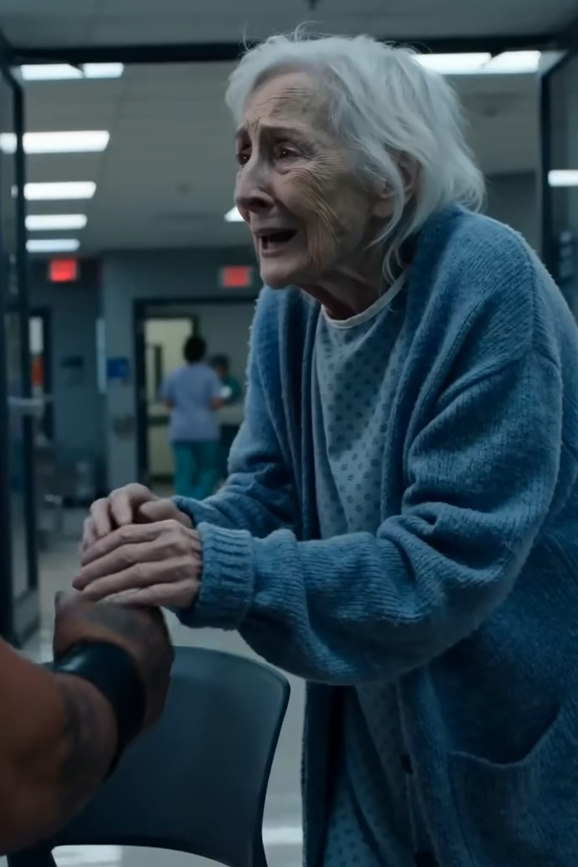
He could have told him about the fluorescent corridor, the bruised hand on his arm, the five words whispered like a last gamble.
He could have told him about the doctor, the forms, the motorcycle ride, the confession about David, the old photographs, the patchwork quilt.
He could have told him how a woman everyone ignored had been braver than an entire building full of professionals.
But the officer lived in a world of reports.
Boxes.
Statements.
Probable cause.
Next of kin.
Brick did not have the energy to watch Margaret’s final hours flattened into categories.
“She wanted to come home,” Brick said.
That was all.
The officer studied him for a long moment.
Then he nodded once.
The coroner arrived just after sunrise.
The van backed up to the curb with a quiet beep that sounded disrespectfully ordinary.
Two men went inside with a stretcher.
Brick stood on the sidewalk, rain darkening his vest, and watched through the open door.
When they brought Margaret out, she was covered in a clean white sheet.
No machines.
No tubes.
No hospital ceiling.
Just Margaret going down her own walkway one last time.
Brick stood very still.
The officers watched him.
The paramedics watched him.
A neighbor had opened her curtains across the street.
Maybe she wondered who the biker was.
Maybe she would tell someone later that a frightening man had stood in the rain for an old woman no one else came to claim.
Maybe she would get it wrong.
Most people did.
The stretcher rolled over the cracked concrete.
One wheel bumped at the edge.
Brick’s jaw tightened, but he did not move.
The coroner’s men loaded her into the van.
The rear doors closed with a heavy final sound.
Brick waited until the tail lights disappeared around the corner.
Only then did he walk back to his Harley.
He swung his leg over the seat.
For a moment, he did not start the engine.
He looked at the little house.
At the crooked mailbox.
At the porch steps where he had smoked.
At the bedroom window where rain still clung to the glass.
The place looked empty now in a way even neglect had not made it look before.
He wondered who would come for her things.
The daughter who did not answer.
A city office.
A bank.
A stranger with a clipboard.
He wondered what would happen to the quilt.
He wondered whether anyone would know which square came from Arthur’s shirt and which one came from David’s childhood blanket.
The thought made him angry.
But the anger was different now.
It had no target worth hitting.
He started the Harley.