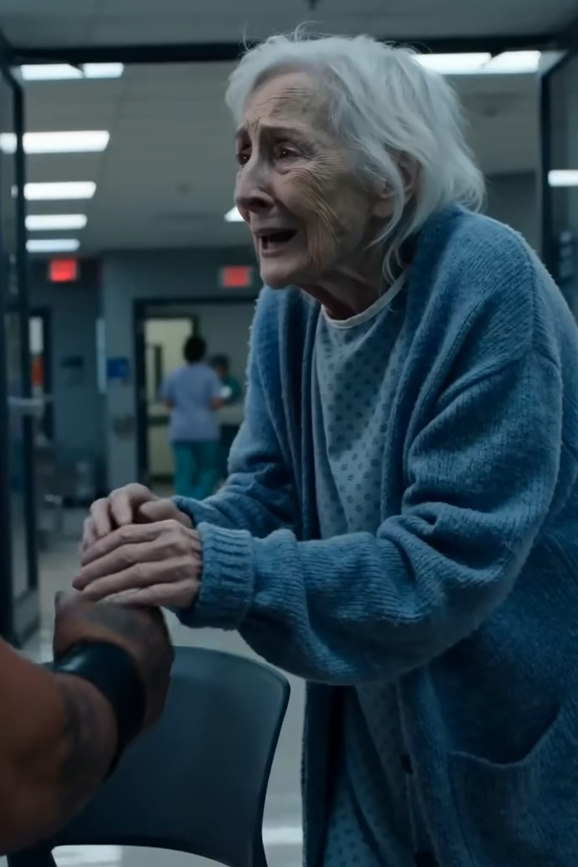
Margaret’s breathing grew shallow.
Brick sat forward with his elbows on his knees.
He had sat watch outside jail cells.
He had watched clubhouses after threats.
He had watched over wounded men after fights no one would report.
But this vigil felt different.
There was no enemy at the door.
No debt to collect.
No insult to answer.
Only time.
Margaret turned her head slightly.
“Why do you ride with them?”
Brick looked down at his leather cut folded across his thigh.
He did not explain the club to civilians.
Civilians did not understand.
They heard motorcycle club and thought crime.
They saw patches and thought violence.
They did not understand what it meant to be claimed by people after the rest of the world had thrown you away.
But Margaret was not asking like a civilian.
She was asking like someone who had just borrowed the idea of family from a stranger.
“Because normal society wants you in a box,” Brick said.
His voice was low so it would not disturb the rain.
“School.”
“Mortgage.”
“Job.”
“Smile at your neighbor.”
“Keep your head down.”
“Die quiet.”
Margaret listened.
“If you don’t fit the box,” Brick said, “they don’t fix the box.”
“They throw you out.”
His thumb rubbed the edge of the patch.
“The club is where thrown-out men go.”
He paused.
“We’re broken.”
He looked at her.
“But we’re broken together.”
Margaret smiled faintly.
“Like family.”
“Exactly like family.”
Her gaze drifted to the ceiling.
“I had a family once.”
Brick did not speak.
“My Arthur worked at the steel mill for fifty years.”
Her voice softened around the name.
“Never missed a shift unless he was too sick to stand.”
She closed her eyes.
“He died of cancer two months after he retired.”
The rain tapped harder.
“He had made all these plans.”
“A small garden.”
“Fishing on Tuesdays.”
“Breakfasts where he didn’t have to rush.”
She breathed in, and the sound caught.
“Two months.”
Brick’s jaw flexed.
“Then my daughter moved away,” Margaret said.
“Then David got lost.”
Her hands twitched against the quilt.
“At first it was pills.”
“Then money missing.”
“Then calls from numbers I did not know.”
She opened her eyes again.
“The last time I saw him, he asked me for twenty dollars and kissed me on the cheek like he was still eight years old.”
Brick looked at the photograph on the wall.
The boy in the baseball uniform.
The young man pretending to smile.
“I told him no,” Margaret whispered.
“I thought maybe if I stopped helping, he would come back to himself.”
Her voice shook.
“He died two days later.”
The room tightened around the words.
Brick had known men like David.
Some had been brothers.
Some had stolen from brothers.
Some had been buried by brothers.
He knew the poison that hollowed a person out until love could not reach them.
He also knew the kind of guilt survivors carried afterward, as if one different sentence could have pulled a soul back from the dark.
“You didn’t kill him,” Brick said.
Margaret’s eyes filled.
“I know that during the day.”
She turned her face toward the window.
“At night, I am not as certain.”
Brick said nothing because there was no cheap comfort big enough for that.
Margaret swallowed.
“The world kept spinning.”
“Arthur gone.”
“David gone.”
“My daughter gone in every way that mattered.”
“I kept sitting in this house, waiting for the phone to ring.”
She gave a small, tired laugh.
“Then one day I realized I was not waiting anymore.”
“I was just getting older.”
Her eyes found his.
“It is a terrible thing to become invisible before you are dead.”
Brick felt those words go somewhere deep.
He had been feared.
Judged.
Wanted.
Hunted.
Avoided.
But invisible was something else.
Invisibility was what happened when the world decided even your pain was not worth noticing.
“You ain’t invisible tonight,” he said.
Margaret held his gaze.
“No,” she whispered.
“Not tonight.”
Her eyes closed again.
The rain softened.
Brick sat in the old armchair while the sky outside went from black to gray.
Every few minutes, Margaret’s breathing changed.
Sometimes it rattled hard.
Sometimes it paused so long Brick leaned forward, waiting.
Then she would draw another thin breath, and he would sit back.
He did not pray.
He had not prayed in years.
But he found himself thinking of Arthur at the steel mill.
Of David on the bicycle in the hallway photograph.
Of a daughter somewhere with a phone she refused to answer.
Of Jackson under hospital blankets, alive because strangers had cut him open and refused to let him go.
Of himself, a man who had walked into the night expecting nothing but anger and had ended up being called grandson by a dying woman.
Near dawn, Margaret stirred.
“David.”
Brick leaned forward immediately.
“Yeah.”
Her voice was barely there.
“I’m here.”
Her eyelids fluttered.
“I’m glad you came home.”
Brick swallowed.
For a second, he could not answer.
The room blurred at the edges.
He looked down at his hands, at the scars and old ink, at the knuckles people feared.
Then he reached out and rested one hand on the quilt beside hers.
“Me too, Grandma.”
Margaret’s mouth softened.
“Go to sleep,” he said.
She obeyed.
Her breathing slowed.
The wet, frantic struggle in her chest began to ease.
Not because she was healing.
Because the fight was ending.
Brick stayed still.
He watched the quilt rise.
Fall.
Rise.
Fall.
Then Margaret took one long, shallow breath.
She exhaled completely.
And did not breathe again.
The house seemed to hold its breath after her.
Even the rain felt quieter.
Brick did not move for a long time.
He had seen men die violently.
He had seen faces twisted by terror, rage, shock, and pain.
He had heard final curses.
Final apologies.
Final choking sounds in alleys and wrecks and rooms no one wanted to remember.
This was different.
Margaret looked smaller in death, but not afraid.
The hard lines around her mouth had eased.
The fear she had carried in the hospital hallway was gone.
She had won the only fight that still belonged to her.
She had come home.
Brick sat in the armchair for another hour.
He listened to rain on glass.
He listened to the old house settle.
He listened to the silence of a life that had finally stopped asking to be noticed.
When gray daylight slipped through the blinds, he stood.
His knees were stiff.
His back ached.
He crossed to the bed and pulled the patchwork quilt up around Margaret’s shoulders.
He smoothed the fabric with both hands.
The gesture felt strange, but right.
Then he looked at the framed photograph on the nightstand.
Margaret and Arthur smiling beside a cake.
Brick picked it up and placed it closer to her.
“He’s waiting,” he muttered, though he did not know if he believed it.
Then he walked to the kitchen.
The phone in his hand felt heavy.
He dialed 911.
When the dispatcher answered, Brick gave the address.
His voice was calm.