Part I — The Threshold
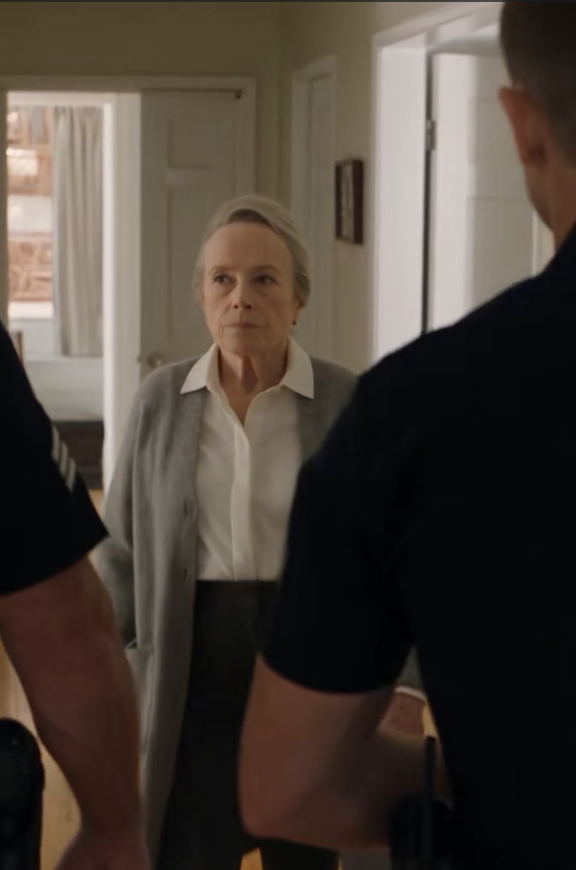
The first officer crossed Eleanor Vale’s threshold before she had finished asking whether he had a warrant.
There was no confusion about it.
His boot came down on the hardwood inside her foyer. His partner slipped past his shoulder, glanced once through the living room, and headed toward the hallway as if he already knew the layout. A third officer stayed near the open front door with one hand resting close to his belt, watching Eleanor with the wary attention people usually reserved for suspects.
Eleanor remained beside the small table where she kept her mail.
“Excuse me,” she said.
The second officer kept walking.
She raised her voice only enough to make ignoring it deliberate.
“Who gave you permission to enter my home?”
That stopped the youngest officer at the door.
He could not have been much older than thirty. Clean-cut. Fresh uniform. A face that had not yet learned to hide uncertainty quickly enough.
The older man leading the group did not stop.
His nameplate read DANNER.
He was broad through the shoulders, late forties perhaps, with closely clipped hair and a manner that suggested he had spent years discovering how often confidence could substitute for explanation.
“We need to take a look around, ma’am.”
Eleanor studied him.
“That wasn’t my question.”
Danner turned.
Behind Eleanor, late-afternoon sunlight reached through the lace curtains and lay in pale rectangles across the living-room floor. The television was off. A half-finished cup of tea sat on the end table beside a book. A knitted blanket rested across one arm of the sofa.
Nothing in the room suggested urgency.
Nothing suggested danger.
Nothing justified three uniformed officers walking through a seventy-three-year-old woman’s house as if ownership were a technicality.
Danner gave her a patient expression that did not reach his eyes.
“We received information requiring us to check the property.”
“What information?”
“We’re looking into it.”
“Are you responding to an emergency?”
“No.”
“Do you believe someone inside is in immediate danger?”
A pause.
“No, ma’am.”
“Are you pursuing someone who entered this residence?”
Danner’s jaw moved slightly.
“No.”
“Then I’ll ask again. Do you have a warrant?”
The officer halfway down the hall—Officer Lyle, according to his nameplate—opened Eleanor’s guest-bedroom door.
“No,” Danner said at last.
Eleanor nodded once.
“Then you do not have my consent to be inside this house.”
The young officer near the door looked at Danner again.
Danner did not look back.
“Ma’am, if you’ll just cooperate, this will go much easier.”
There it was.
Eleanor had heard versions of that sentence for almost forty years.
Sometimes in interrogation recordings.
Sometimes in suppression hearings.
Sometimes from officers seated under oath who insisted that a frightened citizen had “voluntarily” agreed to something after being surrounded, blocked from leaving, or told that refusal would only make matters worse.
Words mattered.
Tone mattered.
Sequence mattered.
And doors mattered most of all.
A threshold was not decorative.
Under the law, a home remained the place where government power faced its highest barrier.
Eleanor folded her hands loosely in front of her.
“Officer,” she said, “I asked you a very simple question.”
Danner exhaled through his nose.
Lyle disappeared into the guest room.
A drawer slid open.
The sound was quiet.
To Eleanor it might as well have been a siren.
The young officer shifted his weight.
“Sergeant,” he said carefully.
Danner’s eyes moved toward him.
“What?”
The officer hesitated.
Eleanor read his nameplate.
PARKER.
Parker glanced down the hallway.
“She said no consent.”
Danner’s expression hardened by a degree.
“We’re already inside.”
It was a remarkable sentence.
Eleanor almost smiled.
Not because it was amusing.
Because she had heard bad legal reasoning before, but rarely delivered so efficiently.
She turned toward the hallway.
“Officer Lyle.”
There was movement in the guest room.
A moment later he leaned out.
“What?”
“Please stop opening my drawers.”
He looked toward Danner.
Danner said nothing.
Lyle disappeared again.
Eleanor’s face changed then.
The softness left it.
She was small—barely five feet—with silver hair pinned neatly behind her ears, gray cardigan buttoned over a white blouse, dark slacks, and the house slippers her granddaughter had mailed her last Christmas because Eleanor had once complained about cold floors.
She did not look powerful.
That had been useful for much of her life.
People who mistook restraint for weakness tended to reveal themselves quickly.
Danner walked farther into the living room.
“Where were you this morning between eight and ten?”
“At home.”
“Anyone with you?”
“No.”
“Can anyone verify that?”
“I don’t need an alibi to stand in my kitchen.”
His eyes sharpened.
“This doesn’t have to become adversarial.”
“You entered my house without permission.”
“We’re conducting an investigation.”
“Then conduct it lawfully.”
“Ma’am—”
“Do you have probable cause to arrest me?”
“No.”
“Do you have exigent circumstances?”
Danner stared at her.
Parker’s gaze came up.
Lyle stopped moving in the bedroom.
Eleanor continued.
“Do you have a valid search warrant signed by a judge?”
Danner did not answer.
“That makes three very easy questions,” Eleanor said. “You’ve answered all of them already.”
For the first time, uncertainty passed openly across Parker’s face.
Danner saw it.
“Check the back rooms,” he said to Lyle.
Eleanor turned to him.
“No.”
Lyle paused.
Danner looked directly at Eleanor.
“Ma’am, I strongly suggest—”
“No.”
Her voice was not loud.
It did not need to be.
Parker’s hand moved away from his belt.
Eleanor walked toward the small writing desk beside the kitchen entrance.
Danner followed her with his eyes.
The desk had belonged to her husband. Walnut, narrow, scarred at one corner from a move twenty-six years earlier. On its surface sat a lamp, a framed photograph, two envelopes, and Eleanor’s cellphone.
She picked up the phone.
Danner moved.
“Who are you contacting?”
Eleanor unlocked the screen.
“Someone who will be very interested to learn that three police officers entered my home without permission and began searching without a warrant.”
Parker looked at Danner.
Lyle stepped fully into the hallway now.
The atmosphere changed—not dramatically, not yet, but enough.
Danner gave a short laugh.
“Ma’am, put the phone down.”
Eleanor typed four words.
They are inside now.
She pressed send.
“No.”
Danner took one step toward her.
Parker said, “Sergeant.”
Danner stopped.
Eleanor looked from one officer to the next, then placed the phone facedown on the desk.
“You should probably stop searching.”
Danner’s eyes narrowed.
“Is that a threat?”
“It’s advice.”
Outside, a sprinkler clicked across a lawn.
A dog barked somewhere behind the neighboring houses.
Across the street, Mr. Benton was watering his roses in a straw hat. Two houses down, a curtain moved and became still.
The neighborhood remained what it had been five minutes earlier: quiet, orderly, unremarkable.
Then Eleanor heard an engine.
A deep one.
Approaching quickly.
Parker turned toward the window.
A second engine followed.
Then a third.
Mr. Benton lowered his hose.
A black SUV came around the corner too fast for neighborhood traffic and braked near Eleanor’s driveway.