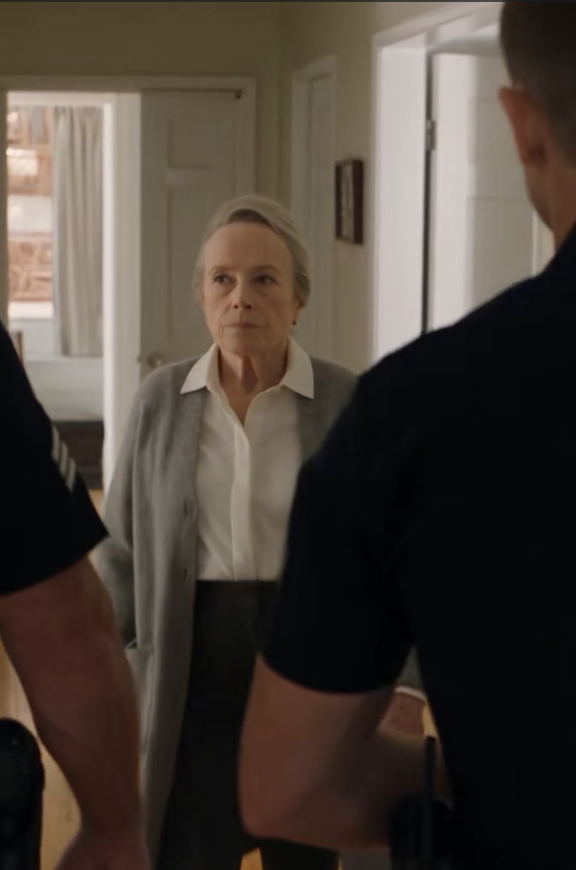
Another appeared from the opposite direction.
Then another.
Parker stepped closer to the front window.
The blood left his face.
“Sergeant.”
Danner turned.
Black vehicles were stopping around the property with an efficiency that made the intention obvious. Doors opened before the last SUV fully settled.
Men and women in plain clothes stepped out.
Dark jackets.
Visible credentials.
Radios.
Purpose.
No confusion.
No hesitation.
Lyle came back into the living room.
“What the hell is this?”
Eleanor said nothing.
Danner crossed to the window.
Whatever irritation had remained in his expression disappeared.
Two agents moved along the side yard. Another pair crossed the lawn. One woman stopped at the driveway, lifted a radio toward her mouth, and said something Eleanor could not hear through the glass.
Parker whispered, “Federal?”
Then someone hit the front door with three hard knocks.
“FEDERAL AGENTS!”
No one inside moved.
The same front door through which Danner had entered without invitation was still open several inches.
A federal agent pushed it wider.
Danner stepped toward it.
“Hold on—”
“Hands where we can see them.”
The command came from a woman in a navy jacket with yellow block lettering across the chest.
FBI.
Danner stopped.
Behind her stood two more agents.
Parker immediately raised both hands away from his body.
Lyle did the same.
Danner did not.
His right hand stayed low.
The woman’s tone changed.
“Sergeant. Hands visible. Now.”
Danner slowly lifted them.
Eleanor stood beside the desk, one hand resting lightly on its edge.
The lead agent looked past the officers.
“Mrs. Vale?”
“I’m all right.”
“Are you injured?”
“No.”
“Did you consent to their entry?”
“No.”
“Did they present a warrant?”
“No.”
Danner turned toward Eleanor.
Something had begun to form in his face.
Recognition, perhaps.
Or calculation.
The agent entered.
“Sergeant Danner, Officer Lyle, Officer Parker, do not move until instructed.”
Danner recovered enough to find his voice.
“You want to tell me what federal agents are doing interfering with a local investigation?”
The woman studied him.
“Yes,” she said.
Then she looked at Eleanor.
“But first I’d like to know exactly what you were looking for in former United States Magistrate Judge Eleanor Vale’s house.”
Parker closed his eyes for half a second.
Lyle stared at Eleanor.
Danner did neither.
He simply stood very still.
And Eleanor understood from that stillness that, unlike the other two, Sergeant Danner had already known exactly whose house this was.
That was the moment the situation stopped being a constitutional mistake.
And became something else.
Part II — What They Came to Find
Special Agent Mara Keene asked Eleanor to sit down.
Eleanor declined.
“I’ve been standing in courtrooms longer than you’ve been carrying that badge.”
Keene gave the faintest suggestion of a smile.
“I was told you might say something like that.”
“By whom?”
“Assistant Director Salazar.”
“That sounds like him.”
Keene looked toward the officers.
Two federal agents had separated them. Parker stood near the front entrance, pale and rigid. Lyle leaned against the far wall with his hands visible. Danner remained in the middle of Eleanor’s living room, saying nothing.
Keene lowered her voice.
“Your message reached us at 4:17.”
“You were close.”
“We were closer than they realized.”
Eleanor held her gaze.
That was confirmation enough.
Three weeks earlier, Assistant Director Rafael Salazar had sat at this same kitchen table and told Eleanor that someone inside the Bellweather Police Department might be trying to locate evidence connected to a federal civil-rights investigation.
He had not told her everything.
Eleanor had not asked him to.
She knew how investigations worked. You compartmentalized facts for a reason.
What she did know was that federal investigators had been examining a pattern of unlawful searches, evidence irregularities, and altered probable-cause affidavits tied to several officers in the department’s special investigations unit.
And she knew one more thing.
Two months earlier, a young public defender named Rebecca Chen had mailed Eleanor a packet containing copies of three search affidavits.
Rebecca had once clerked for her.
The note inside had been only one sentence:
Judge, I think someone is changing these after they leave the courtroom.
Eleanor had compared the documents to archived copies from the federal cases that later absorbed some of the prosecutions.
Rebecca was right.
Dates had shifted.
Informant statements had been strengthened.
A sentence indicating uncertainty became a sentence claiming direct observation.
Small changes.
Legally devastating ones.
Eleanor had contacted the Department of Justice the same day.
After that, she became what Salazar politely called a cooperating witness.
She preferred “citizen who knows how to read.”
The packet itself had been taken into federal custody almost immediately.
But apparently someone did not know that.
Keene glanced down the hallway.
“Did they search your office?”
“Guest room. Hall cabinet. They were moving toward the rear rooms.”
“Did they ask for anything specific?”
“No.”
“Did they tell you why they were here?”
“No.”
Keene nodded toward Danner.
“Sergeant?”
Danner’s face had settled into professional neutrality again.
“We received a tip that property connected to an active theft investigation had been brought to this address.”
“What property?”
“I’m not discussing an active case in front of civilians.”
Eleanor raised an eyebrow.
Keene did not.
“She’s the homeowner.”
“And you’re federal.”
“Yes.”
“So unless you’re claiming jurisdiction—”
“I’m claiming I asked you a question.”
The room held still.
Danner stared at her.
“A laptop.”
“What laptop?”
“Stolen.”
“From whom?”
“I’m not at liberty—”
Keene cut him off.
“Then show me the incident report.”
Danner’s gaze shifted.
Keene waited.
“Sergeant?”
“Our system’s mobile.”
“So pull it up.”
“We didn’t bring a terminal inside.”
“Your phone.”
Danner said nothing.
Keene watched him for a long second.
Then she turned to another agent.
“Photograph every room they entered. Nobody touches anything until the scene is documented.”
Danner’s voice sharpened.
“Scene?”
Keene looked back.
“Yes.”
“You calling this a crime scene?”
“I’m calling it a location where federal evidence may exist regarding potential deprivation of rights under color of law.”
Parker swallowed.
Lyle looked at Danner.
Danner laughed once.
“That’s absurd.”
Eleanor spoke.
“Is it?”
His eyes moved to her.
She pointed toward the hallway.
“You entered without consent. You had no warrant. You admitted there was no emergency. I told you to stop. You continued.”
“We had lawful basis—”
“Name it.”
“You’re not the judge here.”
“No,” Eleanor said. “Which means you don’t have to persuade me. You’ll have to persuade one who’s still on the bench.”
That landed.
Danner looked away first.
Keene asked, “Mrs. Vale, did any officer attempt to seize anything?”
“No.”
“Did anyone touch your phone?”
“No.”
“Did anyone restrict your movement?”
“Not directly.”
Danner seized on it.
“There you go.”
Eleanor turned.
“I wasn’t finished.”
He stopped.
“The sergeant stepped toward me when I used my phone. He ordered me to put it down. I declined. Officer Parker appeared concerned about the legality of the entry. Officer Lyle continued searching after I expressly withdrew any possible ambiguity about consent.”
Parker looked at her.
Not grateful.
Not yet.
But surprised.
She had described exactly what happened without protecting him and without exaggerating his role.