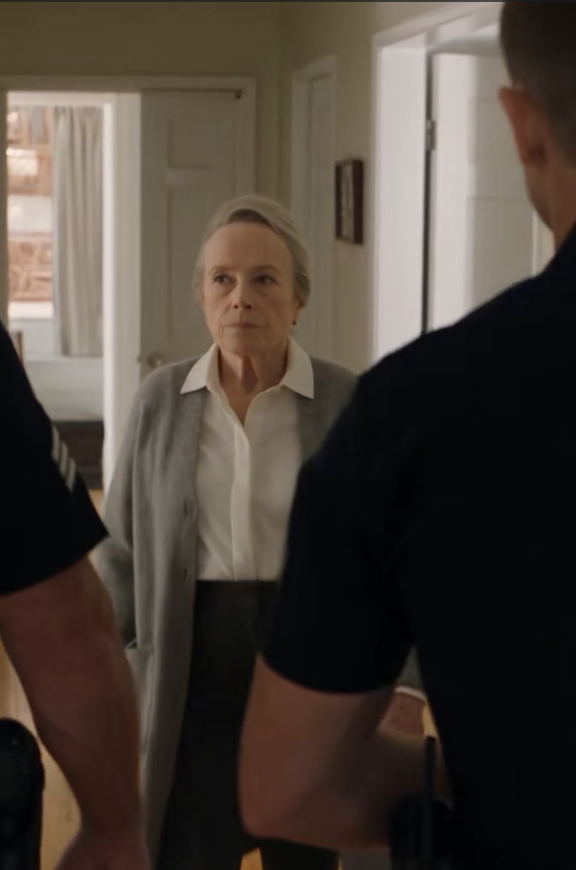
Keene appeared five minutes later.
Beside her walked Sergeant Danner.
Bearded now.
Dirty.
Wrists cuffed behind him.
Eleanor stared.
Danner looked exhausted.
He had apparently been hiding in the narrow utility space beneath the rear addition since sometime before dawn.
Somewhere they had already looked.
Nolan had not been taunting them.
He had been warning them.
Danner stopped when he saw Eleanor.
Agents tried to move him.
He resisted only enough to remain in place.
“I need to talk to her.”
Keene said, “No.”
Danner looked at Eleanor.
“Nolan will put everything on me.”
Eleanor said nothing.
“I have proof.”
Keene stepped between them.
“Tell it to your lawyer.”
“He ordered the deletions.”
Danner’s voice rose.
“He told us which judges would sign and which wouldn’t. He taught us how to rewrite informant language.”
Eleanor watched him.
The man who had walked into her home with effortless authority now looked reduced not by handcuffs but by the need to be believed.
“I can prove it,” he said.
Eleanor finally spoke.
“Then prove it lawfully.”
Danner stared.
“That’s it?”
“What did you expect?”
“You know what Nolan is.”
“Yes.”
“You know I can take him down.”
“Then give investigators truthful evidence through counsel.”
Danner laughed bitterly.
“You still think the system works.”
Eleanor stepped closer, stopping several feet away.
“No.”
That surprised him.
She continued.
“I think systems fail whenever people inside them decide failure gives them permission to become lawless.”
Danner looked at her.
“You think you’re different?”
“I know I’m capable of being wrong.”
“And me?”
“You stopped caring whether you were.”
The agents moved him.
This time he went.
Eleanor watched the vehicle door close behind him.
Keene came to stand beside her.
“You all right?”
“Yes.”
“That question isn’t a legal one.”
Eleanor looked at her.
“I know.”
A long pause.
Then Eleanor said, “No.”
Keene nodded.
It was, Eleanor realized, the first time since the officers crossed her threshold that she had answered that question honestly.
Part VI — Aftermath
The investigation lasted eleven months.
No dramatic revelation repaired everything at once.
Nothing real worked that way.
Deputy Chief Thomas Nolan was indicted on federal charges involving obstruction of justice, falsification of records, conspiracy, and civil-rights violations.
Sergeant Danner pleaded not guilty at first.
Then the evidence accumulated.
Parker’s testimony.
Lyle’s cooperation.
Emily Mercer’s files.
The archived body-camera videos.
Deleted internal complaints.
Messages between Nolan and Danner.
Search-warrant drafts altered after judicial rejection and later resubmitted with language designed to hide the earlier denial.
Eventually Danner changed his plea.
His cooperation exposed more.
Not dozens of officers.
That would have been easier for headlines.
Most officers in the department had done their jobs without knowing what Danner’s unit was doing.
Several had suspected.
A few had looked away.
Three had reported concerns that never reached proper review.
The scandal was not proof that the entire institution was corrupt.
It was proof that a smaller group could do extraordinary damage when the larger institution valued quiet over scrutiny.
Officer Daniel Lyle pleaded guilty to attempted obstruction and unlawful entry related to his return to Eleanor’s home.
His sentence reflected his cooperation.
Eleanor did not object.
Officer Aaron Parker resigned.
For months she heard nothing about him.
Then a letter arrived.
No return address she recognized.
Inside was a single sheet.
He wrote that he had started law school.
Eleanor read that sentence twice.
He did not ask forgiveness.
She respected him for that.
He wrote:
I kept thinking about what you said—that fear becomes leverage when you hide the truth. I don’t know whether I should ever wear a badge again. I do know I want to understand the rules I was too willing to let someone else explain to me.
Eleanor folded the letter and placed it in her desk.
She did not answer immediately.
Three weeks later she sent him a used constitutional-law casebook.
Inside the cover she wrote:
Read the dissents too.
Rebecca Chen remained a public defender.
Her role became public only after the criminal cases concluded.
When reporters praised her as a whistleblower, she corrected them.
Emily Mercer had been the whistleblower.
Marcus Bell had taken the first risk outside the department.
Rebecca had merely listened.
Eleanor liked her more for saying it.
Emily eventually testified before Congress about evidence-retention safeguards.
She did not enjoy the attention.
Afterward, she returned to Oregon and accepted a position far from law enforcement.
Marcus Bell’s death was reinvestigated.
The result was less satisfying than television would have demanded.
Investigators found no evidence Danner or Nolan killed him.
His death remained an overdose.
But they discovered something equally important: Bell had called Danner two days earlier and told him copies of the recordings existed.
Danner had threatened him with prosecution for possession of stolen police evidence.
Bell, frightened, gave the drive to Rebecca.
Rebecca, not understanding what it contained, placed it in the same envelope as the affidavits she mailed Eleanor.
A chain of ordinary choices.
No master plan.
No secret conspiracy elaborate enough to impress a novelist.
Only frightened people passing evidence toward someone they thought might know what to do with it.
Eleanor had nearly thrown the most important piece into the trash.
The thought amused her eventually.
At first, it terrified her.
Forty-seven convictions were formally reviewed.
Twelve were vacated because unlawful searches or falsified reports had materially affected the cases.
Six defendants were retried using independent lawful evidence.
Four were convicted again.
Three cases were dismissed.
Two people were released after years in prison.
The remaining reviews found misconduct that did not alter the convictions.
Messy.
Unsatisfying.
Necessary.
Eleanor attended none of the press conferences.
When a cable network offered her an interview titled THE JUDGE WHO TOOK DOWN A CORRUPT POLICE UNIT, she declined before the producer finished explaining the segment.
She had not taken down anyone.
Evidence had.
Witnesses had.
The officers’ own choices had.
That distinction mattered.
One year after the day Danner first entered her home, Eleanor stood at the same threshold holding a paintbrush.
The doorframe needed repainting.
Mr. Benton sat in a folding chair across the porch, supervising despite not being invited.
“You missed a spot.”
“I have not reached that spot.”
“You missed it preemptively.”
“That isn’t a thing.”
“It is in gardening.”
“This is paint.”
“Same principle.”
Eleanor shook her head.
The street was quiet again.
The news vans were gone.
Federal surveillance vehicles no longer sat around corners.
Neighbors had stopped slowing their cars when they passed her house.
Ordinary life had reclaimed the block.
Inside, the furniture remained largely where it had always been.
The desk beside the kitchen had one new addition.
A framed photocopy of the Fourth Amendment.
Rebecca had given it to her as a joke.
Eleanor had told her it was tacky.
Then framed it anyway.
A sedan stopped at the curb.
Mara Keene stepped out.
No FBI jacket.
No visible credential.
She carried a bakery box.
Mr. Benton looked at Eleanor.
“Federal?”
“Not today.”
Keene came up the walk.
“I brought pie.”
“What kind?”
“Apple.”
“You may enter.”
Keene stopped at the threshold.