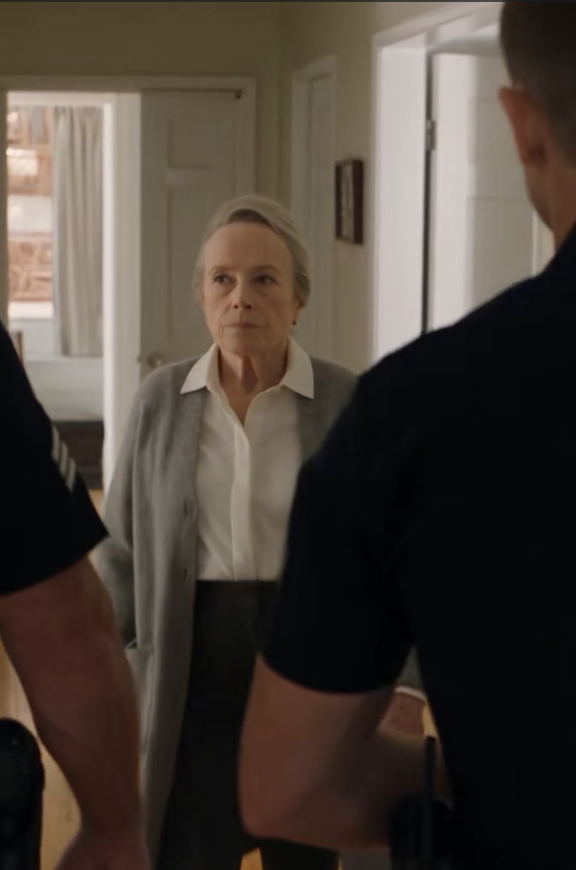
Then smiled.
“Do I have your consent?”
Eleanor stared at her.
Mr. Benton laughed so hard he started coughing.
Eleanor tried not to smile.
Failed.
“Yes, Agent Keene.”
“Former Agent Keene.”
Eleanor blinked.
“When?”
“Last month.”
“You didn’t tell me.”
“I wanted to do it in person.”
“What now?”
“Inspector general’s office. Policy side.”
Eleanor grimaced.
“Meetings.”
“Apparently.”
“My condolences.”
Keene stepped inside.
One foot across the threshold.
Then the other.
Simple.
Ordinary.
Permitted.
Eleanor looked down at the strip of wood beneath Keene’s shoes.
A year earlier, three officers had crossed it believing authority itself was permission.
The courts that followed had produced hundreds of pages of rulings, plea agreements, evidentiary hearings, disciplinary findings, and revised department policies.
But the principle underneath all of it had always been smaller than the paperwork.
A door belonged to the person inside it.
Power had to stop there until law gave it reason to continue.
Eleanor shut the front door behind them.
Later, after Keene left and Mr. Benton finally went home, Eleanor returned to the desk.
Parker’s letter still rested in the top drawer.
Beside it lay the old notebook in which she had written Danner’s name after the welfare call.
May 14.
At the time, the entry had meant almost nothing.
She ran one finger beneath it.
There were moments in life that seemed important immediately—verdicts, arrests, doors opening under shouted commands.
Others waited quietly until later facts gave them meaning.
A glance.
A name.
A copied file.
A young officer hesitating near a doorway.
A plastic drive forgotten in a bowl.
Eleanor closed the notebook.
Outside, evening settled over the houses.
She turned off the desk lamp and walked toward the kitchen.
Halfway there, someone knocked.
Three times.
Firm but ordinary.
Eleanor stopped.
For one second, the old scene returned with perfect clarity: Danner in her hallway, federal vehicles crowding the curb, Keene’s agents moving across the lawn.
Then the feeling passed.
She walked to the door and looked through the glass.
Aaron Parker stood on the porch.
No uniform.
A law-school backpack over one shoulder.
In his hands was the constitutional-law book Eleanor had mailed him, now swollen with tabs and notes.
She opened the door.
He looked nervous.
“Mrs. Vale.”
“Mr. Parker.”
He glanced down at the book.
“I was in town.”
“So I gathered.”
“I wanted to return this.”
“It was a gift.”
“I know. I just thought maybe…”
He stopped.
Eleanor waited.
His eyes moved briefly toward the interior of the house.
Then back to her.
“I wanted to thank you.”
“For a used textbook?”
“For not telling me I was a good person.”
Eleanor studied him.
“That would have been inappropriate.”
A small smile appeared.
“I know.”
“And probably inaccurate at the time.”
He laughed quietly.
Then nodded.
“That too.”
Neither spoke for a moment.
Finally Parker shifted the book under his arm.
“I should go.”
He stepped backward.
Eleanor looked at the young man who had once stood inside this same house watching another officer violate a boundary he knew existed and had been too afraid to defend.
He had paid for that choice.
Perhaps he would spend years understanding it.
That was not redemption.
But it might be the beginning of responsibility.
“Mr. Parker.”
He stopped.
Eleanor opened the door wider.
“You may come in for coffee.”
Parker stared at her.
Then something in his expression softened.
“Are you sure?”
Eleanor looked down at the threshold.
The same wood.
The same line.
Nothing magical about it.
Only meaning.
Only choice.
She looked back at him.
“Yes,” she said. “This time, I’m sure.”