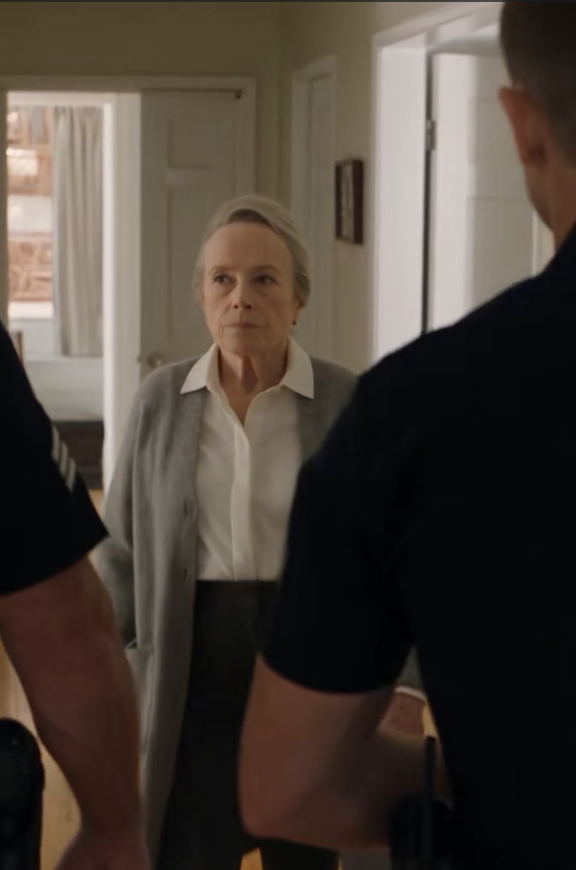
Eleanor backed toward the living room.
Her home had never felt large.
Tonight it felt full of blind corners.
“Stay with me,” Keene said.
“I am.”
A beam of light passed across the backyard.
Not a flashlight inside.
Outside.
Then a man’s voice.
“Federal agents! Show your hands!”
Movement.
Fast.
A curse.
Running footsteps.
Another command.
Eleanor stayed where she was.
Keene said, “Do not go outside.”
“I wasn’t planning to.”
Thirty seconds later someone knocked on the front door.
Not pounded.
Knocked.
“FBI. Agent Keene is on the phone with you.”
Eleanor opened it only after Keene confirmed the agent’s name.
Two men stood on the porch.
One remained with her while the other moved toward the rear.
Keene arrived six minutes later.
They had caught the intruder at the back fence.
Not Danner.
Lyle.
Officer Daniel Lyle, still officially on administrative leave.
He had a lock-pick set in his pocket.
And latex gloves.
Eleanor sat at her kitchen table while Keene looked at the blue flash drive without touching it.
“You’re sure this came with Rebecca’s packet?”
“I’m sure it was in or near the envelope.”
“Did you ever plug it in?”
“No.”
“Why not?”
“I thought it was junk.”
Keene stared at her.
Eleanor shrugged.
“I’m seventy-three. I have enough cables.”
Under different circumstances Keene might have laughed.
Instead she looked toward the rear of the house, where agents photographed the door.
“Lyle says Danner told him you stole evidence.”
“Tonight?”
“He says Danner contacted him an hour ago.”
“Did he?”
“We’re checking.”
“What was Lyle supposed to retrieve?”
“He says the blue drive.”
Eleanor looked at it.
“So Danner knew.”
“Yes.”
“How?”
“That’s what we need to learn.”
An evidence technician sealed the drive inside a bag.
Eleanor watched it disappear.
A piece of plastic smaller than her thumb.
Two unlawful entries.
A dead former defendant.
Altered affidavits.
A police sergeant who had known the layout of her home months before she knew his name.
Keene sat across from her.
“Parker is with us.”
“He called?”
“His attorney did.”
“Good.”
“He gave us enough for a warrant on the department storage area.”
Eleanor’s eyes shifted.
“You have it already?”
“Federal magistrate signed it twenty minutes ago.”
Despite herself, Eleanor smiled faintly.
“What?”
“Nothing.”
Keene understood anyway.
“Nice when someone gets a warrant first?”
“It has its advantages.”
Keene allowed herself the smile this time.
Then it disappeared.
“We need to relocate you.”
“I’m not leaving.”
“Eleanor.”
“Again?”
“This is different. Someone attempted to enter the house after dark.”
“Your agents caught him.”
“Yes.”
“You have the drive.”
“Yes.”
“What exactly is left here to steal?”
Keene hesitated.
“That’s not the only concern.”
Eleanor understood.
“Retaliation.”
“Yes.”
“I won’t be pushed out of my home.”
“This isn’t about pride.”
“No. It’s about control.”
Keene leaned forward.
“You spent your career deciding when government intrusion was justified. I’m asking you to recognize when caution is justified too.”
That irritated Eleanor because it was effective.
She looked toward James’s photograph.
He would have told her to go.
Not because he was timid.
Because he had possessed the infuriating ability to distinguish courage from stubbornness when Eleanor could not.
“Two nights,” she said.
“Good.”
“No hotel under federal reservation.”
“Fine.”
“I choose the location.”
“Within reason.”
“And no agents inside the room.”
Keene sighed.
“You negotiate every conversation, don’t you?”
“Only the ones I’m losing.”
The safe location was a furnished apartment in a neighboring county leased under a government contractor’s name.
Eleanor hated it immediately.
The art was generic.
The couch was too firm.
The kitchen knives were dull.
At 2:13 the next morning, she sat awake in the living room while Keene and Salazar worked somewhere else.
At 3:04, Keene called.
“We opened the drive.”
Eleanor straightened.
“What was on it?”
“Video files.”
“What kind?”
“Body-camera backups.”
Eleanor said nothing.
Keene continued.
“Dozens.”
“Backups of what?”
“Searches.”
“Danner’s?”
“His unit. Several officers.”
“Why were they on the drive?”
“We’re still working that out.”
“Were they deleted from official storage?”
“Yes.”
That explained the value.
Body-camera recordings could establish what happened before reports were written.
Before affidavits changed.
Before official memory became convenient.
“What do they show?”
Keene did not answer immediately.
“Mara.”
“One shows a search from two years ago. The written report says officers saw narcotics in plain view after the resident opened the door.”
“And the video?”
“They opened the door themselves.”
Eleanor closed her eyes.
“Another report says consent was given.”
“It wasn’t?”
“The resident refused repeatedly.”
“How many?”
“We’ve reviewed six so far.”
“And?”
“Five have material conflicts with the official reports.”
Eleanor stood and walked toward the window.
Below, the parking lot was empty except for two government sedans.
“Who made the drive?”
“We found a text document. Initials only.”
“What initials?”
“E.M.”
Eleanor searched her memory.
“Do those mean something to you?”
“No.”
“Maybe to the dead former client?”
“No. His initials were Marcus Bell.”
“Then who is E.M.?”
“We don’t know.”
Eleanor looked at the time.
“What did Parker say?”
“That Danner controlled supplemental body-camera exports for internal training.”
“There.”
“What?”
“Access.”
“You think Danner made the copies?”
“No. I think whoever made the drive needed access to files Danner could reach.”
“Internal affairs?”
“Maybe.”
Keene was silent.
Then she said, “We searched the storage room.”
“And?”
“We found case files. Evidence bags. Several unlogged phones. Cash.”
“How much?”
“Enough that we’re not discussing it by phone.”
Eleanor absorbed that.
“Danner?”
“Missing.”
She turned from the window.
“What do you mean missing?”
“He didn’t report when ordered to the station. His personal vehicle is gone.”
“His phone?”
“Off.”
“Family?”
“Not at home.”
Eleanor thought of the calm way he had looked at her.
You should’ve left it alone.
“What about Lyle?”
“Talking.”
“Parker?”
“Talking more.”
“And Danner is running.”
“Yes.”
Eleanor sat.
For the first time since the officers had entered her house, she felt something close to fear.
Not because Danner had vanished.
Because men like him often became most dangerous when control disappeared.
“What do you need from me?” she asked.
Keene’s response came carefully.
“Nothing tonight.”
“That’s not why you called.”
Silence.
“What?”
“One of the videos on the drive is from your neighborhood.”
Eleanor stared ahead.
“When?”
“May 14.”
The welfare call.
Her house.
“Danner’s body camera?”
“Yes.”
“But he came after the emergency was over.”
“Yes.”
“What does it show?”
Keene took a breath.
“He entered your home after your statement.”
“I remember.”
“He looked around.”
“Yes.”
“Then while you were getting a copy of the incident number from the kitchen, he photographed documents on your desk.”
Eleanor’s skin went cold.
“What documents?”
“We enhanced several frames.”
“Which documents?”
“Your letter from Rebecca Chen.”
Eleanor stood.
“No.”
“The date on the letter is four months later.”
Eleanor stopped.
“What?”
“The letter visible on your desk is not Rebecca’s packet. It’s something else. But the return address belongs to her legal-aid office.”
Eleanor tried to remember.
Then it came back.
A holiday card.
Not holiday.