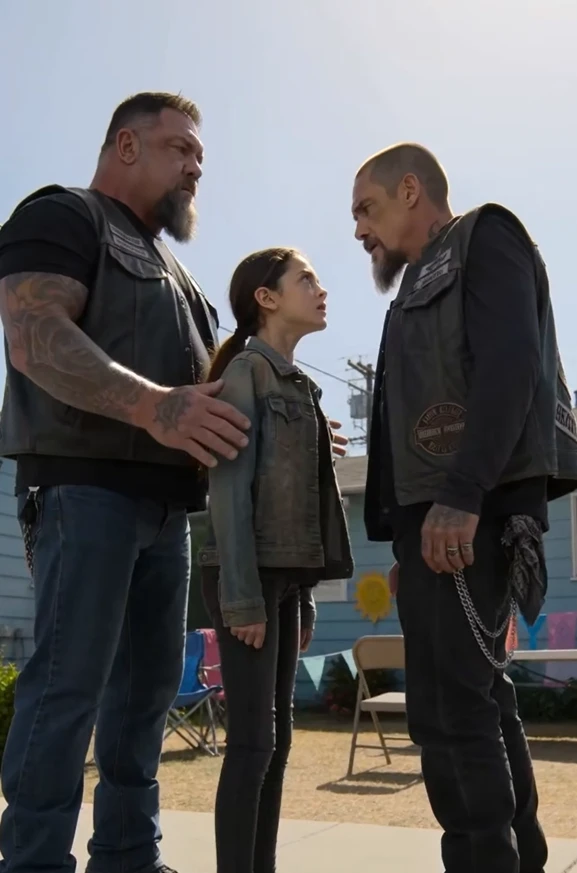
He did not ask for her story.
He did not tell her to be grateful.
He did not say everything would be fine.
He just sat there in the dark.
The silence held.
A tear slipped down Hadley’s cheek.
Then another.
Then the grief came all at once, silent at first, then shaking her shoulders until she could barely breathe.
Garrett remained still.
He gave her the dignity of not being forced to explain pain that had no clean beginning and no simple end.
When the sobs finally slowed, he spoke.
“It gets easier.”
Hadley stared at the wall.
“Not the pain,” he said.
“That stays.”
“Carrying it gets easier.”
She wanted to believe him.
She did not yet.
But some small part of her wanted to stay alive long enough to find out.
The next morning Garrett told her the truth about himself.
They sat in the yellow kitchen with coffee between them and scrambled eggs cooling on Hadley’s plate.
His leather vest hung over the chair.
Without it, he looked less like a warning and more like a tired man with scars he had stopped trying to hide.
“You probably have questions,” he said.
Hadley did.
She had hundreds.
Why did the other kids trust him.
Why had the police not come.
Why did he still wear the vest.
Why did kindness look so much like danger on him.
Garrett rolled up one sleeve and showed the edge of an old tattoo.
“Twenty years ago, I was deep in the club life,” he said.
“Violence.”
“Drugs.”
“Everything that comes with pretending fear is power.”
Hadley looked at him carefully.
He did not try to make himself sound heroic.
That mattered.
“I did eight years in state prison,” he continued.
“Had a lot of time to stare at concrete and think about the damage I had done.”
“What changed?”
Garrett looked toward the backyard where the others were laughing over something.
“I got out and found a kid behind a gas station half frozen.”
“Thirteen, maybe.”
“Angry as hell.”
“Scared even worse.”
“I saw myself in him.”
Hadley wrapped both hands around her mug.
“Couldn’t leave him there,” Garrett said.
“So I brought him here.”
“Fed him.”
“Let him sleep on the couch.”
“Then he told another kid.”
“Then that kid told another.”
“Word got around.”
He looked at her.
“Eventually this became what it is.”
“And the Hells Angels?”
A humorless smile touched his mouth.
“You don’t just walk away clean.”
“But I walked away.”
“Lost friends.”
“Made enemies.”
“Paid for it in ways I probably deserved.”
Hadley’s eyes moved to his hands.
Hands that had hurt people once.
Hands that had held a soup pot carefully.
“Why tell me?”
Garrett leaned forward.
“Because when you’re in the dark, it helps to know someone else found a way out.”
He stood and carried his mug to the sink.
“You don’t have to trust me today.”
“You probably shouldn’t.”
“But you’re safe here.”
“For now, that is enough.”
Days passed.
Then a week.
Hadley kept expecting the floor to fall away.
Instead, breakfast appeared every morning.
Chores were assigned.
Laundry was done.
Arguments happened and ended without anyone disappearing.
No one stole her backpack.
No one touched her photograph.
No one mocked the way she hid food in her sleeves during the first few meals.
Sloane noticed once, gently set a granola bar beside Hadley’s plate, and said nothing.
That silence was kinder than questions.
Beckett showed her which cabinet held the snacks Garrett pretended not to buy too often.
Holden taught her the card game everyone played badly but defended passionately.
Delaney asked if Hadley wanted to help with dinner.
Hadley almost said no.
Then she remembered her mother standing at their old stove, stirring tomato Nextce and humming like the world had never been cruel.
“Cooking is love made visible,” Catherine used to say.
So Hadley chopped onions with trembling hands.
She crushed garlic.
She opened cans of tomatoes.
She found basil in the pantry and added too much, then worried she had ruined everything.
The kitchen filled with a smell that was both comfort and grief.
By dinner, Hadley was shaking for a different reason.
Everyone sat at the table.
Garrett took the first bite.
His eyes widened.
“This is something special, Hadley.”
Beckett went back for thirds.
Sloane whispered that the Nextce was good.
Delaney asked if Hadley could teach her.
Hadley felt warmth spread through her chest.
Not pride exactly.
Belonging.
For the first time in longer than she could remember, she was not just surviving in a corner of someone else’s world.
She had made something.
She had fed people.
She had mattered.
Later that night, Garrett raised his glass of water.
“To Hadley.”
The others followed.
It was a small toast around a scratched wooden table in a house with faded paint.
To Hadley, it felt like a door opening inside her.
Two nights later, she heard Beckett crying on the phone.
She had gotten up for water and was passing his room when his voice stopped her.
Low.
Urgent.
Terrified.
“I told you I can’t.”
A pause.
“No.”
“Things are different here.”
Another pause.
“You lost that right when you did what you did.”
Hadley should have kept walking.
She knew that.
Privacy was a rare thing in houses full of damaged kids.
But fear has a sound, and she recognized it.
“Stop calling me,” Beckett whispered.
“Please.”
The call ended.
Hadley knocked softly.
“Beckett?”
The door opened.
He stood there in a wrinkled shirt, eyes red, hands shaking.
“You heard?”
She nodded.
He let her in.
His room was neat in a way that looked almost painful.
Books lined up perfectly.
Shoes squared under the bed.
Blanket tucked tight.
A life arranged like order could keep the past out.
“My dad,” Beckett said.
“He’s been calling.”
Garrett did not know.
That was the part that scared him most.
His father said he had changed.
He said he had gone to rehab.
He said he had found God.
He said he would come take Beckett back if Beckett refused.
“He can’t,” Hadley said.
Beckett laughed bitterly.
“You don’t know that.”
“I know Garrett won’t just let you be taken.”
“You’ve been here a week.”
The words stung.
Hadley let them.
Pain often spoke before trust could.
“You’re right,” she said.
“But I know what it feels like to be scared that the good thing is going to disappear.”
Beckett’s face changed.
“I can’t go back,” he whispered.
“I’d rather die.”
Hadley understood.
Not the details.
The desperation.
“Then we tell Garrett,” she said.
“Together.”
The next morning they did.
Garrett listened without interrupting.
His hands were folded on the table, knuckles pale.
When Beckett finished, the kitchen felt very still.
“First thing,” Garrett said.
“You’re not going anywhere you don’t want to go.”
Beckett’s shoulders dropped as if a weight had slid off.
“Second thing.”
Garrett leaned forward.
“You tell me sooner next time.”
“Secrets grow teeth in the dark.”
He looked at Hadley.
“Thank you for looking out for him.”