Hadley shrugged.
“It’s what you do.”
Garrett’s mouth curved.
“Yeah.”
“It is.”
The first police visit came that afternoon.
Two sharp knocks hit the front door.
Garrett opened it to find Detective Brennan in a dark suit and Officer Marsh behind her.
Their eyes moved over the house with professional coolness.
The teenagers went silent.
Detective Brennan said they had received concerns.
She said minors were living there without proper oversight.
She said Garrett’s history raised questions.
She said words like documentation, licensing, risk, and investigation.
Garrett remained respectful.
He showed paperwork from a thick folder.
Temporary guardianship arrangements.
Contacts with social services.
Records of schooling.
Medical appointments.
Emergency contacts when there were any.
But Hadley saw the detective’s eyes linger on his tattoos.
His vest.
His past.
“Your association with the Hells Angels concerns us,” Brennan said.
“So does your criminal record.”
Garrett’s face did not move.
“That was years ago.”
“These kids are safe.”
“We will verify that,” Brennan said.
The words sounded like a warning.
When the officers left, the house seemed smaller.
The walls that had felt protective suddenly felt thin.
That night, Hadley lay awake with a new fear.
Not street fear.
Not hunger fear.
A different kind.
The fear of having something to lose.
By morning, Garrett gathered everyone in the living room.
The sun came through the windows, but nobody felt warmed by it.
“They’re watching us,” he said.
“They want licensing.”
“Certifications.”
“Proof we’re doing things properly.”
“Can they shut us down?” Delaney asked.
“Not today,” Garrett said.
But not today was not the same as no.
Hadley looked at the faces around her.
Beckett small on the couch.
Sloane pale and quiet.
Holden pretending not to be afraid.
Delaney twisting her fingers.
Then she looked at Garrett.
He had saved them, but now the thing he had built was under a light harsh enough to burn it down.
A thought formed.
“What if we show them?” Hadley said.
Everyone turned.
“Show them what this place really is.”
Garrett frowned.
“How?”
“A community event.”
She spoke faster as the idea grew.
“Invite neighbors.”
“Teachers.”
“Business owners.”
“Social workers.”
“Let them see the house.”
“Let them hear from us.”
“Let them know we are not being hidden here.”
Sloane lifted her hand.
“We could cook.”
“Show them what we learn.”
Beckett nodded slowly.
“I could talk about school.”
Holden added that they could display budget lessons and chore charts.
Delaney wanted to make posters.
The fear in the room began to shift into motion.
Garrett listened.
“It’s risky,” he said.
Hadley met his eyes.
“You took a chance on us.”
“Maybe we let other people take a chance on you.”
For several seconds, he said nothing.
Then he nodded.
“One week.”
“If we do this, we do it right.”
The house became a workshop of hope.
Beckett and Holden measured the backyard, borrowed folding chairs from a church, and tested old string lights from the garage.
Sloane and Delaney made posters with bright markers.
Give Us A Chance.
See Who We Really Are.
Hadley coordinated everything from the kitchen table with Garrett’s old notebooks open in front of her.
He taught her budgeting.
How to stretch money.
How to decide what mattered first.
How to ask for help without begging.
How to delegate without controlling every small thing.
“You’ve got good instincts,” he told her one evening.
Hadley looked at the lists, embarrassed.
“I’m just doing what needs doing.”
“That is leadership.”
She did not know what to do with that word.
It sounded too large for a girl who had been eating from dumpsters less than two months earlier.
But Garrett said it as if it fit.
So she tried to grow into it.
The hardest part was the speech.
Night after night she wrote pages and tore them up.
Everything sounded false.
Too polished.
Too dramatic.
Too much like someone trying to earn sympathy instead of tell the truth.
Garrett found her at the desk past midnight.
“You’re trying to impress them,” he said after reading a draft.
“Tell the truth instead.”
Hadley frowned.
“Isn’t that what I’m doing?”
“No.”
“You’re trying to make pain sound pretty.”
He tapped the paper.
“Don’t.”
“The truth is enough.”
After he left, Hadley crumpled every page and started over.
Five days.
That was the first line she wrote.
Three days before the event, another motorcycle came.
Hadley heard the engine from the backyard.
It was not Garrett’s.
This one sounded sharper.
Meaner.
Everyone froze.
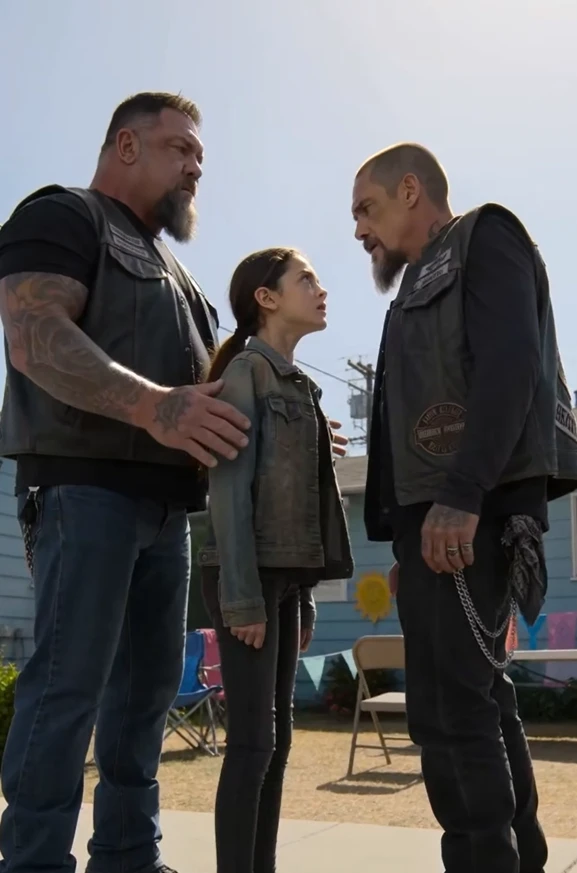
A man dismounted in front of the house.
He was lean, wiry, and cold-eyed, with a salt-and-pepper beard and the same Hells Angels colors Garrett once wore with pride.
Garrett stepped onto the porch.
His face hardened in a way Hadley had never seen.
“Ray.”
“Bear.”
The name carried a history that made the air feel dangerous.
Ray Kessler looked over the lawn, the posters, the kids watching from behind Hadley.
“Nice place.”
His smile was thin.
“Playing house with strays now?”
Hadley’s hands curled.
Garrett’s voice stayed low.
“What do you want?”
Ray lit a cigarette.
“People are asking questions about you.”
“About the old days.”
“People willing to pay for testimony.”
Garrett went pale.
Hadley noticed.
That frightened her more than Ray’s words.
“You wouldn’t,” Garrett said.
Ray exhaled smoke.
“You walked away.”
“Some people don’t forget betrayal.”
“I changed,” Garrett said.
Ray laughed.
“You think feeding throwaway kids makes you clean?”
Throwaway.
The word sliced through Hadley.
Before Garrett could stop her, she stepped between them.
“You don’t know anything about us.”
Ray looked down at her with amusement.
“I know enough.”
“No,” Hadley said.
Her voice shook, then steadied.
“You don’t know what it feels like to be invisible.”
“I was dying when Garrett found me.”
“Starving outside a diner while people walked past.”
“He saw me.”
“He saw a person.”
She pointed toward the house.
“That is what this place is.”
“Kids who have somewhere to sleep.”
“Kids who have food.”
“Kids who have someone who believes they are not garbage.”
Ray’s cigarette burned between his fingers.
Hadley did not look away.
“Whatever Garrett did before, this is who he is now.”
“If you can’t see that, you are the one who’s blind.”
Silence fell.
Ray looked at Garrett.
Then at the kids.
Then at the posters.
Something unreadable moved in his face.
He turned without another word, climbed onto his bike, and rode away.
Only after the sound faded did Garrett breathe again.
“That was either brave or stupid,” he said.
Hadley’s legs started shaking.
“Probably both.”
Garrett rested one heavy hand on her shoulder.
“Probably both.”
But his eyes held respect.
The community event began under a bright spring sky.
The backyard looked transformed.
Tables lined the grass.
Chairs faced a small platform.
String lights waited for dusk.
Food warmed in the kitchen.
People arrived slowly at first.
Then all at once.
Neighbors.
Shop owners.
Teachers.
Social workers.
Former residents who returned as adults with jobs, apartments, children, and stories of how Garrett had kept them alive long enough to build lives of their own.