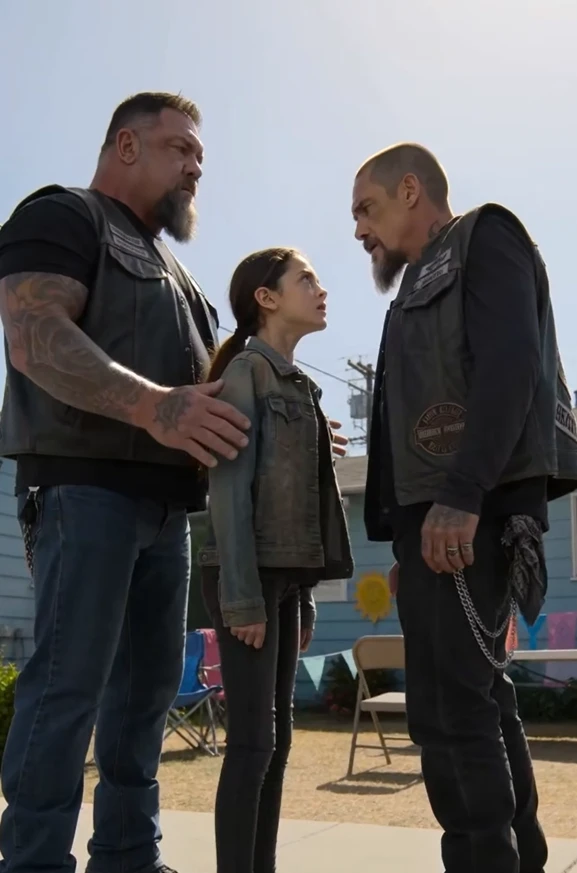
The same company had mistaken a house full of unwanted kids for an easy target.
They were wrong.
Three weeks later, Hadley sat in the front row of the courtroom wearing a clean borrowed dress.
Garrett sat at the defense table.
He looked older.
Thinner.
But when he saw her, he smiled.
The alleged victim took the stand.
His story cracked under questioning.
Then it collapsed.
He admitted he had been paid.
He named the company.
He confessed that Garrett had never asNextlted him.
The courtroom erupted.
The judge called for order.
Before the prosecution could retreat fully, the doors opened.
Ray Kessler walked in.
He was not wearing his Hells Angels vest.
He wore a plain button-down shirt and the face of a man carrying a burden he had finally decided to set down.
“Your Honor,” he said.
“I would like to testify for the defense.”
Ray took the stand.
He said he had known Garrett during the worst years.
He said he had seen Garrett do things neither of them could undo.
Then he said he had seen him change.
“I came to destroy him,” Ray admitted.
“I was offered money too.”
Hadley stopped breathing.
“But I saw those kids.”
Ray’s voice roughened.
“I saw what he built.”
“I am not a good man.”
“But even I know the difference between justice and greed.”
He looked at the judge.
“Garrett paid for his past.”
“Now he is spending what is left of his life helping kids who have nothing.”
“If that house closes so someone can build fancy condos, that is not justice.”
“That is profit wearing a badge.”
By afternoon, the charges were dropped.
The judge ordered an investigation into the development company.
Garrett walked out of the courthouse a free man.
Hadley ran to him on the steps.
Beckett, Sloane, Holden, and Delaney were there too.
So were dozens of supporters.
Garrett held Hadley close.
“You saved us all, kid.”
She shook her head.
“I just told the truth.”
He looked down at her.
“Sometimes that is the bravest thing there is.”
When they returned to the house, the yellow tape was gone.
The front door stood open.
Volunteers had painted the trim.
Flowers lined the path.
The porch railing had been repaired.
Beside the door hung a new sign.
Second Chance Youth Home.
Licensed and approved by the state of California.
Garrett stood in the yard without speaking.
Hadley saw tears in his eyes.
“The community did this,” she said.
“The lawyer handled the paperwork.”
“Businesses donated supplies.”
“People showed up.”
Garrett looked at the sign, then at the kids gathered around him.
“No,” he said softly.
“We did this.”
“This place was never just mine.”
The years that followed proved him right.
Second Chance Youth Home grew.
Donations came.
Social workers who once hesitated began calling for placements.
New kids arrived with guarded eyes, empty stomachs, and stories that made the walls feel heavy.
Hadley learned to meet them at the door.
She learned that the first bowl of soup mattered.
So did the first night of sleep.
So did the first time a kid realized no one was going to throw away their backpack.
She finished her GED with honors.
She earned a scholarship.
She studied social work.
Every weekend, she came back to the blue house.
She cooked meals.
Led group sessions.
Sat on the porch with kids who could not sleep.
She became fluent in the language of silence, flinches, hidden food, locked jaws, and eyes that always searched for exits.
Garrett watched her become exactly who he had known she could be.
“You have a gift,” he told her.
Hadley shook her head.
“I just remember.”
“That is the gift,” he said.
“You remember what invisible feels like.”
Years passed.
Hadley graduated from college.
Garrett stood in the front row at commencement in his leather vest, clapping louder than anyone.
“That’s my girl,” he shouted.
Hadley laughed through tears and held up her diploma.
Six months later, Garrett placed a ring of keys on her desk.
He was older then.
His hair had gone gray.
His body moved more slowly.
Pain lived in him now, even when he tried to hide it.
“I am not dying tomorrow,” he said.
“At least I do not plan to.”
Hadley tried to smile and failed.
“But I am tired.”
“I have run this place for over twenty years.”
“And I know who should run it next.”
Hadley stared at the keys.
“I cannot replace you.”
“I’m not asking you to.”
He leaned forward.
“I am asking you to continue what we started.”
The keys felt heavier than metal when she picked them up.
Responsibility always does.
Hadley became director of Second Chance Youth Home.
Garrett stayed close.
He advised.
He teased.
He argued with donors.
He fixed leaky faucets even when everyone told him not to climb ladders.
But slowly, he stepped back.
Hadley made the hard calls.
She signed the checks.
She met the frightened kids at the door.
She made mistakes.
Garrett never pretended she would not.
“You will mess up,” he told her once.
“The question is what you do after.”
“You keep trying,” she said.
“Always.”
His smile was tired and proud.
“Exactly.”
Garrett died on a Tuesday morning in early autumn.
Peacefully.
Quietly.
Hadley was with him.
She held his hand as his breathing slowed.
“You saved me,” she whispered.
“You saved all of us.”
His eyes opened one last time.
Warm.
Clear.
Still seeing her.
“No,” he breathed.
“You saved yourselves.”
“I just opened the door.”
Those were his last words.
The funeral was standing room only.
Former residents came from across the country.
Teachers.
Neighbors.
Social workers.
People who had once feared him.
People who later trusted him with the most vulnerable children they knew.
Hadley spoke at the service.
She told them Garrett was not perfect.
She told them he had made mistakes.
She told them he had spent years proving that a person could become more than the worst thing they had done.
Then she told them about a hungry girl outside a diner and the four words that changed her life.
Pack your things.
You’re coming with me.
One year later, Hadley sat in her office at Second Chance Youth Home reading intake applications.
The house had expanded into the property next door.
Twelve kids lived there now.
The waiting list was still too long.
A knock came at the door.
Marcus, one of the young staff members, leaned in.
“Someone is here to see you.”
“A girl.”
“Fourteen.”
“No paperwork.”
“No family.”
“Found behind a grocery store near Fourth Street.”
Hadley’s heart tightened.
She knew that neighborhood.
“Send her in.”
The girl appeared in the doorway.
Small.
Thin.
Dirty.
Hair matted.
Eyes huge with the trapped-animal fear Hadley knew too well.
“Hi,” Hadley said softly.
“I’m Hadley.”
“What is your name?”
The girl hesitated.
“Mia.”
“How long since you ate, Mia?”
The silence lasted long enough for Hadley to feel the past step into the room.
“Five days,” Mia whispered.
Five days.
The same number.
The same wound.
The same door waiting to open.
Hadley stood and walked slowly around her desk.
She knelt so they were eye to eye.
“Would you like some soup?”
Mia nodded.
In the kitchen, the yellow cabinets had been repainted, but the room still held Garrett’s presence.
Hadley heated the soup that was always kept ready.
She set a bowl on the table.
She poured water.
She pulled out a chair.
“Sit.”
“Eat slowly.”
Mia lifted the spoon with trembling fingers.
After the first bite, tears slid down her dirty cheeks.
Hadley sat beside her and waited.
She knew better than to rush the moment when a starving child realized the food was real.
Mia looked up.
“Why would you help me?”
Hadley smiled, and for a second she felt Garrett there, not as a ghost, but as a flame passed from one hand to another.
“Because someone did the same for me once.”
She took Mia’s thin hand.
“And now it is my turn to open the door.”
Mia’s lip trembled.
“Can I stay?”
Hadley squeezed her hand.
“For as long as you need.”
Through the kitchen window, the sun lowered over the backyard where kids were laughing beneath the string lights.
The world was still painful.
Still unfair.
Still full of invisible children waiting for someone to stop walking past.
But in that house, the door stayed open.
Garrett’s legacy was not a perfect life.
It was not a clean past.
It was not even rescue in the way people liked to imagine rescue.
It was a bowl of soup.
A safe bed.
A patient silence in a dark room.
A belief offered to someone who had none left.
It was one person choosing to see another.
It was Hadley kneeling beside Mia and speaking the words every lost child deserved to hear.
You’re safe now.
You’re home.