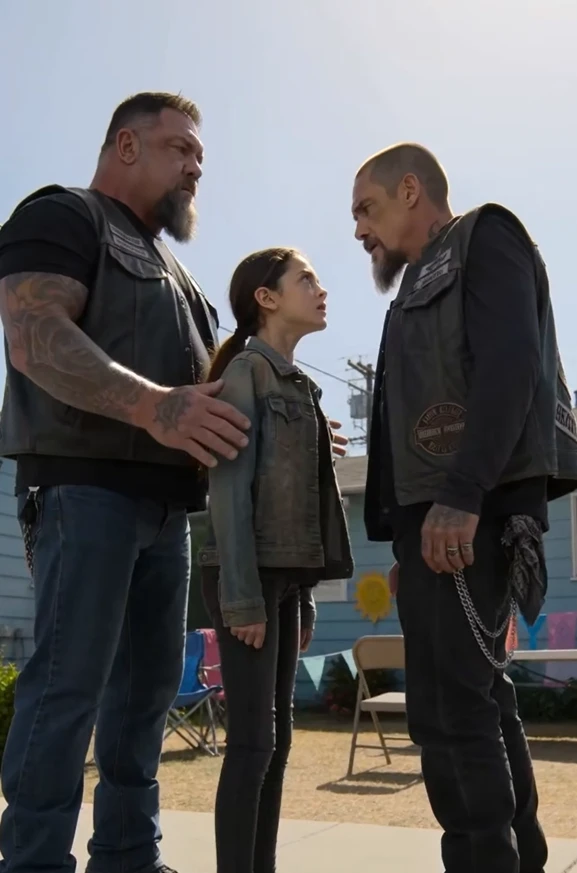
Hadley stood near the platform with her speech folded in her pocket.
Her hands trembled.
A young woman in her mid-twenties approached.
“I was you once,” the woman said.
“Scared.”
“Angry.”
“Sure nobody cared.”
She smiled gently.
“The truth is enough.”
Then Hadley stepped to the microphone.
For a second, the crowd blurred.
She thought of running.
Then she saw Garrett in the front row.
He gave one small nod.
Hadley breathed.
“Five days,” she began.
“That is how long it had been since I had eaten when Garrett found me.”
The backyard went silent.
She told them about hunger.
About being walked past.
About her mother dying of cancer.
About her father vanishing into bottles, pills, and then absence.
About the note on the refrigerator.
I’m sorry.
She told them about shelters that were full and systems that had gaps big enough for a child to fall through.
She told them about the diner.
The curb.
The smell of food.
The man in the Hells Angels vest who should have terrified her and did.
Then she told them about the four words that changed her life.
“Pack your things.”
“You’re coming with me.”
Murmurs passed through the crowd.
Hadley’s voice grew stronger.
“He did not ask what was wrong with me.”
“He did not ask what I could give him.”
“He did not see a burden.”
“He saw me.”
She looked at the house.
“This place is not pity.”
“It is not charity.”
“It is what happens when someone decides that invisible kids are worth seeing.”
She turned back to the crowd.
“I know Garrett has a past.”
“I am not here to excuse it.”
“But I am here to tell you who he is now.”
“He is the man who fed me when I was starving.”
“He is the man who gave Beckett a place to be safe.”
“He is the man who taught us that our past does not have to own our future.”
Garrett had tears on his face.
Hadley had never seen him cry before.
She finished with the only truth that mattered.
“This house is worth fighting for.”
For two heartbeats, nothing happened.
Then the applause rose.
People stood.
Some cried.
Some clapped with both hands over their hearts.
Garrett pulled Hadley into a hug that lifted her off her feet.
“You did it, kid,” he whispered.
“You really did it.”
For forty-seven minutes, everything seemed possible.
Then the police cars arrived.
Three of them.
Lights flashing.
No sirens.
That made it worse.
Detective Brennan stepped out with a folded document in her hand.
Uniformed officers spread across the lawn.
The crowd fell silent.
“Mr. Calloway,” Brennan said.
“I have a warrant for your arrest and an order to shut down this facility immediately.”
The words seemed to hit the yard like a physical blow.
Garrett stepped forward.
“On what grounds?”
“A formal complaint has been filed by a victim from your Hells Angels days.”
Brennan’s voice stayed cold.
“Allegations of asNextlt.”
“Additionally, this facility is operating without proper licensing.”
Hadley moved before she thought.
“That’s a lie.”
An officer stopped her gently.
Garrett looked at her.
“Don’t fight it.”
The handcuffs clicked around his wrists.
That sound entered Hadley and stayed there.
Social workers arrived.
Clipboards.
Questions.
Black bags.
Temporary placements.
Sloane cried as she packed.
Holden argued and was guided toward a car.
Beckett looked white with shock.
Delaney held her cards from the living room game like they were proof that yesterday had existed.
Yellow tape went across the front door.
The house with the blue paint went dark.
The crowd dispersed.
Garrett was gone.
The others were gone.
Hadley, sixteen and still easy for systems to misplace, stood on the sidewalk with her backpack and a promise from a social worker that someone would be in touch.
No one was.
That night she walked until her feet hurt.
She ended up in the same park where she had slept before Garrett.
The bench was cold.
Her stomach began to gnaw again.
She took out her mother’s photograph and held it to her chest.
For one terrible moment, she thought hope had been the cruelest thing of all.
Then her mother’s voice rose in her memory.
You’re stronger than you know, Hadley.
No matter what happens, you have the strength to survive.
Hadley opened her eyes.
She was not the girl Garrett had found outside the diner.
Not anymore.
He had fought for her when she could not fight for herself.
Now she would fight for him.
By dawn, she was standing in the lobby of a local news station.
A security guard looked up from his phone.
“Can I help you?”
Hadley was exhausted, hungry, and shaking.
“I need to talk to someone about a story.”
He looked doubtful.
“It’s important,” she said.
“It’s about homeless teens.”
“And a man who tried to help them.”
“And a system that just destroyed the only safe place they had.”
Something in her voice made him pick up the phone.
Twenty minutes later, reporter Sarah Martinez entered the lobby.
Sharp eyes.
No-nonsense face.
Press badge clipped to her jacket.
“You’re the girl with the story?”
Hadley stood.
“Yes.”
Sarah led her into a meeting room.
A recorder blinked red between them.
“Start at the beginning.”
So Hadley did.
She told everything.
Not the pretty version.
The true one.
The cancer.
The abandonment.
The hunger.
The diner.
The soup.
The house.
The other kids.
The police.
The handcuffs.
The yellow tape.
Sarah did not interrupt.
When Hadley finished, the reporter set her pen down.
“Going public will not be easy.”
“I know.”
“People will judge you.”
“I know.”
“They will pick apart your life.”
Hadley thought of Garrett in handcuffs.
“He saved my life.”
Her voice steadied.
“Now it is my turn to save his.”
The story aired that evening.
Hadley watched from a coffee shop where the owner had given her a sandwich and hot chocolate after hearing only a piece of what had happened.
On the screen, Sarah Martinez looked into the camera and spoke about a controversial youth program, a former biker, and children with nowhere else to go.
Then Hadley’s face appeared.
“Five days,” her recorded voice said.
“That is how long it had been since I had eaten when Garrett found me.”
The coffee shop went quiet.
Customers stopped talking.
Phones came out.
The story showed former residents.
Teachers.
Social workers.
Business owners.
People who had seen Garrett’s work and had stayed silent too long.
Then Sarah reported something that changed everything.
The man accusing Garrett had financial troubles.
Sources believed he may have been paid.
Within hours, the phones at the station flooded.
Local outrage became regional attention.
Then national.
A lawyer who had attended the community event took Garrett’s case for free.
A fundraiser started by a stranger raised thousands overnight.
Then another journalist dug deeper.
The accusation had not come from old revenge.
It had been bought.
The money traced back to a real estate development company.
The same company had been trying to buy Garrett’s property for months.
The same company stood to profit if the youth home closed.