She Served a Stranger. The Town Never Saw the Reckoning Coming.
The first sign that the morning was about to go wrong was so small nobody else noticed it.
A cup shattered near table six. A baby started crying by the window. Somebody in the drive-thru leaned on the horn for half a second too long. Inside Desert Bloom Café, the breakfast rush moved with its usual chaos—orders barked, plates sliding, coffee pouring, the smell of bacon and cinnamon woven into the air.
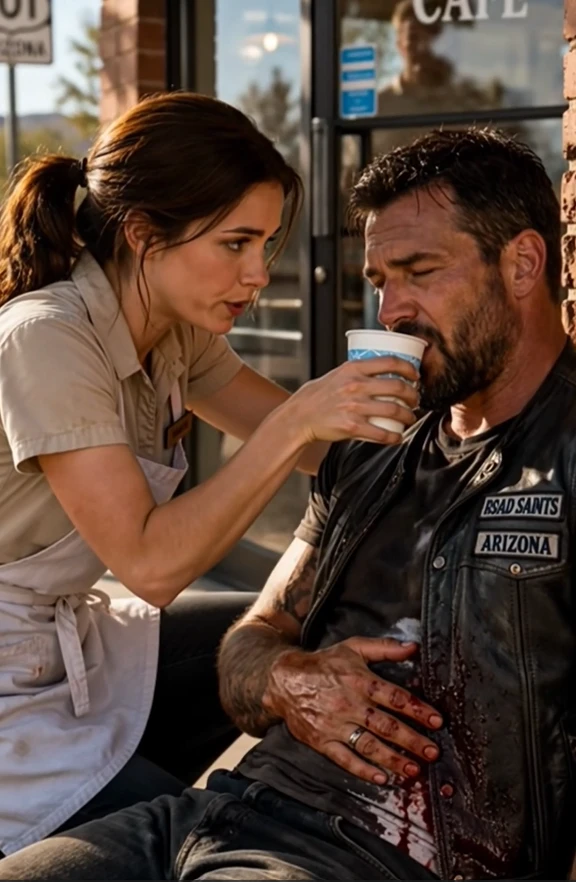
And then, beyond the front glass doors, **a man in a leather vest slowly sank against the brick wall like his body had finally given up negotiating with pain**.
Maren Holt saw it.
She was balancing two coffees and a plate of toast when she froze mid-step. **Something in the way he held himself hit her harder than the sight of him**. He wasn’t drunk. He wasn’t causing trouble. He was trying—desperately—to avoid becoming anyone’s problem.
“Maren,” her manager snapped from behind the register. “Table four.”
But she kept looking.
The man was huge, the kind of huge people noticed before they noticed anything human underneath. **Broad shoulders. Weathered hands. Tattoos along both arms. Leather vest. Motorcycle helmet beside one boot.** The whole shape of him screamed biker, and in places like this, that was enough for people to make up the rest.
Her manager, Denny Cross, followed her gaze and frowned.
“Don’t,” he said quietly. “We don’t get involved in that.”
Maren set the coffees down on the counter. “He looks hurt.”
“He looks like trouble.”
She didn’t answer. **She had spent too much of her life watching people confuse those two things**.
Arizona had been her restart. New state. New apartment. New job. No one here knew about her mother’s debts, her ex-fiancé’s lies, or the ugly months she’d spent sleeping on a friend’s couch after her life had caved in all at once. Here, she was just Maren—the waitress who remembered names, worked doubles without complaining, and smiled even when her feet ached.
She liked that version of herself.
Maybe that was why she couldn’t stand there and do nothing.
She grabbed a paper cup, filled it with water, and walked outside.
The heat hit her first. Then the silence. Up close, the man looked worse than she’d thought. His face was pale under a week’s worth of stubble, and sweat clung to his forehead. One hand pressed hard against his ribs.
“You okay?” she asked.
He let out something halfway between a laugh and a wince. “Do I look okay?”
“No,” Maren said honestly.
For the first time, he looked at her fully. His eyes were clear, blue-gray and sharp despite the pain. “Bike rolled on loose gravel,” he muttered. “Thought I could ride it off. Guess not.”
He shifted, and his jaw clenched so hard a muscle jumped. That was when Maren saw it—**a dark stain spreading low across his shirt beneath the vest**.
“You’re bleeding.”
“It’s fine.”
“It is absolutely not fine.”
Inside, Denny pushed open the door. “Maren!”
She ignored him and crouched beside the stranger. “You need a medic.”
“No hospitals.”
“You don’t get to be dramatic with me while actively bleeding.”
That earned the faintest ghost of a smile. “Name’s Rhett.”
“Maren.” She looked toward the road. “Can you stand if I help you?”
Before he could answer, Denny strode outside.
“What did I say?” he barked. “Get back inside. Right now.”
Maren stood. “He’s injured.”
“And you are on shift.”
“He needs help.”
Denny lowered his voice, but it came out harsher. “Customers are already staring. We are not turning this place into some roadside biker shelter.”
Rhett’s face closed off instantly, not embarrassed exactly—just familiar with being talked about like a stain nobody wanted to touch.
Something in Maren snapped.
“He’s a person,” she said.
Denny folded his arms. “And you’re fired if you don’t get back in here this second.”
There should have been hesitation. Rent was due in nine days. She had forty-three dollars in checking until payday. **This job was not just a job. It was survival**.
But she looked at Rhett, at the blood he was trying to hide, at the expression on Denny’s face, and suddenly the choice felt disgustingly simple.
Maren untied her apron and set it on the outdoor table.
“Then I’m fired.”
For one breathless second, even Denny seemed surprised she’d done it.
Then he snatched up the apron. “You’ve got five minutes to clear your locker.”
Maren turned back to Rhett. “Can you walk?”
He stared at her like he didn’t understand what kind of person would throw away her paycheck for a stranger. “Why are you doing this?”
She slid his arm carefully over her shoulders. “Because no one did it for me when I needed it.”
They made it to the shade of the building before a pickup truck pulled into the lot and stopped hard. Two bikers jumped out—an older woman with silver braids under a bandanna and a younger man with a beard down to his chest.
“Rhett!” the woman shouted.
He lifted one weak hand. “Easy, Jo. I’m still alive.”
Jo rushed forward and took one look at the blood. Her eyes snapped to Maren. “You stayed with him?”
Maren nodded.
The younger biker muttered a curse and ran to the truck for a first-aid kit. Jo’s movements were fast and sure as she checked Rhett’s side.
“Cracked ribs, maybe worse,” she said. “We’re taking him to Doc Alvarez.”
“Not hospital?” Maren asked.
Jo looked up sharply, then softened. “Retired trauma surgeon. Rides with us now.”
Rhett caught Maren’s sleeve before they moved him. “You lose your job over this?”
She tried to shrug. “Apparently.”
He held her gaze a second longer. “That was a hell of a thing to do.”
She almost laughed. “I’m not feeling very heroic.”
“No,” he said quietly. “Most real courage doesn’t.”
They got him into the truck. Before climbing in, Jo asked, “You need a ride anywhere?”
Maren glanced back through the café windows. Denny was already talking animatedly to customers, probably turning the whole thing into some story about protecting the business from dangerous people.
“I’ve got my car,” she said.
Jo pulled a worn card from her pocket and pressed it into Maren’s hand. A name was embossed across the front:
**Ruth “Jo” Callahan
Road Saints Foundation**
“Come by if you need help,” Jo said. “That man doesn’t forget debts.”
The truck left. Maren stood alone in the parking lot with no apron, no shift, and no plan.
By noon, she had emptied her locker into a grocery bag and driven home in tears she kept angrily wiping away.
By two, the story was already moving through town.
Not the truth.
The café version.
That she’d abandoned the counter. That she’d chosen a “gang member” over customers. That she’d caused a scene. By four, someone had posted a grainy photo online of Maren outside with Rhett, captioned: **Some people care more about bikers than paying customers.**