She stared at the post from her tiny apartment, humiliation burning in her chest. Then her phone buzzed.
Unknown number.
You home? — Jo
Maren typed back yes before she could overthink it.
Fifteen minutes later, three motorcycles rolled quietly into her apartment complex. Not roaring. Not intimidating. Just present.
Jo came up the stairs carrying a paper bag that smelled like soup. “Rhett’s patched up. Two cracked ribs, deep bruising, nasty cut. He asked me to check on you.”
“You didn’t have to.”
“We know.” Jo handed her the bag. “That’s why we did.”
Inside the bag was soup, bread, and an envelope. Maren opened it and froze.
Five hundred dollars.
Her head jerked up. “I can’t take this.”
“It’s not charity,” Jo said. “It’s bridge money. Until you get steady again.”
Maren’s throat tightened. “Why would strangers do this for me?”
Jo gave a sad smile. “Because we know what it is to be judged before we even speak.”
Then she added, “Tomorrow morning, maybe don’t go near that café.”
Maren frowned. “Why?”
Jo looked toward the sunset, where engines murmured below. “Because word travels fast among people society likes to underestimate.”
The next morning, Desert Bloom Café opened at six.
At six-ten, the first motorcycle arrived.
Then another.
Then another.
By six-thirty, **a silent line of bikers stretched along the curb in front of the café—men and women of every age, every race, every kind of face, all standing beside their parked motorcycles in absolute, unnerving stillness**.
They did not shout.
They did not threaten.
They simply formed a line.
Inside, panic spread faster than coffee orders. Denny called the sheriff before anyone had even entered.
Maren found out because Jo texted her a single photo.
The line of bikers.
Silent.
Waiting.
Her heart dropped. She grabbed her keys and drove.
By the time she reached the café, two patrol cars were already there. A crowd of onlookers had gathered across the lot, phones out, eager for drama.
But the bikers weren’t causing any.
Rhett stood near the front now, bandaged but upright, one arm in a sling. He looked pale, exhausted, and immovable.
Maren pushed through the spectators. “What are you doing?”
Several heads turned. Rhett looked at her, and relief flickered through his face.
“Making a point,” he said.
“This is not making a point. This is making me nauseous.”
Jo stepped beside him. “No laws broken. No threats made. We’re customers.”
Sure enough, each biker held either cash in hand or helmets tucked under one arm as if waiting their turn to order.
Denny burst out the front door, red-faced. “There she is! She brought them here!”
“I did not,” Maren snapped.
The sheriff, a heavyset man named Collins, looked between them. “Is this your group?”
Rhett answered evenly. “We came to spend money at a local business. One customer at a time. Quietly. Unless service is refused.”
Denny barked a humorless laugh. “I have the right to refuse service.”
A voice from the line answered, calm and female. “Not for appearances alone.”
Another biker stepped forward—an older Black man in a pressed vest covered not in outlaw patches, but pins from charity rides, veteran fundraisers, and blood drives.
Then another.
And another.
One by one, they began setting things on the outdoor tables.
A framed certificate from a children’s burn hospital thanking the Road Saints Foundation for donations.
A photo of bikers delivering Christmas gifts to a shelter.
A plaque for wildfire relief fundraising.
A folded newspaper clipping about a toy run.
A memorial bracelet.
A military commendation.
The murmuring crowd went quiet.
Jo faced them all. “You see leather and decide the rest. But these people raised money for my daughter’s cancer treatment. That man—” she pointed at Rhett “—paid for three funerals after a drunk-driving crash because the families couldn’t. Hank over there spent twenty-two years as a medic. Tessa runs a foster program. We bury veterans no one claims. We build wheelchair ramps. We escort abused kids to court so they don’t walk in afraid.”
Every word landed like a hammer.
Denny scoffed, but it sounded weaker now. “This is a stunt.”
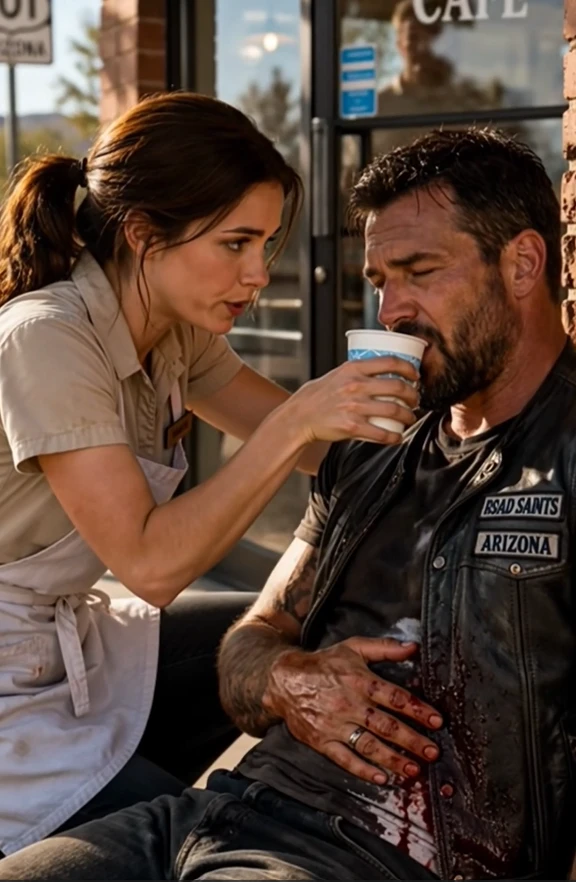
Rhett stepped forward carefully, pain tightening his face. “No. A stunt is firing a waitress for giving water to an injured man because you didn’t like what he looked like.”
The crowd shifted.
Phones tilted toward Denny now.
Maren wanted to disappear. Instead, she lifted her chin. “He was bleeding. I helped him. That’s all.”
From somewhere behind the spectators, a woman’s voice rang out. “I was here yesterday. She’s telling the truth.”
A woman in hiking clothes stepped forward. “Your manager told her not to help. I heard him.”
Then a trucker raised his hand. “So did I.”
Another customer nodded. “He called them trouble before the guy said one word.”
Denny’s confidence cracked right down the middle.
Sheriff Collins exhaled slowly. “Mr. Cross, maybe you want to stop talking.”
But Denny was the kind of man who only knew how to double down. “This is harassment. All because she made a stupid choice.”
Rhett stared at him a long second. Then he reached into his vest and pulled out a folded document.
He handed it to Collins.
The sheriff read the first page, blinked, then read it again.
“What is that?” Denny demanded.
Collins looked up. “A purchase agreement.”
Maren frowned. “For what?”
Rhett’s gaze never left Denny.
“For this property.”
Everything stopped.
Denny laughed too quickly. “That’s impossible.”
“It was in escrow,” Rhett said. “Owner signed two weeks ago. Close of business today. I was here yesterday to look at the place before final transfer.” He paused. “I like old roadside buildings. Been restoring them into community kitchens through the foundation.”
Jo smiled faintly. “This would’ve been number four.”
The silence that followed was devastating.
Maren felt like the world had tilted under her feet.
Rhett went on, voice low and steady. “I was going to come inside after I caught my breath. Meet the manager. Talk plans. Keep the staff who cared about people. Invest in the place.” His jaw hardened. “Then yesterday happened.”
Denny’s face went white. “You’re lying.”
Collins handed him the first page. “Looks real enough.”
Rhett took one careful step closer. “The owner already heard what happened. After I called last night, he agreed to amend one part before closing.”
Denny’s hand trembled as he scanned the paper. “What part?”
Rhett’s expression didn’t change.
“Management.”
For a second Denny just stood there, breathing through his mouth.
Then the crowd began to murmur again, only this time it wasn’t fear. It was something sharper. Satisfaction. Shame. Realization.
Maren’s heart pounded so hard it hurt. “You bought the café?”
Rhett looked at her. “Was buying it anyway.”
She laughed once in disbelief, almost angry with it. “That is an insane twist to a terrible week.”
A genuine smile touched his mouth. “Yeah. Been told that.”
By noon, Denny was gone.
By one, the line of bikers had finally moved—inside, one by one, buying coffee, tipping heavily, thanking the stunned cooks and servers who had remained silent the day before but now looked like they were waking from something ugly.
By three, Rhett gathered the staff.
He stood carefully, favoring his ribs, while Jo leaned against the counter beside him.
“No one here is required to stay,” he said. “But this place is changing. New name. New rules.” His eyes moved across every face. “We serve people. All people. We don’t punish kindness here.”
Then he looked at Maren.
“If she wants it, the first offer I’m making is manager.”
The room fell into astonished silence.
Maren actually looked behind her to make sure there wasn’t another woman standing there.
“I have never managed anything,” she said.
Rhett’s eyes warmed. “Yesterday you managed to be the only person with any courage.”
Her throat tightened so suddenly she couldn’t speak.
She accepted.
Three months later, the old Desert Bloom sign came down.
In its place went a new one:
**Second Mile Café**
Below it, in smaller letters:
**Coffee. Breakfast. No Judgment.**
Travelers stopped for the novelty. Locals stayed for the food. Veterans had breakfast discounts. Social workers ate free on Thursdays. A donation board near the register funded gas cards, medical rides, and emergency meals. On weekends, motorcycles lined the curb—not as a warning, but as a welcome.
And Maren, who once thought five minutes of kindness had cost her everything, stood behind the counter of a place reborn from that very choice.
One evening, as sunset poured copper over the highway, Rhett sat at the counter with a cup of black coffee and watched the room hum with life.
“You ever regret it?” he asked.
She smiled, wiping down the espresso machine. “Getting fired?”
“No. Stepping outside.”
Maren looked around the café—the laughing family in the corner booth, Jo teaching a new server how to carry four plates at once, Hank fixing a wobbling chair, the bell over the door ringing as two dusty riders walked in and were greeted with warmth instead of suspicion.
Then she looked back at Rhett.
“Not for a second,” she said.
Because in the end, **the town had been right about one thing**.
That moment outside had changed everything.
They had just been wrong about who should be feared.
It was never the man in the leather vest.
It was the kind of judgment that made people walk past someone in pain and call it good business.