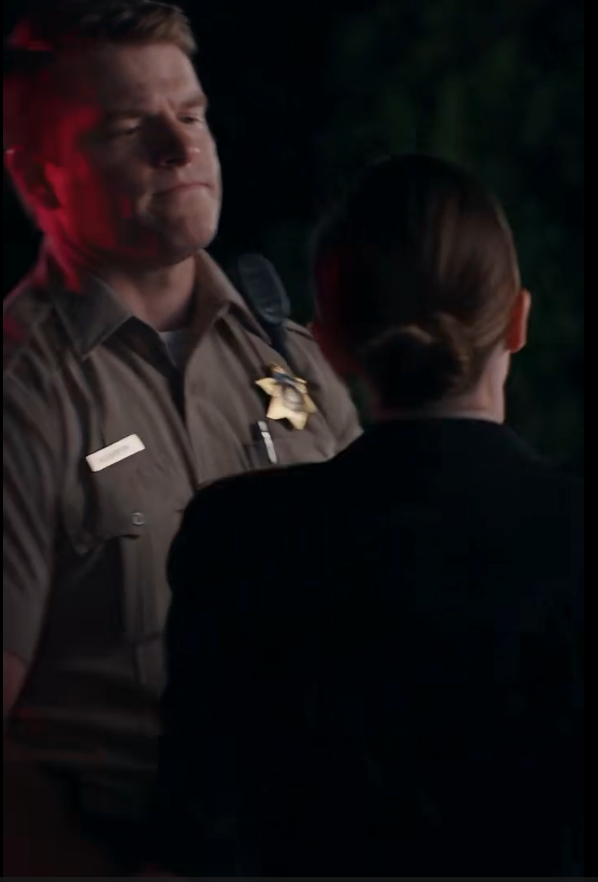
Chapter 4
At 1:07 a.m., I arrived at a federal building thirty miles away wearing my Army dress uniform beneath a borrowed black coat.
No handcuffs.
No patrol car.
No explanation.
They placed me in a conference room with no windows.
There was coffee I did not drink.
A television mounted on the wall showed a live evidence log.
Outside the glass, agents moved quickly.
Three agencies.
Then four.
FBI.
Army CID.
DoD Inspector General.
Department of Justice National Security Division.
I had seen multinational operations with less coordination.
Vale entered carrying a folder.
“You need to know some things.”
“Good.”
“You also need to understand there are things I still cannot tell you.”
“I was dragged out of my car, handcuffed, and apparently targeted on the same night I was promoted. I think we’ve passed the point where withholding information helps.”
He sat.
“Fair.”
He opened the folder.
Inside was a photograph.
Old.
Grainy.
A man in Army uniform stood beside a military Humvee.
My breath stopped.
My father.
Major Marcus Carter.
He had died when I was eleven.
Officially, he had been killed in a helicopter accident during a training mission.
The photograph showed him younger than I remembered.
Same strong jaw.
Same slight tilt in his smile.
“What does my father have to do with this?”
Vale slid another page toward me.
A report title.
CARTER REVIEW.
Classification markings.
Date: seventeen years earlier.
“Your father discovered evidence that military transportation contracts were being manipulated to move restricted equipment through civilian law-enforcement channels.”
I stared at him.
“What?”
“He believed a network of defense contractors, police departments, logistics personnel, and military officers were using legitimate government shipments to hide unauthorized transfers.”
“Transfers of what?”
“At the time? Surveillance hardware. Secure radios. Weapons components. Later, encryption technology.”
My throat tightened.
“And Carter Protocol?”
“Was named after him.”
The room suddenly felt smaller.
Vale continued.
“Your father reported the operation internally. Before investigators could act, he died.”
“You’re saying his accident wasn’t an accident.”
“I’m saying the investigation never conclusively established what happened.”
“That is not the same answer.”
“No.”
I stood.
My chair rolled backward.
“For seventeen years my mother believed he died because a rotor assembly failed.”
Vale didn’t move.
“Your mother was told what the Army believed it could prove.”
“What did you believe?”
He looked me straight in the face.
“That someone killed him.”
I had imagined many versions of my father’s death as a child.
Fire.
Impact.
Fear.
Had he known?
Had it been fast?
Had he thought of us?
Eventually I learned not to ask.
Now every question returned at once.
I gripped the edge of the table.
“Who?”
“We never knew.”
“And tonight?”
“Tonight may have reopened the case.”
He slid another photograph forward.
Police Chief Raymond Voss.
Next to him stood a younger man.
I recognized him.
General Stephen Rainer.
The photograph had been taken fifteen years earlier.
They were standing at a fundraising event for a defense logistics company called Meridian Strategic Systems.
Vale tapped the company name.
“Meridian was investigated twice in connection with your father’s report.”
“Was Rainer involved?”
“Never charged.”
“That isn’t what I asked.”
Vale hesitated.
“He was questioned.”
I sat down slowly.
General Rainer had known me since I was twenty-three.
He had written one of my recommendations for command.
He had visited my mother after surgery.
He had called me after my second deployment.
Tonight, he had pinned captain’s bars onto my shoulders.
Then given me an envelope that vanished during a targeted traffic stop.
“What was in the envelope?”
“We don’t know.”
“He wrote it.”
“Maybe.”
I looked at him.
“You think it might not have been from Rainer.”
“We think somebody wanted you to believe it was.”
Before I could answer, the conference-room door opened.
An agent entered.
“Sir, we found the missing body-camera segment.”
Vale stood.
“What missing segment?”
“Mercer’s body camera dropped twenty-seven seconds during the stop.”
“I thought Carter Protocol preserved everything.”
“It did.”
The agent looked at me.
“That’s how we recovered what he tried to delete.”