Part I — The Line
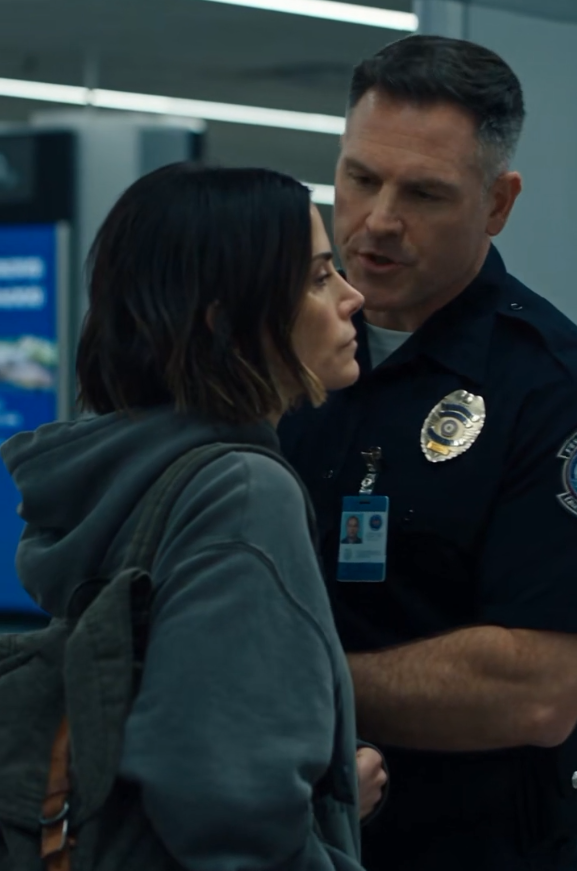
The handcuff was cold against my wrist when a voice behind Officer Richard Dawson said his name, and for the first time all night, the man holding me looked less like an authority figure than a defendant.
“Dawson.”
He stopped.
Not gradually. Not reluctantly.
His entire body locked.
The metal cuff rested against the inside of my wrist without closing. His other hand was still twisted around my arm, holding it behind my back. A moment earlier, his grip had been confident enough to hurt. Now his fingers loosened by a fraction.
Around us, the airport terminal remained frozen in that peculiar public way people freeze when they realize they may have witnessed the instant before something becomes serious.
I could hear a rolling suitcase somewhere behind the security line.
A departure announcement echoed from the concourse.
Someone’s phone chimed.
Nobody spoke.
Dawson turned his head.
I followed his gaze.
The woman standing ten feet behind him wore a dark business suit beneath a government-issued identification badge. She was in her late fifties, silver threaded through short brown hair, posture straight, expression unreadable.
Her name was Miriam Vale.
She ran security operations for the entire terminal.
And until that moment, Dawson had not known she was in the building.
“Director Vale,” he said.
His voice changed.
Not much.
Enough.
The arrogance that had filled every word he had spoken to me disappeared beneath the careful tone of a man trying to reconstruct the last thirty seconds before they hardened into consequences.
Vale’s eyes moved from his face to his hand around my wrist.
“Release her.”
Dawson did.
Immediately.
Blood returned sharply to my fingers. I brought my arm forward without rubbing it. The skin around my wrist had already begun turning red.
Dawson noticed.
Then he noticed Vale noticing.
“I was conducting a lawful detention,” he said.
Vale’s gaze shifted to the handcuffs.
“They’re open.”
“I hadn’t completed the detention yet.”
“Why were you detaining her?”
“She presented suspicious credentials.”
I raised my phone.
“He never scanned them.”
Dawson looked at me as though I had violated some private agreement by speaking.
Vale held out her hand.
I passed her the phone.
She examined the screen.
The boarding credential was valid. The security status was valid. The identity information matched.
She handed it back to me.
“How did you determine it was suspicious?” she asked him.
Dawson’s jaw tightened.
“Behavior.”
“What behavior?”
“She was argumentative.”
“I asked you to scan my pass.”
His eyes snapped toward me.
Vale did not.
She kept watching him.
“That’s the argumentative behavior?”
Dawson’s mouth opened, but nothing useful came out.
I had known this moment was possible. I had imagined it many times during the three weeks we spent planning the operation.
In my imagination, it had felt satisfying.
It did not feel satisfying now.
My wrist hurt.
People were staring.
And Richard Dawson, for all his size and polished confidence, suddenly looked like a man who understood that the room had changed around him.
That was the problem with accountability.
From a distance, people imagined it as a clean moral event. Someone did something wrong. Someone stronger arrived. The truth appeared. Justice followed.
In real life, accountability was paperwork, frightened witnesses, defensive supervisors, lawyers, conflicting memories, institutional embarrassment, and people discovering that telling the truth could be much more expensive than living with a lie.
Vale looked past Dawson toward the line.
“Everyone remain where you are for a moment, please.”
That created movement.
Travelers began checking watches.
A man in a suit groaned quietly.
A mother several positions back pulled her carry-on closer to her leg and whispered something to her husband.
Dawson glanced at them.
He knew what I knew.
The longer they stood there, the more witnesses existed.
“Director,” he said quietly, “perhaps we should discuss this away from the checkpoint.”
Vale’s expression did not change.
“We will.”
Then she looked at me.
“Ms. Hayes?”
Dawson stared at her.
I watched recognition arrive.
Slowly.
First the name.
Then the possibility.
Then the reason I had not been afraid enough.
His face lost color.
“You know her?”
Vale did not answer.
I slipped my phone into the front pocket of my hoodie.
“My name is Evelyn Hayes,” I said.
Dawson’s eyes stayed on me.
Three minutes earlier, he had called me a fraud.
Now he looked as if he wished he had asked one more question before touching me.
I picked up my backpack from the floor.
“I think we should talk somewhere private.”
Vale nodded.
Dawson did not move.
“Am I being suspended?”
Vale looked at him.
“You are being removed from screening duties pending review.”
“For what? Doing my job?”
“No,” I said.
He turned toward me.
“For deciding what your job allowed before you bothered finding out what the facts were.”
His nostrils flared.
Vale stepped between us, not dramatically, simply positioning herself where a supervisor should have been from the beginning.
“Turn over your access card.”
Dawson stared at her.
“Now.”
He reached toward the badge clipped to his belt.
His hand shook once.
Barely.
Then he handed it over.
The passengers behind us had gone completely quiet.
I looked at their faces.
Some curious.
Some uncomfortable.
A few avoiding my eyes.
One young man who had laughed earlier was staring at the floor.
I remembered his smirk.
I also remembered that he had not been the one with power.
That distinction mattered.
Vale gestured toward the administrative corridor behind the checkpoint.
Dawson walked first.
I followed.
As I passed beneath the fluorescent lights, I looked down at my wrist.
Four pale marks were already rising under the skin.
I had spent twenty years studying what authority did when it believed nobody important was watching.
Tonight I had stepped into the picture myself.
And Dawson had given us more in four minutes than three months of complaints had managed to prove.
What I did not yet understand was that Dawson was only the easiest part of the problem.
The harder part was waiting behind a locked office door.
And it had been there long before I arrived.
Three weeks earlier, Richard Dawson had been a name in a file.
Not an extraordinary file.
That was important.
Extraordinary cases attracted attention. They arrived with lawyers, reporters, photographs, medical records, and language strong enough to make senior people nervous.
The Dawson file was worse.
It was ordinary.
Thirty-one complaints over four years.
Nine formal.
Twenty-two informal.
Passengers reported being singled out, mocked, threatened with detention, moved out of expedited lanes without explanation, accused of lying about credentials, or pressured to open personal belongings outside standard procedure.
None of the complaints, standing alone, was spectacular.
Together, they formed a shape.
I first saw it on a gray Tuesday morning.
I was sitting in a windowless review room with three monitors and coffee that had gone cold an hour earlier. On one screen was a spreadsheet of passenger complaints. On another were shift assignments. On the third, security footage from a terminal checkpoint.
I had been asked to review a pattern of “service concerns.”
That phrase told me everything about how uncomfortable the organization already was.