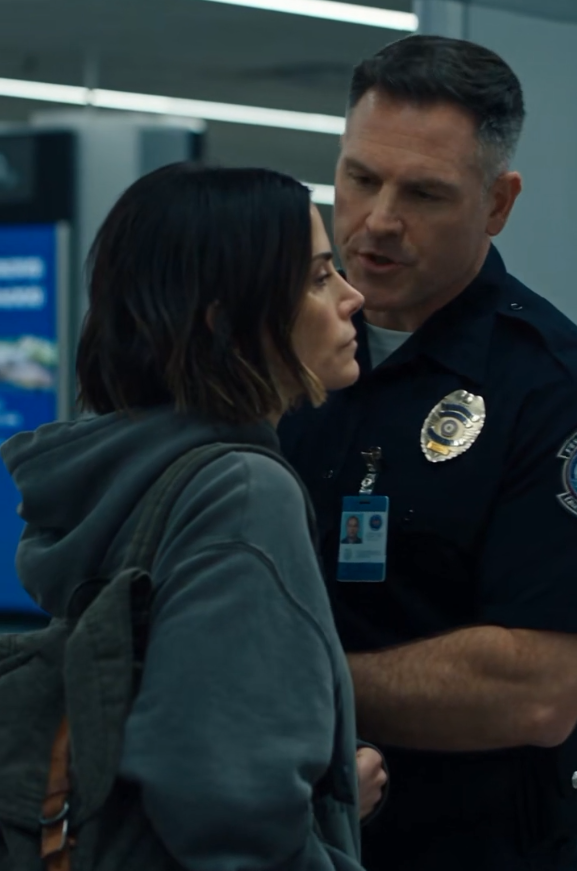
Sore.
Functional.
I photographed it against the white bathroom counter, added the image to the case file, and disliked myself for how automatic the process felt.
Documentation turned pain into evidence.
Evidence made pain useful.
That was one of the stranger lessons of my career.
At eight fifteen, Vale sent me the personnel file.
At eight thirty-seven, I found the first problem.
Complaint number seven had been marked “reviewed—no corroboration.”
The complainant was a sixty-three-year-old woman traveling alone.
Her statement said Dawson accused her of trying to use someone else’s expedited status. She insisted the credential was hers. He sent her to general screening and told her that arguing could result in removal from the airport.
The review notes said video showed “no visible escalation.”
I opened the footage.
No audio.
Dawson stood close to the woman.
She held out her phone.
He never touched it.
After forty seconds, he pointed away from the line.
The woman remained still.
He stepped closer.
She left.
I watched it again.
Then I checked the timestamp against scanner records.
Her credential had never been scanned.
I sat back.
Complaint fourteen.
Different month.
Different passenger.
Same accusation.
Credential never scanned.
Complaint nineteen.
Same.
Twenty-three.
Same.
Twenty-eight.
Same.
Five complaints involving allegedly improper expedited access.
Five cases where Dawson claimed credentials appeared suspicious.
Five cases where he never scanned the credential.
That was not proof of every allegation.
It was something better than coincidence.
I called Vale.
She answered immediately.
“What?”
“Do you have scanner logs archived by station?”
“Yes.”
“For how long?”
“Years.”
“I need all logs for Dawson’s assigned positions corresponding to every complaint.”
A pause.
“What did you find?”
“I’ll tell you when I know.”
“Evelyn.”
“Miriam, if I tell you now, you’ll start interpreting.”
“That’s my job.”
“Not today.”
She went silent.
Then, “You’re enjoying this.”
“No.”
“You sounded like you were.”
“I sound like this when I have work.”
“You always this pleasant?”
“Usually worse.”
This time she did laugh.
Briefly.
Then she stopped.
“I’ll send the logs.”
I hung up.
At eleven forty-two, I found the second problem.
Three complaints had been closed based partly on supervisory notes stating that Dawson’s conduct “appeared consistent with standard discretionary screening practice.”
All three notes used identical language.
All three were approved by the same manager.
Miriam Vale.
I printed them.
Then I stared at her signature.
That afternoon, she came to the review room carrying two coffees.
She put one beside me.
I pointed at the pages.
“You wrote these?”
Vale read the first note.
Her expression did not change.
Then the second.
Then the third.
“Yes.”
“Why are they identical?”
“Template language.”
“Did you review the footage personally?”
“I don’t remember.”
“You signed them.”
“I signed hundreds of reviews.”
“That isn’t an answer.”
“It’s the only one I have.”
I slid another document toward her.
“Complaint nineteen. Passenger says Dawson threatened detention after refusing to scan her pass.”
Vale read it.
“I know.”
“You approved no finding.”
“Yes.”
“Scanner records show no attempt to verify her credential.”
Vale looked up.
“So?”
“So Dawson’s written response said the credential failed verification.”
Her face went still.
I pushed the scanner log toward her.
“No scan occurred.”
Vale did not touch the paper.
For several seconds, the only sound in the room was the ventilation system.
Then she pulled out a chair and sat.
“How many?”
“I’ve confirmed five so far.”
Her voice dropped.
“Five false statements?”
“Five statements that conflict with electronic records.”
“Why didn’t anyone compare them?”
I looked at her.
She closed her eyes.
“Right.”
That was the moment the case changed.
Until then, Dawson had been the subject.
Now he was a symptom.
Part III — Reversal
The oldest false record was thirty-eight months old.
That mattered more than anything Dawson had done to me.
My bruise would heal.
The system’s mistake had lasted more than three years.
Vale and I spent the next two days rebuilding complaint histories from raw records.
No shortcuts.
No conclusions first.
We matched shift schedules to camera footage. Scanner activity to timestamps. supervisor notes to witness statements.
The pattern became clearer.
Dawson did not target everyone.
He targeted opportunity.
Passengers who appeared unlikely to understand procedure well enough to challenge him.
Passengers traveling alone.
Passengers already under time pressure.
Passengers whose clothing or luggage allowed him to make assumptions about class.
People he could send away before anyone asked a second question.
Most incidents never became complaints.
That was obvious.
A complaint file did not tell you how often something happened.
It told you how often someone survived the inconvenience, anger, embarrassment, or fear and still had enough energy afterward to report it.
The thirty-one files were not the problem.
They were the visible edge of it.
Late on the second afternoon, Vale pushed away from the table.
“I should have caught this.”
I kept reading.
“Yes.”
She looked at me.
I turned a page.
“You could pretend to disagree.”
“You’d know I was pretending.”
She stood and walked toward the observation window.
Dawson had not returned to the terminal.
Another officer occupied his usual station.
Vale watched for a while.
“I thought I was managing risk.”
“You were.”
“That sounded almost sympathetic.”
“It wasn’t.”
She turned.
“What risk did I manage?”
“Operational risk. Staffing risk. grievance risk. Legal risk.”
“And passenger risk?”
I looked up.
“That’s the one you discounted.”
She nodded slowly.
I had learned over the years that the most dangerous moment in an investigation was not when people lied.
It was when they finally told the truth and expected absolution in exchange.
Vale did not ask for that.
I respected her for it.
“I had him on a performance plan two years ago,” she said.
“That isn’t in the complaint file.”
“Personnel.”
“I saw it.”
“He improved for six months.”
“Because he was watched.”
“Yes.”
“And then?”
“We stopped watching.”
I closed the folder.
“Miriam, why?”
She leaned against the window frame.
“We were short twelve officers. Then seventeen. Then a budget review froze hiring. Dawson picked up overtime. He trained new people. He knew procedures. He never missed shifts.”
There it was again.
Usefulness.
Organizations tolerated different behavior from useful people.
Not officially.
Never in policy.
In practice.
“He made himself expensive to lose,” I said.
Vale gave me a tired look.
“Yes.”
“Did that affect complaint findings?”
“Not consciously.”
I waited.
She looked away.
“I don’t know.”
That answer was worse than yes.
Because honest institutional failure rarely came with one dramatic choice.
It came through dozens of small ones.
A complaint reviewed too quickly.
A supervisor assuming the last supervisor had checked.
A warning instead of documentation.
A template instead of a conversation.
A difficult decision postponed until the next quarter.
No villain necessary.
Only enough people choosing the easier explanation.
“Why did you agree to the operation?” I asked.
Vale considered.
“I think I wanted you to prove me wrong.”
“About Dawson?”
“About me.”
That surprised me.
She continued before I could answer.
“I thought you’d go through his line. He’d be rude. Maybe dismissive. You’d write that he needed retraining. I’d suspend him for a week. Everyone would say the process worked.”