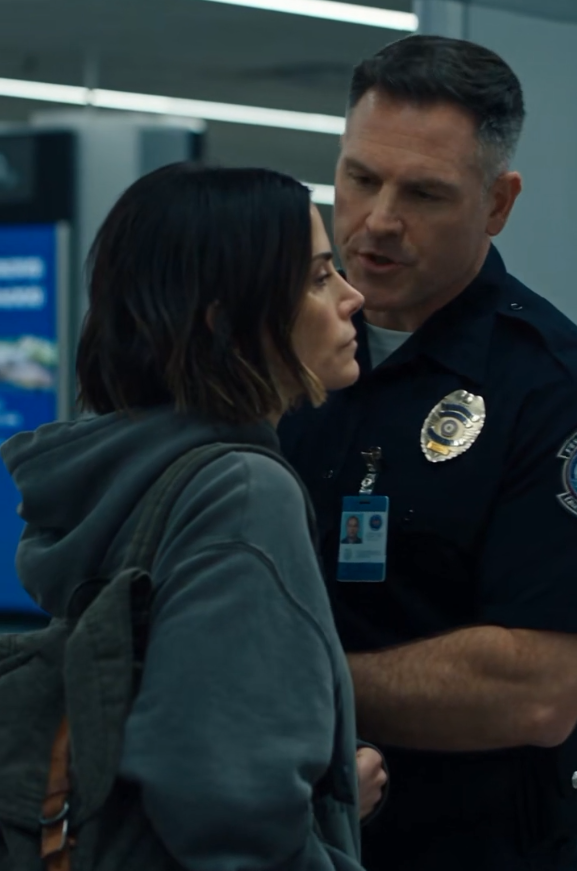
“You studied the complainants.”
“Of course.”
“What happens if he recognizes you?”
“He won’t.”
“You’re sure?”
“I spent twenty years behind glass for a reason.”
That almost made her smile.
Almost.
Instead, she said, “I want an intervention threshold.”
“If he attempts physical restraint without a legitimate basis, you intervene.”
“And before that?”
“We let him work.”
Vale looked unhappy.
Good.
Comfort had already been too expensive.
“Three weeks,” she said.
“Why?”
“Scheduling. Staffing. I want legal review.”
“Fine.”
“And Evelyn?”
“Yes?”
“If he does nothing wrong, that goes in your report too.”
I met her eyes.
“Especially then.”
Part II — Pressure
Dawson spent the first twenty minutes after the checkpoint incident insisting he had followed procedure.
He did it in Vale’s conference room with his access card sitting on the table between us.
The room was small enough that nobody could pretend distance.
Vale sat at one end.
I sat across from Dawson.
He remained standing until she told him twice to take a chair.
“I observed suspicious conduct,” he said.
“What conduct?” Vale asked.
Dawson looked at me.
“She entered the expedited lane without presenting herself appropriately.”
I almost asked what that meant.
Vale got there first.
“Appropriately how?”
Dawson hesitated.
“She appeared confused.”
“I walked directly to the lane.”
“You were looking at your phone.”
“So were half the passengers.”
“You challenged an officer.”
“After you told me I didn’t belong there.”
Dawson leaned back.
“There. That.”
“What?”
“The attitude.”
Vale’s face hardened slightly.
Dawson saw it.
He changed direction.
“I’m not explaining this properly.”
“No,” I said. “You are.”
His eyes narrowed.
Vale tapped the table once with her finger.
“Walk me through your decision chronologically.”
Dawson did.
He said he noticed me entering the line.
He said my casual appearance was not relevant.
Then he spent three sentences describing it.
He said I seemed out of place.
He said he redirected me.
He said I refused.
He said I became confrontational.
He said he suspected fraudulent access.
Vale interrupted.
“Why not scan the credential?”
“I was managing behavior first.”
“Why?”
“Officer safety.”
I looked at him.
Dawson looked back.
Neither of us spoke.
Vale’s voice became quieter.
“What specifically made you fear for your safety?”
Dawson rubbed his thumb across his knuckles.
“She was noncompliant.”
“She stood still.”
“She questioned instructions.”
“What instruction?”
“To leave the line.”
“Was the instruction lawful if her credential was valid?”
“I didn’t know it was valid.”
“Because you didn’t scan it.”
His face tightened.
He knew we had returned to the same hole.
Every route led back to it.
“I made a judgment call.”
“Yes,” I said.
He turned toward me.
“That’s exactly what we’re reviewing.”
For the first time, his anger slipped past caution.
“You set me up.”
“No.”
“You came looking for a reaction.”
“I came with a valid boarding pass.”
“You knew who I was.”
“Yes.”
“You dressed like that on purpose.”
Vale looked at me.
I answered honestly.
“Yes.”
Dawson gave a short, humorless laugh.
“There it is.”
“There what is?”
“Entrapment.”
Vale closed her eyes briefly.
I kept my voice level.
“I did not ask you to insult me.”
He said nothing.
“I did not ask you to ignore my credential.”
Nothing.
“I did not ask you to grab my wrist.”
His gaze dropped for an instant toward my arm.
“I did not ask you to threaten to write charges however you wanted.”
That landed.
Vale looked at him.
Dawson’s face changed.
“What?”
I did not answer immediately.
He looked from me to Vale.
“What did she just say?”
Vale folded her hands on the table.
“You told her, ‘I’ll write it any way I want.’”
Dawson stared.
“That is not what I said.”
I leaned back.
The operation had not depended on hidden audio from me.
That had been deliberate.
Instead, Vale had stood twenty feet behind the line, outside Dawson’s immediate field of view, wearing a small recording device authorized for the observation.
Dawson had believed the airport noise protected him.
It had not.
Vale reached toward a tablet.
“I listened to the recording twice before we entered this room.”
Dawson’s eyes shifted to the device.
“You recorded me?”
“I documented an employee observation.”
“Without telling me?”
“You were on duty in a public screening area.”
He looked at me again.
The confidence was gone now.
In its place was calculation.
“You baited me.”
“No,” I said. “I gave you opportunities to make better decisions.”
He stood.
Vale’s voice sharpened.
“Sit down.”
“I want representation.”
“That is your right.”
“I’m not saying another word.”
“Also your right.”
He looked at the access card on the table.
Then at the door.
Vale nodded once.
“You are relieved pending formal review. Someone will escort you to collect personal belongings.”
Dawson turned toward me before leaving.
“You think you proved something?”
I said nothing.
He waited.
Maybe he wanted anger.
Maybe he wanted triumph.
Maybe he wanted me to give him a reason to rewrite the scene inside his own head.
I gave him none.
He opened the door.
Then he stopped.
“This place runs because people like me make decisions while people like you sit in offices afterward and decide whether they were pretty enough.”
Vale’s expression did not change.
Dawson looked at her.
“You know I’m right.”
That was the first time all evening that he said something that unsettled me.
Because part of it was true.
Security officers made thousands of decisions under pressure. Most were ordinary. Some were difficult. A few required speed.
Oversight arrived later, with time, recordings, documents, and chairs.
The difference was that pressure did not excuse everything.
But institutions often became vulnerable when bad employees wrapped themselves in the legitimate difficulty of the job.
Dawson walked out.
The door closed.
Vale stayed very still.
“He’ll make that the defense,” she said.
“Yes.”
“And people will listen.”
“Yes.”
She looked at me.
“You don’t seem concerned.”
“I’m concerned when bad arguments are persuasive.”
“That sounded persuasive.”
“It sounded familiar.”
Vale leaned back.
“What happens now?”
“Now we find out whether tonight was an exception.”
She frowned.
“You already have the complaint pattern.”
“I have allegations.”
“You have what happened tonight.”
“I have one substantiated incident.”
Her eyes narrowed.
“What are you saying?”
“I’m saying removing Dawson may solve your staffing problem. It doesn’t answer what happened to the thirty-one people who complained before me.”
Vale looked toward the window.
“There’s nothing more we can do for some of those cases.”
“Maybe.”
“You think the reviews were mishandled?”
“I think I haven’t finished reviewing them.”
Silence settled between us.
Then Vale said, “You’re investigating me now.”
“I’m investigating the system.”
“That means yes.”
“It means I follow the evidence.”
She smiled once without humor.
“That sounds very noble when you say it.”
“It’s less noble when you have to write it.”
The next morning my wrist was purple.
I noticed it while making coffee in the hotel room.
The bruise curved along the inside of my arm where Dawson’s fingers had pressed hardest. I flexed my hand.