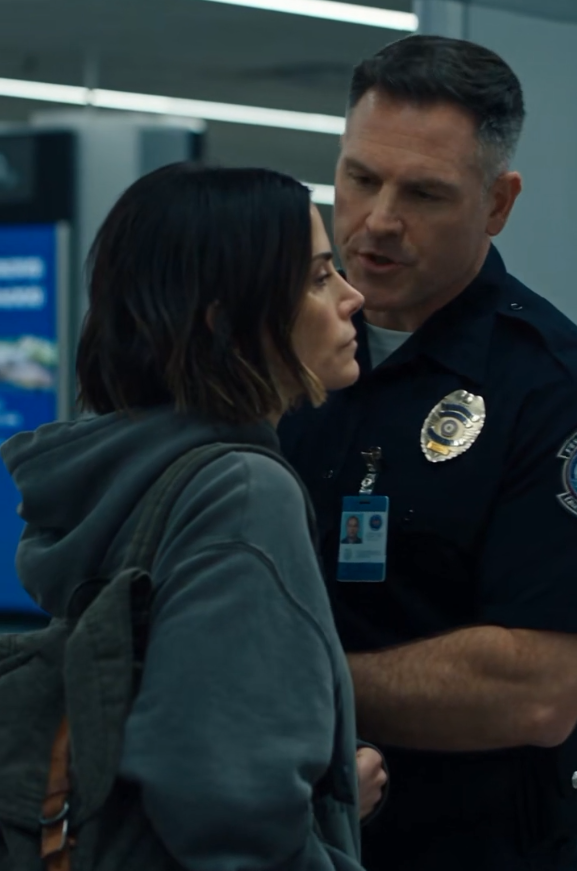
“What’s the hard part?”
I looked at the closed door.
“Deciding whether the organization writes this as one bad employee.”
Vale said nothing.
She understood.
If the final report focused only on Dawson, the institution could congratulate itself.
Problem identified.
Problem removed.
Process restored.
But the process had not worked.
It had protected him until someone deliberately placed herself in front of him.
That was not success.
That was an admission.
Part IV — Reckoning
By Thursday, Dawson was no longer arguing that nothing had happened.
He was arguing that everyone had allowed it.
That was more dangerous.
His written response arrived at 6:12 a.m.
Seventeen pages.
He described staffing shortages, inconsistent supervision, unclear complaint standards, shifting expectations, inadequate training, and the organization’s reliance on experienced officers to make quick decisions.
Then, on page thirteen, he wrote:
Management knew my style, approved my performance, repeatedly assigned me to high-volume expedited screening, and closed prior complaints without discipline. If my conduct was unacceptable, management had years to say so.
I read the sentence three times.
Then I sent it to Vale.
She called within a minute.
“He’s blaming me.”
“He’s describing you.”
“That’s not funny.”
“I’m not joking.”
“You think he’s right?”
“Partly.”
Silence.
“Come upstairs,” she said.
Her office door was open when I arrived.
Vale stood behind her desk with Dawson’s response printed in front of her.
She did not ask me to sit.
“Tell me what your report is going to say.”
“I haven’t written it.”
“Tell me what you think it will say.”
“That Dawson repeatedly exercised authority based on assumptions he did not verify. That he made inaccurate statements in complaint responses. That he used physical restraint against me without a sufficient basis. That his statements at the checkpoint demonstrated willingness to frame conduct after the fact.”
Vale nodded once.
“And me?”
“That supervisory review repeatedly failed to test his written explanations against objective records.”
Her face tightened.
“Anything else?”
“That complaint procedures were altered in a way that reduced independent review.”
“I didn’t create that alone.”
“I know.”
“You’re going to name me.”
“If the facts require it.”
Vale turned toward the window.
Below, passengers moved through the terminal.
“You know what happens if you write it that way.”
“Yes.”
“Headquarters comes in.”
“Probably.”
“They tear apart the unit.”
“They review it.”
“They call it review. Everyone here loses months proving they did their jobs.”
“Did they?”
She turned sharply.
“Most of them did.”
“I know.”
“Then why punish everyone?”
“I’m not punishing anyone.”
“That is what it feels like from this side.”
I leaned against the edge of her desk.
“From this side?”
“You arrive after the fact.”
There was Dawson’s argument again.
Different voice.
More honest.
Same pressure point.
Vale continued.
“You find the failure. You write it cleanly. Then you leave. The people here stay. They cover shifts. They retrain staff. They answer headquarters. They rebuild morale. They deal with passengers who saw the story online.”
“No story is online.”
“Not yet.”
I looked at her.
She was breathing faster now but kept her voice controlled.
“I agreed to your operation,” she said. “I stood behind him. I stopped it. I turned over every file you asked for.”
“Yes.”
“And that counts for nothing?”
“It counts.”
“Where?”
“In the report.”
She laughed once.
“Right beside the part where I failed.”
“Yes.”
Her eyes hardened.
“That’s convenient.”
“No. Convenient would be pretending the last three weeks erase the previous three years.”
She looked away.
The words hurt her.
I knew because they hurt me to say.
Vale had helped.
She had not obstructed.
Once the evidence appeared, she had cooperated completely.
But accountability became meaningless if cooperation after discovery purchased immunity from what came before.
“I could have refused the operation,” she said quietly.
“Yes.”
“I could have warned him.”
“Yes.”
“I could have protected myself.”
“Yes.”
“I didn’t.”
“I know.”
She turned back toward me.
“Then what do you want?”
The question surprised me.
“Want?”
“What outcome makes you satisfied?”
I shook my head.
“That’s the wrong question.”
“Why?”
“Because my satisfaction doesn’t matter.”
“Everyone says that when they have power over the outcome.”
The sentence landed harder than she intended.
I stood still.
Vale realized what she had said.
“I didn’t mean—”
“Yes, you did.”
She exhaled.
I looked through the window.
She had given me something useful.
Not about her.
About me.
I had spent years studying how people used authority.
That did not exempt my own.
I could write a report devastating enough to end careers.
I could also soften language until failure became “process improvement.”
Both choices were forms of power.
And power did not become harmless just because I believed I was right.
“I’ll show you the factual findings before final submission,” I said.
Vale looked at me.
“You don’t have to.”
“I know.”
“Why?”
“So you can identify errors.”
“And disagree?”
“You can disagree in writing.”
Her shoulders dropped slightly.
“That’s fair.”
“It should have been fair for the complainants too.”
Vale looked down.
“Yes.”
That evening I called three of them.
Not all thirty-one.
The oldest cases were beyond practical reopening, and some complainants had asked for no further contact.
But three had agreed to follow-up.
Helen Morris answered from Arizona.
She remembered Dawson immediately.
“I knew that man was lying,” she said.
Her voice was not angry.
That made it worse.
“He kept telling me my pass wasn’t valid. I kept asking him to scan it.”
I looked at my notes.
“Did he?”
“No.”
“Why didn’t you continue arguing?”
She laughed quietly.
“Honey, I was sixty-three, traveling alone, and trying to get to my sister before surgery. A man in uniform told me if I kept causing trouble, I might miss my flight. What would you have done?”
I looked at the bruise fading on my wrist.
“I don’t know.”
“Yes, you do.”
She was right.
That was the strange privilege of my operation.
I had been able to resist because I knew the limits of Dawson’s authority better than he expected.
Most passengers did not.
They obeyed not because he was correct.
They obeyed because uncertainty was part of his power.
“Did anyone follow up on your complaint?” I asked.
“A woman emailed me.”
“Did you speak?”
“No. She said they reviewed it.”
“Were you told the outcome?”
“They said appropriate action had been taken.”
It had not.
I thanked her.
Before we hung up, she said, “Did something happen?”
I considered how much I could say.
“We’re reviewing the matter again.”
A pause.
Then, “Good.”
Not triumphant.
Not relieved.
Just tired.
Good.
The second caller was more angry.
The third had almost forgotten the details until I read a line from her original complaint.
Then she became quiet.
“I stopped using that airport for a year,” she said.
That was a consequence no internal metric had captured.
One passenger changing travel plans because one officer had made the place feel unsafe.
Multiply that by people who never complained.
Institutions measured what they knew to count.
Trust rarely fit in a spreadsheet.