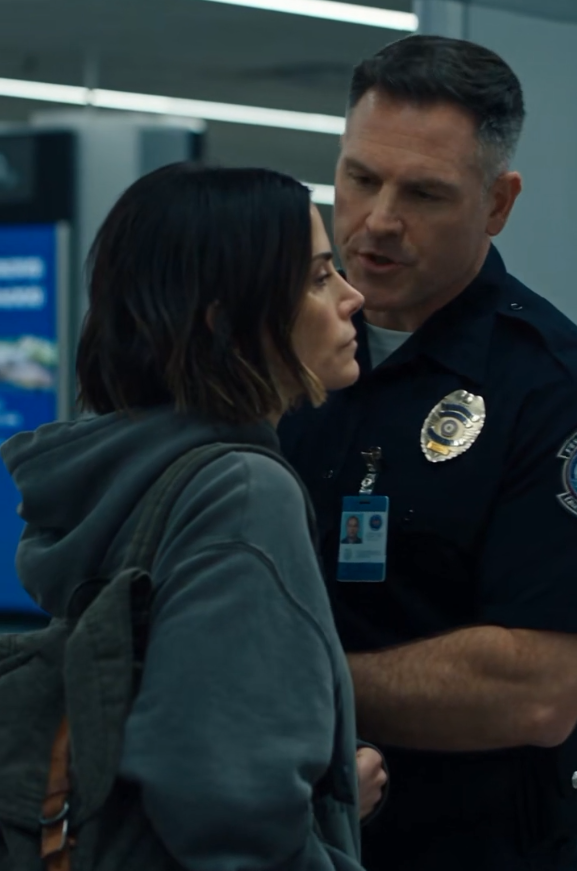
Two days later, Vale sent me a message at 10:48 p.m.
Need to show you something.
I went back to the airport.
Her office lights were the only ones on along the administrative corridor.
She had a file open on her monitor.
“What?”
She rotated the screen.
An old internal email thread.
Subject: Complaint Routing Standardization.
The messages dated back nearly four years.
Dawson’s grievance had triggered a policy review, but Vale had not been the person who proposed localizing complaints.
A regional legal advisor had.
The rationale was efficiency.
Too many low-level conduct complaints were reaching centralized review.
Local leaders were encouraged to resolve “service-tone issues” unless objective misconduct appeared.
I read the language.
“Objective misconduct.”
Vale nodded.
“But local supervisors were being asked to decide whether objective misconduct existed before independent review.”
“Yes.”
“That’s circular.”
“Yes.”
I scrolled.
There were responses from several terminal directors.
Most approved.
Vale had written one line:
Agree. Local review will reduce unnecessary escalation.
I looked at her.
She did not defend it.
“I forgot this existed,” she said.
“Do you remember writing it?”
“I remember the policy discussion. I don’t remember that email.”
“That sounds believable.”
“Which means?”
“It means memory is unreliable.”
She sat down.
“I helped build the process that protected him.”
“You helped build a process designed to solve a different problem.”
“That protected him.”
“Yes.”
She rubbed her forehead.
“You enjoy saying yes too much.”
“No. I just don’t think every truth needs cushioning.”
“Sometimes people do.”
“Maybe.”
Vale looked at the monitor.
“What happens to this?”
“It goes in the report.”
“Of course it does.”
I studied the email chain again.
Then I noticed something.
Dawson had been copied on the final policy announcement.
Not because he was senior.
Because his grievance had initiated the review.
He knew exactly how complaints would be routed after that.
He knew local supervisors would evaluate them.
He knew what evidence they usually checked.
He knew where cameras had audio and where they did not.
He knew the scanner system logs existed.
But he apparently did not expect anyone to compare them years later.
That was the flaw.
People who manipulate systems often confuse delay with disappearance.
“Print the entire chain,” I said.
Vale did.
As the pages emerged, I felt the structure of the case settle into place.
Not one rogue officer.
Not one negligent supervisor.
A feedback loop.
Dawson generated complaints.
The system redesigned itself to reduce complaint burden.
The redesign reduced scrutiny.
Reduced scrutiny increased Dawson’s freedom.
His clean record then justified more trust.
The better he became at avoiding documented violations, the more the organization believed complaints were merely interpersonal.
It was not conspiracy.
It was worse in a different way.
Everyone had been able to believe they were behaving reasonably.
Part V — Final Confrontation
The final review took place three weeks after the airport incident.
Dawson sat at the far end of a long conference table.
His representative sat beside him.
Vale was on my left.
Two senior reviewers joined remotely from another office.
A recorder sat in the center.
No uniforms.
No terminal noise.
No passengers.
Just documents.
Dawson looked at me when I entered.
My wrist had healed.
His career had not.
The lead reviewer began with procedure.
Dawson had been notified of findings.
He had received the evidence packet.
He would have an opportunity to respond.
No final decision had been made.
Then the reviewer turned to me.
“Ms. Hayes, summarize your findings.”
I opened the report.
This was the moment everyone expected me to destroy Dawson.
That was not my job.
My job was to tell the truth accurately enough that nobody had to exaggerate it afterward.
“The investigation substantiated that Officer Dawson improperly escalated an encounter with a passenger who possessed valid access credentials, failed to verify those credentials before alleging misuse, used physical restraint without an established security basis, and stated that he could characterize alleged violations according to his discretion.”
Dawson stared at the table.
I continued.
“The investigation also identified five prior complaint cases in which Officer Dawson stated that passenger credentials had failed or appeared invalid despite scanner records showing no verification attempt at the relevant station or adjacent stations.”
His representative raised a hand.
“We dispute that the absence of scanner activity proves no attempt occurred.”
“That dispute is noted.”
“Then the language should reflect uncertainty.”
“It does.”
The representative glanced at the report.
I continued.
“More significantly, the review found that repeated complaints involving similar conduct were evaluated independently, without systematic pattern analysis, and that local complaint-routing procedures reduced the likelihood of independent review.”
Dawson looked up.
Vale remained still.
“This investigation therefore does not conclude that Officer Dawson’s conduct occurred in isolation from organizational conditions.”
His representative sat back.
For the first time, Dawson looked uncertain in a different way.
He had expected me to isolate him.
Instead I was widening the frame.
One of the remote reviewers spoke.
“Ms. Hayes, are you assigning management responsibility?”
“Yes.”
Vale inhaled quietly.
I continued.
“Supervisory review failed to compare several employee statements with objective system records. Prior performance intervention was discontinued after temporary improvement despite continuing complaints. Complaint-routing changes prioritized efficiency and local resolution without adequate safeguards for recurring allegations.”
The remote reviewer looked toward Vale’s camera feed.
“Director Vale?”
Vale’s face appeared in a small window on the conference monitor even though she sat ten feet from me; the system had been configured for recording.
She spoke into the room microphone.
“I agree with those findings.”
Dawson turned toward her.
His expression changed.
Not triumph.
Something like betrayal.
“You agree?”
Vale looked at him.
“Yes.”
“You signed those closures.”
“Yes.”
“You approved my evaluations.”
“Yes.”
“You assigned me to that checkpoint.”
“Yes.”
“And now you’re sitting there acting like you had no part in this?”
“I’m doing the opposite.”
Dawson leaned forward.
“You let me work that way for years.”
Vale’s voice stayed even.
“I failed to examine some complaints as closely as I should have.”
“Some?”
“Yes.”
He laughed.
“There it is.”
His representative touched his arm.
Dawson pulled away.
“You need me to be the villain because otherwise you have to admit the system told me I was doing fine.”
I spoke before Vale could.
“The system did tell you that.”
Everyone looked at me.
Dawson went still.
I closed the report.
“That is part of the finding.”
His eyes narrowed.
“Then how is this on me?”
“Because you were there.”
He stared.
I continued.
“You were there each time you chose not to scan a credential before accusing someone of using it improperly.”
He opened his mouth.
I raised a hand.
“You were there when you wrote that scans had failed.”
His representative started to speak.
The lead reviewer stopped him.
I continued.
“You were there when you stepped close enough to passengers to make disagreement feel dangerous. You were there when you used authority you understood they could not easily measure.”
Dawson’s jaw tightened.
“The organization made it easier for you. That does not mean the organization made your decisions.”
He leaned back.
“So everyone else gets training and I get fired.”