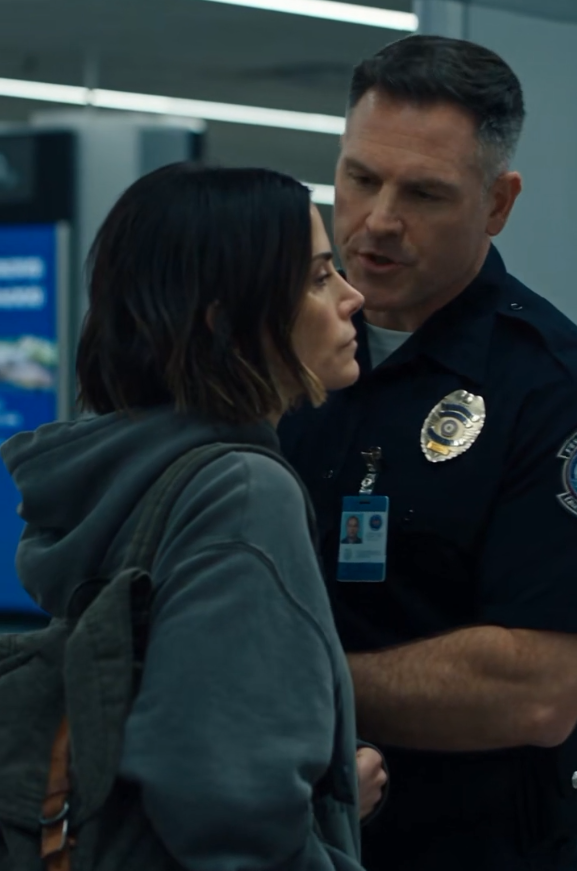
The regional complaint policy was suspended within a week.
Within a month, repeat allegations involving the same employee automatically triggered independent review.
Scanner records became part of standard verification when complaints involved credential disputes.
Supervisory observations became less predictable.
Not secret.
Unpredictable.
There was a difference.
Nothing became perfect.
Systems never did.
But they became harder to manipulate in the exact way Dawson had manipulated this one.
That was enough for a beginning.
Part VI — Aftermath
Six months later, I returned to the airport wearing the same old backpack.
Not intentionally.
I did not realize until I stepped out of the car.
The hoodie was different.
The leggings were not.
For a moment I stood at the entrance looking through the sliding glass doors while travelers moved around me.
Nobody recognized me.
That suited me.
There had been no press conference.
No viral interview.
No photograph of Dawson being walked out of the terminal.
The case had remained largely what it should have been.
Work.
Inside the checkpoint, a young officer stood at the expedited entrance.
A woman ahead of me presented her phone.
The scanner flashed red.
“Give me one second,” the officer said.
He tried again.
Red.
The passenger immediately became anxious.
“I swear it worked earlier.”
“No problem.”
The officer looked at the screen, checked something at his station, then called a supervisor.
No accusation.
No sarcasm.
No assumption.
The supervisor arrived, examined the credential, and discovered a system delay.
Thirty seconds later, the screen went green.
“Sorry about that,” the officer said.
The woman smiled.
“That’s okay.”
She walked through.
The entire exchange took less than a minute.
Nobody else noticed.
I did.
Vale was waiting beyond the checkpoint.
She had more gray in her hair than six months earlier.
Or maybe I had not noticed it before.
“You could have used the employee entrance,” she said.
“I wanted to see the line.”
“Of course you did.”
We walked toward her office.
The terminal looked the same.
That was another strange thing about institutional change.
The walls remained.
The lights remained.
Travelers still rushed.
Flights still boarded late.
The system altered itself invisibly.
Vale handed me coffee.
“Dawson’s appeal concluded.”
I looked at her.
“Result?”
“Termination upheld.”
I nodded.
She watched me.
“That all?”
“What do you want me to do?”
“I don’t know. Smile?”
“Why?”
“You’re impossible.”
“So I’ve been told.”
We reached the observation window.
Below us, the young officer who had helped the woman was now explaining something to an elderly couple.
Vale leaned against the glass.
“I spoke to Dawson.”
That surprised me.
“When?”
“Last week.”
“Why?”
“He called.”
I waited.
Vale stared down at the checkpoint.
“He wanted a reference.”
I turned toward her.
“For what?”
“Private security job.”
“What did you tell him?”
“The truth.”
“That could mean anything.”
“I said he was reliable, knowledgeable, punctual, and experienced.”
“All true.”
“I also said I could not recommend him for a role requiring unsupervised discretionary authority over the public.”
I looked at her.
“That’s specific.”
“He hung up.”
“I imagine he did.”
Vale sipped her coffee.
“Was I wrong?”
“No.”
“You answered too quickly.”
“You want me to pretend it’s complicated?”
“Isn’t everything complicated with you?”
“Complicated does not mean unclear.”
She considered that.
Then she reached for a folder sitting on the windowsill.
“What’s this?”
“Follow-up metrics.”
I opened it.
Complaints at the terminal had increased twelve percent.
I looked at Vale.
She smiled faintly.
“Thought you’d like that.”
“Why are complaints higher?”
“Because we changed the reporting form. Easier access. QR code at the checkpoint. Staff actually mention it when someone has a concern.”
I flipped pages.
Substantiated conduct findings had also increased.
At first glance, that looked bad.
Then I saw something else.
Average time from complaint to resolution had fallen by half.
Repeat complaints against the same employee were being identified sooner.
Passenger satisfaction had improved slightly.
“You’re getting more complaints because people trust the complaint system enough to use it.”
“That’s our theory.”
“Good.”
Vale laughed.
“What?”
“You spent six months making my life miserable, and now you’re pleased our complaint numbers went up.”
“Bad systems celebrate low complaint numbers.”
“And good systems?”
“Want accurate ones.”
She nodded.
We stood quietly for a moment.
Then she said, “I keep thinking about what Dawson said.”
“Which part?”
“That management told him he was fine.”
I closed the folder.
“He wasn’t completely wrong.”
“No.”
“I hate that.”
“You should.”
Vale looked at me.
“You ever give anyone comfort?”
“Rarely.”
“I noticed.”
She turned back toward the terminal.
“I used to think accountability meant catching people.”
“So did I.”
“What do you think now?”
I looked through the glass.
The line moved.
An officer scanned a phone.
Green.
Another passenger stepped forward.
“Catching people is the easy version.”
Vale waited.
“The harder version is building something that doesn’t need a person like me standing twenty feet away to make it behave.”
She considered that.
“Are we there?”
“No.”
“Of course not.”
“But you’re closer.”
Vale nodded.
Below us, the same young officer stopped a man entering the wrong lane.
I watched carefully.
The officer pointed to the sign.
The man looked irritated.
They exchanged a few words.
Then the officer scanned his credential anyway.
Red.
He explained something.
The man checked his phone.
Wrong boarding pass.
He apologized.
The officer smiled and directed him to the correct line.
Ordinary.
Professional.
Forgettable.
Exactly what the interaction should have been.
Vale’s phone rang.
She looked at the screen.
“I have to take this.”
“Go.”
She started toward her desk.
Then stopped.
“Evelyn.”
I turned.
“Why did you really smile at Dawson when he was about to cuff you?”
I remembered the metal against my wrist.
The pressure in my shoulder.
The crowd watching.
The instant before Vale said his name.
“I wasn’t smiling at him.”
Vale waited.
“I was smiling because he had finally stopped hiding.”
She studied me, then nodded once.
After she answered the call, I stayed by the window.
For twenty years I had spent my career behind glass, watching people use authority when they thought attention was somewhere else.
I used to believe the glass was an advantage.
Distance made patterns easier to see.
It protected judgment from the emotion of the moment.
But the airport had taught me something distance never could.
Sometimes the truth of a system was not visible until you stood inside it and let it make a decision about you.
I looked at my wrist.
No bruise remained.
Only skin.
Below me, hundreds of strangers moved through the checkpoint, each surrendering a little control because public systems required trust to function.
Shoes in bins.
Phones in trays.
Bags opened.
Questions answered.
Instructions followed.
Most of those travelers would never know Richard Dawson’s name.
They would never know about the complaint files, the scanner logs, the policy changes, the meetings, the appeal, or the woman in the oversized hoodie who had refused to leave the line.
That was fine.
Accountability was not valuable because people saw it happen.
It was valuable because afterward, someone who would never know the story could walk into the same place and be treated better.
An elderly woman approached the scanner below.
She seemed uncertain and held out her phone.
The officer took one look at the screen and said something I could not hear through the glass.
The woman laughed.
He pointed her gently toward the correct position, waited, then scanned the credential.
Green.
She continued forward.
No humiliation.
No threat.
No story worth telling.
I picked up my backpack.
For once, that was exactly the ending I wanted.