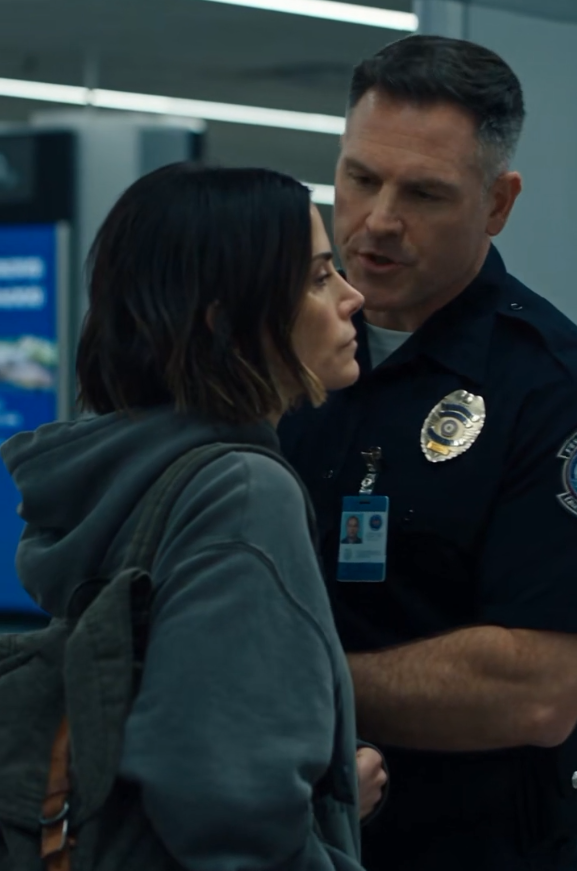
“No decision has been announced.”
“You know what’s coming.”
I did.
So did he.
But there was still one unresolved question.
The hardest one.
The lead reviewer asked to pause for ten minutes before recommendations.
Everyone stood.
Dawson remained seated.
As I gathered my papers, he spoke.
“Ms. Hayes.”
I looked at him.
“Can I ask you something without the performance?”
His representative looked alarmed.
I sat back down.
Vale remained near the door.
“What?”
Dawson looked at the empty chair beside me.
“When you came through my line, were you hoping I’d touch you?”
The room changed.
Vale turned.
His representative whispered, “Richard.”
I answered.
“No.”
“You knew it was possible.”
“Yes.”
“You chose the clothes.”
“Yes.”
“You chose my lane.”
“Yes.”
“You knew complaints.”
“Yes.”
“And you stood there anyway.”
“Yes.”
He shook his head.
“That’s not normal.”
“No.”
“Why?”
There were several answers.
Because evidence mattered.
Because complaints had failed.
Because systems became honest when they could no longer avoid looking at themselves.
But those were professional answers.
He had asked something else.
I looked at him.
“Because the people before me didn’t know what would happen when they challenged you.”
Dawson’s face changed slightly.
“I did.”
He looked away.
That was the first time I believed he understood the difference.
Maybe only for a second.
Maybe not enough to matter.
The lead reviewer called us back.
We sat.
The recommendation options were laid out.
Termination for Dawson.
Formal management findings against Vale and corrective action at the unit level.
Independent re-review of recurring conduct complaints across the terminal.
Restoration of centralized review triggers when repeated allegations involved the same employee.
Expanded audit access to scanner records.
Mandatory audio-capable observation in certain complaint investigations.
It was broader than one case.
Which meant it was messier.
One reviewer raised a concern.
“If we include the management findings at this stage, we may complicate disciplinary action against Officer Dawson.”
I looked up.
“How?”
“His representative will argue shared responsibility.”
“He already has.”
“Yes, but a report formally acknowledging management failures strengthens that argument.”
The room went quiet.
There it was.
The choice.
Write the narrow truth and make the case against Dawson easier.
Or write the whole truth and accept that accountability would become more complicated.
The reviewer continued.
“We could issue the employee conduct finding first. Then address process deficiencies separately.”
Vale looked at me.
Dawson’s representative watched carefully.
I understood the logic.
It was not corrupt.
It was strategic.
Remove the immediate threat.
Fix the system later.
A clean sequence.
A safer sequence.
Also the same habit that had created the problem.
Separate incidents.
Separate reviews.
Separate responsibility until the pattern disappeared.
The lead reviewer asked, “Ms. Hayes?”
I looked down at the report.
For twenty years, I had watched authority from behind glass.
It was easy to see misuse when someone else held it.
Harder when the authority was yours.
I thought of Helen Morris.
I thought of the passenger who stopped using the airport.
I thought of Dawson telling me he could write the incident any way he wanted.
I thought of Vale saying everyone wanted certainty.
Most of all, I thought about the possibility that we could remove Dawson and still teach the organization the wrong lesson.
That the problem had been one man.
That everyone else had merely been nearby.
I closed the folder.
“No.”
The reviewer raised an eyebrow.
“No to which part?”
“We do not separate the findings.”
Dawson looked at me.
Vale did not move.
The reviewer said, “You understand that may complicate the employee action.”
“Yes.”
“It could create appeal issues.”
“Yes.”
“It may delay resolution.”
“Yes.”
“Then why?”
“Because the report should not be shaped around which truth is easiest to prosecute.”
The reviewer leaned back.
I continued.
“If the organization contributed to the conditions, we say so. If Officer Dawson made independent choices within those conditions, we say that too. One does not cancel the other.”
Dawson’s representative looked dissatisfied.
Good.
So did the reviewer.
Also good.
Truth that pleased one side too completely usually deserved another look.
Vale spoke.
“I support the full finding.”
Dawson turned toward her.
She met his gaze.
“I should have acted sooner.”
He stared at her.
Then he said quietly, “Yeah.”
No sarcasm.
No anger.
Just one word.
Vale nodded.
“Yes.”
It was the closest thing to accountability I had seen from either of them.
Not punishment.
Recognition.
The lead reviewer looked toward Dawson.
“Mr. Dawson, do you wish to make a final statement?”
His representative whispered something.
Dawson ignored him.
For several seconds he said nothing.
Then he looked at me.
“I still think you came in there wanting a confrontation.”
“I came in expecting a possibility.”
“That’s the same thing.”
“No.”
He looked at the table.
“Maybe not.”
His representative closed his eyes.
Dawson continued.
“I’ve worked that checkpoint eleven years. You know how many people lie to us?”
“A lot.”
His eyes came up, surprised by the answer.
“I know,” I said.
“How many try to push through because they’re late?”
“A lot.”
“How many get angry when we tell them no?”
“A lot.”
“Then you know what it does to you.”
“Yes.”
He leaned forward.
“No, you don’t.”
I let that stand.
Maybe I did not.
He continued.
“You start deciding faster. You can tell who’s going to be trouble before they open their mouth.”
“That was the problem.”
“No. That’s experience.”
“Experience can become prejudice when you stop checking whether you’re right.”
He stared at me.
The sentence stayed between us.
Then he looked at Vale.
“You taught me to trust judgment.”
Vale answered quietly.
“I should have taught you when not to.”
Dawson’s face tightened.
He looked toward the ceiling for a second, then back down.
When he spoke again, the anger had gone.
“What happens to the complaints?”
“We reopen what can still be meaningfully reviewed,” I said.
“And me?”
“That isn’t my final decision.”
“You know.”
“Yes.”
He nodded once.
I expected one last argument.
Instead, he said, “I should’ve scanned the phone.”
Nobody answered.
Because there was nothing to add.
The most important fact in the case had always been that simple.
He should have scanned the phone.
One action.
Two seconds.
A check against assumption.
Everything after that came from his refusal to learn whether the story in his head was true.
The final decision arrived forty-eight hours later.
Dawson was terminated.
Not because he was rude.
Not because passengers disliked him.
Not because I had worn an oversized hoodie into his line.
The decision cited inappropriate physical escalation, inaccurate statements in prior complaint responses, failure to follow verification procedures, misuse of discretionary authority, and conduct inconsistent with public trust.
He appealed.
That was his right.
Vale received a formal management finding and remained in position under corrective oversight.
That decision angered people on both sides.
Some thought she should have been removed.
Others thought any finding against her punished the person who had ultimately helped expose Dawson.
I thought the outcome was uncomfortable.
That was probably evidence we had not simplified it too much.