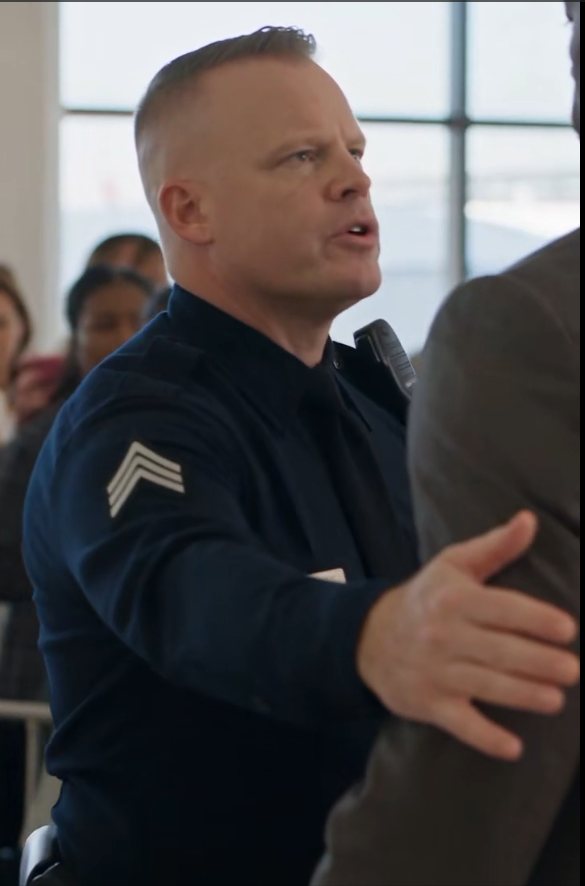
That man happened to be me.
I called engineering into a meeting the following Monday.
“No more single-custody deadlines,” I said.
My head of engineering smiled.
“You finally admit I was right?”
“Don’t ruin the moment.”
We created redundant executive keys.
Independent escrow.
Multiple secure transfer paths.
Remote exception authentication that required two officers instead of one.
The next crisis would not depend on whether I reached Gate 32 on time.
That was accountability too.
Not only asking what someone else should have done differently.
Asking what I should.
Six months after O’Hare, I received an envelope at the office.
No return address.
Inside was a photocopy of a handwritten letter.
Davies.
He did not ask me to call.
He did not ask me to forgive him.
He wrote that after leaving the department, he had begun doing something he should have done years earlier: reviewing old reports.
Not all of them.
The stops where the reason for contact had been vague.
The ones built around words like nervous, evasive, unusual, out of place.
He said he had found several that bothered him now.
He did not claim they were all wrong.
He wrote one sentence I read three times.
I used to think experience meant trusting my instincts faster. I am starting to think experience should have taught me when not to trust them.
I folded the letter.
Put it in my desk.
Never answered.
Some things are not conversations.
They are records.
A year after the incident, I flew through O’Hare again.
Same terminal.
Different flight.
I had a meeting in Seattle and more time than I needed.
I wore a navy jacket instead of a suit.
The Omega was still on my wrist.
My briefcase was newer and considerably less important.
When I approached the priority line, I recognized Claire before she recognized me.
She looked up from the scanner.
Then smiled.
“Well, look who decided to try airports again.”
“I’ve been practicing.”
“First class?”
I held up my boarding pass.
“Apparently.”
She inspected it with exaggerated suspicion.
“Seat 2C.”
“Downgrade.”
“Tragic.”
I laughed.
There were three passengers behind me.
Nobody recording.
No police officer watching from the side.
No deadline that could decide four hundred futures.
Claire scanned the pass.
The machine beeped green.
I started toward the jet bridge.
“Mr. Hayes.”
I turned.
She nodded toward my wrist.
“Still keeping time?”
I looked at the Omega.
The crystal had another scratch now.
My grandfather would have complained.
Then he would have worn it anyway.
“Trying to.”
Claire smiled.
I walked down the jet bridge.
Halfway to the aircraft, I stopped beside a window.
Outside, baggage carts moved beneath the wing. Ground crews guided another plane away from the gate. Beyond them, evening light spread across the runway.
I thought about how close I had come to losing Vanguard.
Not because a hostile equity firm was clever.
Not because the software failed.
Not because one police officer made a bad decision.
All of those things mattered.
But the moment that stayed with me was smaller.
A checkbox.
YES or NO.
I could have lied and probably saved the company faster.
Nobody in that airport would have stopped me.
Nobody except the system we had built.
And myself.
For years, I had thought my grandfather’s lesson was about refusing humiliation.
Standing straight.
Knowing who you were when somebody else tried to decide it for you.
I understood it differently now.
Dignity was not the refusal to bend.
Sometimes it was choosing which pressure deserved to change you.
Davies had changed me.
The airport had changed Vanguard.
The crisis had changed our systems.
But none of them had decided what I was willing to sign my name to.
I touched the watch once.
Not twice anymore.
Then I boarded.
My seat was exactly where the ticket said it would be.