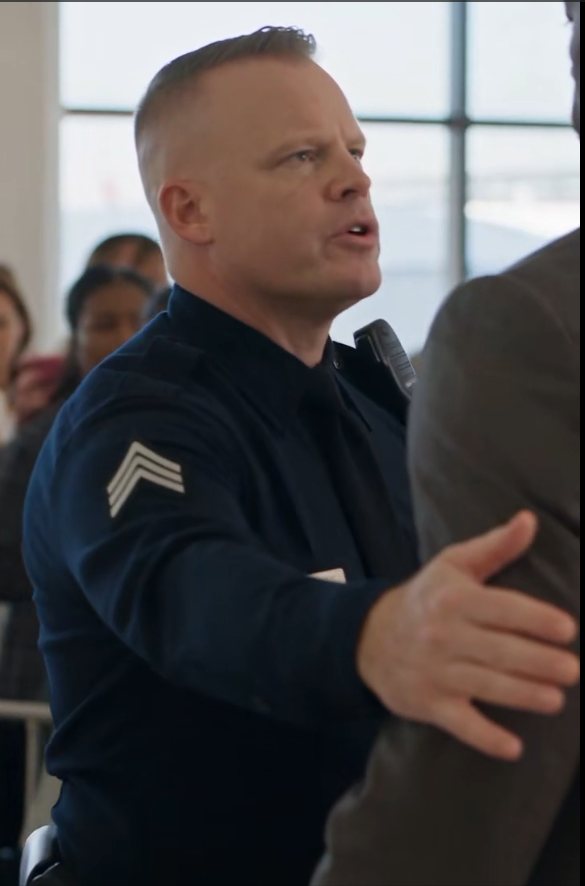
“This review is not finished.”
“I know.”
“Resigning does not end it.”
“I know.”
His voice had changed.
The defensiveness was gone.
Not replaced by enlightenment.
Just exhaustion.
He looked at me.
“I watched the footage.”
I said nothing.
“All of it.”
“That seems wise.”
He accepted the jab.
“At the gate, before you came forward, I asked Claire whether 1A was really yours.”
“Yes.”
“I told myself it was because you were watching the boarding lane.”
“I was waiting to board.”
“I know.”
He rubbed a hand across his face.
“I told myself the case was unusual.”
“It was a briefcase.”
“I know.”
He almost laughed.
There was no humor in it.
“I kept telling myself things after I had already decided something was wrong.”
That was the closest he came to naming it.
Maybe the closest he could.
I looked at the badge.
“What do you want from me?”
“Nothing.”
“An apology accepted?”
He shook his head.
“No.”
“Forgiveness?”
“No.”
“Then why are you here?”
Davies looked through the glass at the terminal.
“Because the report.”
I waited.
“I’ve written reports for twenty-two years.”
His voice lowered.
“I watched myself type that you resisted.”
Parker’s face remained unreadable.
Davies continued.
“I remembered it that way when I wrote it.”
That interested me.
“You believed it?”
“Yes.”
“Until the video?”
“Yes.”
He looked at me.
“That’s worse, isn’t it?”
I thought about it.
“Yes.”
He nodded.
No argument.
No self-defense.
Just yes.
Because a deliberate lie can be confronted.
A false memory built to protect your own judgment is harder.
It can follow you for twenty-two years and call itself experience.
Davies picked up the badge again.
“Professional standards told me there will be an administrative hearing. There may be civil action. The city attorney said not to speak with you.”
“Your city attorney is correct.”
“Probably.”
He slid the badge into his pocket.
“I wanted to say I’m sorry anyway.”
I looked at him.
“For which part?”
He did not hesitate this time.
“For deciding you were suspicious before you did anything suspicious.”
The room remained quiet.
That was the sentence.
Not everything.
Enough.
I nodded once.
“I heard you.”
Not I forgive you.
Not It’s okay.
Neither would have been true.
I heard you.
Davies accepted it.
He turned to Parker.
“I’ll report downtown tomorrow.”
“You’ll follow the written instructions from professional standards.”
“Yes, ma’am.”
He left.
The door closed.
Claire looked at me.
“You think he’ll really resign?”
Parker answered.
“That’s between him and the department now.”
I stood and returned the drive to its case.
The security indicator remained green.
My phone showed dozens of new messages.
The story had grown beyond the terminal.
National outlets were running the video.
Vanguard employees had posted messages defending the company.
Civil rights attorneys had already contacted my office.
The airline had issued a statement.
Airport authorities had announced an investigation.
Everybody wanted the next sentence.
I wanted dinner.
Instead, I called my mother.
“You done?” she asked.
“For today.”
“Company?”
“Safe.”
“You?”
I looked at the fading restraint marks.
“Safe.”
“Officer?”
“Under investigation.”
She was quiet.
Then: “Your grandfather would have liked the watch getting all this attention.”
I laughed for the first time that day.
“He would have complained I needed to service it.”
“He always complained.”
“He called it standards.”
“He called everything standards.”
We talked for two minutes.
Nothing important.
That made it important.
When I hung up, Claire was collecting empty coffee cups.
“You’re still working?” I asked.
“My shift ends at eight.”
“You’ve had a strange one.”
“I’ve had worse.”
“I doubt that.”
“You’ve never worked Thanksgiving cancellations.”
Fair.
Lieutenant Parker walked me toward the terminal exit.
No service corridor.
No side door.
The public concourse.
Just as I had asked.
The crowd outside the operations area was larger now.
Passengers.
Reporters.
Cameras.
Airport staff.
A few people applauded when they saw me.
That embarrassed me more than the handcuffs had.
I raised one hand, not in victory, just acknowledgment.
Questions came immediately.
“Mr. Hayes, do you believe you were racially profiled?”
“Are you suing?”
“Did the officer apologize?”
“Was your company actually at risk?”
“Will you demand his termination?”
Parker glanced at me.
I stopped.
Microphones pushed forward.
I thought about the headline I hated.
BLACK CEO DETAINED TRYING TO BOARD FIRST CLASS.
I thought about Davies saying, You think this is about race.
I thought about his first question to Claire before I ever approached the scanner.
Was 1A really mine?
I could have answered in a sentence that would dominate every network for twenty-four hours.
Instead I said, “There is video. There are reports. There is an investigation. People should look at the facts before they decide what is in another person’s mind.”
A reporter shouted, “Do you believe the officer treated you differently because you’re Black?”
I looked at her.
“I believe he decided I did not belong before he knew who I was.”
Pens moved.
Cameras held steady.
“What people conclude from that should come after the evidence, not before it.”
Another reporter asked, “Are you angry?”
“Yes.”
“What do you want to happen?”
“Accountability that is accurate enough to matter.”
That was all I gave them.
Two weeks later, the airport police department completed its preliminary administrative review.
The findings were narrower than the headlines and more serious than the apology.
Davies had initiated the contact without sufficient documented basis.
He had exceeded the scope of the encounter.
He had improperly detained me after no articulable security threat emerged.
And he had entered a materially inaccurate statement in his draft incident report.
The review did not make a formal finding about his motivation.
Some people called that cowardice.
Others called it discipline.
I understood both reactions.
Davies submitted his resignation before the final hearing.
The department continued the review anyway.
The city’s aviation authority separately determined that procedures at the gate had violated passenger-protection rules and imposed a $10,000 administrative penalty tied to the improper denial of boarding and handling of the incident.
The money did not come to me.
I was glad.
I did not want a neat price attached to what had happened.
Ten thousand dollars would have been an absurd number for dignity and a trivial number for four hundred careers.
The airline refunded my ticket.
They offered lifetime elite status.
I declined the lifetime part.
I kept the refund.
My lawyer said that was inconsistent.
I told him lawyers were expensive.
Vanguard survived the takeover attempt.
Not because the equity firm disappeared.
They did not.
They returned with different arguments, different filings, and different pressure.
But once our authentication package was validated, their fastest route to control closed.
Three months later, our board rejected the acquisition.
We restructured some debt.
We froze executive bonuses for a year.
Mine included.
No employees lost pensions because of the attempted takeover.
That mattered more to me than any headline.
There were consequences inside Vanguard too.
The airport incident exposed a weakness I could not ignore.
We had built a system so secure that one man carrying one drive had become a point of failure.