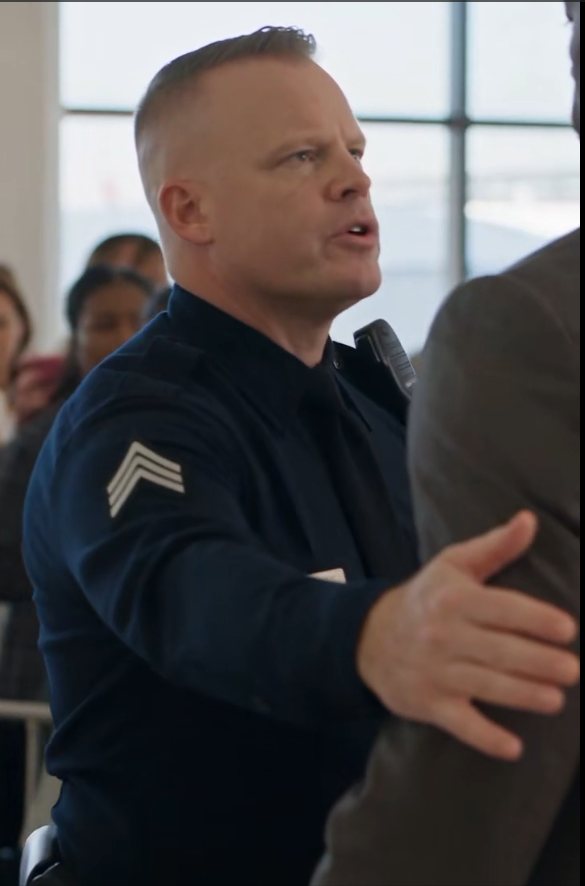
“Not normally.”
“Could management authorize it?”
The duty manager answered.
“Possibly.”
Davies looked between us.
“What exactly are you trying to do?”
I looked at him.
“The thing I was trying to do before you stopped me.”
He shook his head.
“You said you had to fly to San Francisco.”
“I said Flight 427 was my only realistic chance. I didn’t say physics stops working if I miss it.”
That was not bravado.
It was desperation dressed as problem-solving.
The drive had been prepared for a direct physical connection to our Silicon Valley mainframe because that was the cleanest route. Our system could authenticate through a remote secure tunnel, but doing so required a hardened network, stable power, a trusted machine, and time.
I had rejected the option when my engineers raised it the night before because commercial networks introduced variables I did not want.
Now variables were all I had.
I looked at the duty manager.
“I need a private room, a wired connection, and permission to bring in one company engineer by encrypted video call.”
Davies laughed.
“You’re not getting access to airport systems.”
“I didn’t ask for airport systems.”
“You asked for a network.”
“A commercial connection isolated from operations.”
The duty manager looked thoughtful.
“There may be something in the airline suite.”
“Can you check?”
Davies interrupted.
“He’s not going anywhere.”
The duty manager looked at him.
“Why?”
Davies did not answer quickly enough.
That was the first crack.
Not in his authority.
In everyone else’s willingness to accept it.
The duty manager looked at me.
“I’ll check.”
“Thank you.”
He left with Claire.
Davies waited until the door closed.
Then he leaned both hands on the table.
“You’re very good at making people think you’re in charge.”
I looked up at him.
“I run a company.”
“This isn’t your company.”
“No.”
I glanced at the briefcase.
“That’s why this is going so badly.”
His eyes narrowed.
“You know what I think?”
“No.”
“I think people who have nothing to hide don’t fight this hard over a bag.”
I stood slowly.
Davies straightened.
I kept my hands where he could see them.
“Officer, that bag contains fifteen years of work belonging to people you have never met. It contains retirement contributions, licensing agreements, client systems, and legal authorization that expires tonight. I am not protecting a secret because I’m ashamed of it.”
I pointed toward the case.
“I’m protecting it because I’m responsible for it.”
He stared at me.
For half a second, something in his expression changed.
Not sympathy.
Uncertainty.
Then the door opened.
A woman in a command uniform entered.
No introduction.
No wasted movement.
She looked at me, then Davies, then the briefcase.
“Who authorized the detention?”
Davies straightened.
“I did.”
“Basis?”
“Suspicious conduct and refusal to comply.”
“With what?”
“A bag inspection.”
“Was there an alarm?”
“No.”
“TSA referral?”
“No.”
“Canine alert?”
“No.”
“Threat report?”
“No.”
She looked at him.
“Then why did you initiate a secondary search?”
Davies opened his mouth.
Nothing came out.
The supervisor turned to me.
“Mr. Hayes?”
“Yes.”
“I’m Lieutenant Parker, airport police watch commander. I need ten minutes to review the footage.”
“I don’t have ten minutes.”
“I understand you missed your flight.”
“That is not the main problem.”
I explained the deadline.
Not the proprietary details.
Enough.
Parker listened without interrupting.
When I finished, she looked at the case.
“Is it dangerous?”
“No.”
“Any hazardous materials?”
“No.”
“Battery?”
“A small encrypted solid-state unit. Commercially compliant.”
“Did it clear screening?”
“Yes.”
She looked at Davies.
He said nothing.
Parker picked up the case carefully by the handle.
Davies stepped forward.
“Lieutenant, I haven’t completed—”
She looked at him.
“Don’t.”
One word.
Flat.
He stopped.
Parker set the case on the table in front of me.
“Do not open it yet.”
I looked at her.
“Why?”
“Because I want the condition of the seal documented before it leaves police custody.”
That was the first fully correct procedural decision anyone had made since the gate.
I nodded.
“Fine.”
She examined the exterior without touching the latches.
Then she turned to Davies.
“Body camera stays on.”
His face went still.
“You’ll remain here.”
“Lieutenant—”
“Here.”
She looked at me.
“Come with me.”
I took the briefcase.
My watch read 3:52.
The door closed behind us.
For the first time in thirty-seven minutes, I was moving again.
Part III — The Record
The airline operations suite had no glamour.
A conference table.
Six black chairs.
Two wall screens.
A hardwired business network intended for flight crews, managers, and irregular-operations teams who needed reliable access when the public terminal systems failed.
To me, it looked better than any first-class lounge on earth.
Claire stood by the door.
The duty manager was speaking quietly into a phone.
Lieutenant Parker remained near the wall, watching without hovering.
I placed the briefcase on the table.
“Internet isolated from airport operational systems?” I asked.
The duty manager nodded.
“Separate commercial line.”
“Hardwired?”
“Yes.”
“Stable?”
“As stable as anything in this building.”
“That isn’t comforting.”
He almost smiled.
“Best I can give you.”
“Good enough.”
Claire handed me my phone.
3:57.
Twenty-three missed calls.
Nine from my chief legal officer.
Six from my head of engineering.
Four from board members.
Two from numbers I recognized as reporters.
One from my mother.
I called engineering first.
The answer came before the first full ring.
“Marcus?”
“I’m here.”
A breath.
Then: “Where the hell are you?”
“Still at O’Hare.”
Silence.
“You missed the flight.”
“Yes.”
“Do you have the drive?”
“Yes.”
“Seal intact?”
I looked at Parker.
She nodded.
“Appears intact.”
“Appears?”
“It was in police custody.”
Another silence.
“What happened?”
“Later. Can we tunnel from a clean commercial network?”
“We can.”
“How fast?”
“If the drive is clean and the line holds, fifty-two minutes for transfer, maybe another forty for full verification.”
“Maybe?”
“Could be less. Could be more.”
“What do you need?”
“A machine we control.”
“I don’t have one.”
“You have your laptop.”
“It’s in the case.”
He exhaled.
“Right.”
I looked at the latches.
The briefcase was not simply a container. It was part of the security chain.
Two biometric contacts sat beneath the handle.
A physical seal ran inside the frame.
If the latches were forced out of sequence, the drive could trigger its failsafe.
I touched the watch on my wrist.
Not because it did anything.
Because my grandfather had taught me that panic wastes time before bad decisions.
“Walk me through it,” I said.
My engineer did.
Thumb.
Index finger.
Left latch.
Seven-second pause.
Right latch.
Biometric confirmation.
The case opened.
No alarm.
I exhaled once.
Inside, the laptop sat above a foam-lined compartment. Beneath it was the drive, smaller than the fate we had assigned to it.
I lifted the laptop.
A narrow security indicator beside the drive glowed amber.
My engineer saw it through the video call.
“Stop.”
I froze.
“What?”
“Don’t remove the drive.”
“Why?”
“Amber means a physical intrusion event registered.”
I looked at Parker.
Her posture changed.
“What kind?”
“Could be impact. Could be latch pressure.”